Smart parking guidance systems have moved from airport and downtown garage applications into mainstream hospital parking. The technology is mature, the ROI is well-documented, and patient expectations for digital-assisted navigation have risen significantly since 2020. Healthcare organizations that have not yet deployed parking guidance systems are increasingly being left behind by peer institutions that have.
For facility directors evaluating or deploying smart parking systems, understanding the technology architecture, integration requirements, and realistic ROI drivers produces better procurement decisions and implementation outcomes.
What Smart Parking Guidance Encompasses
“Smart parking” is an umbrella term covering several distinct but complementary capabilities:
Space occupancy detection — Sensors that determine whether individual parking spaces are occupied or vacant. Technologies include ultrasonic sensors mounted above each space, loop detectors embedded in the pavement, camera-based vision systems, and entry/exit counting with differential calculation.
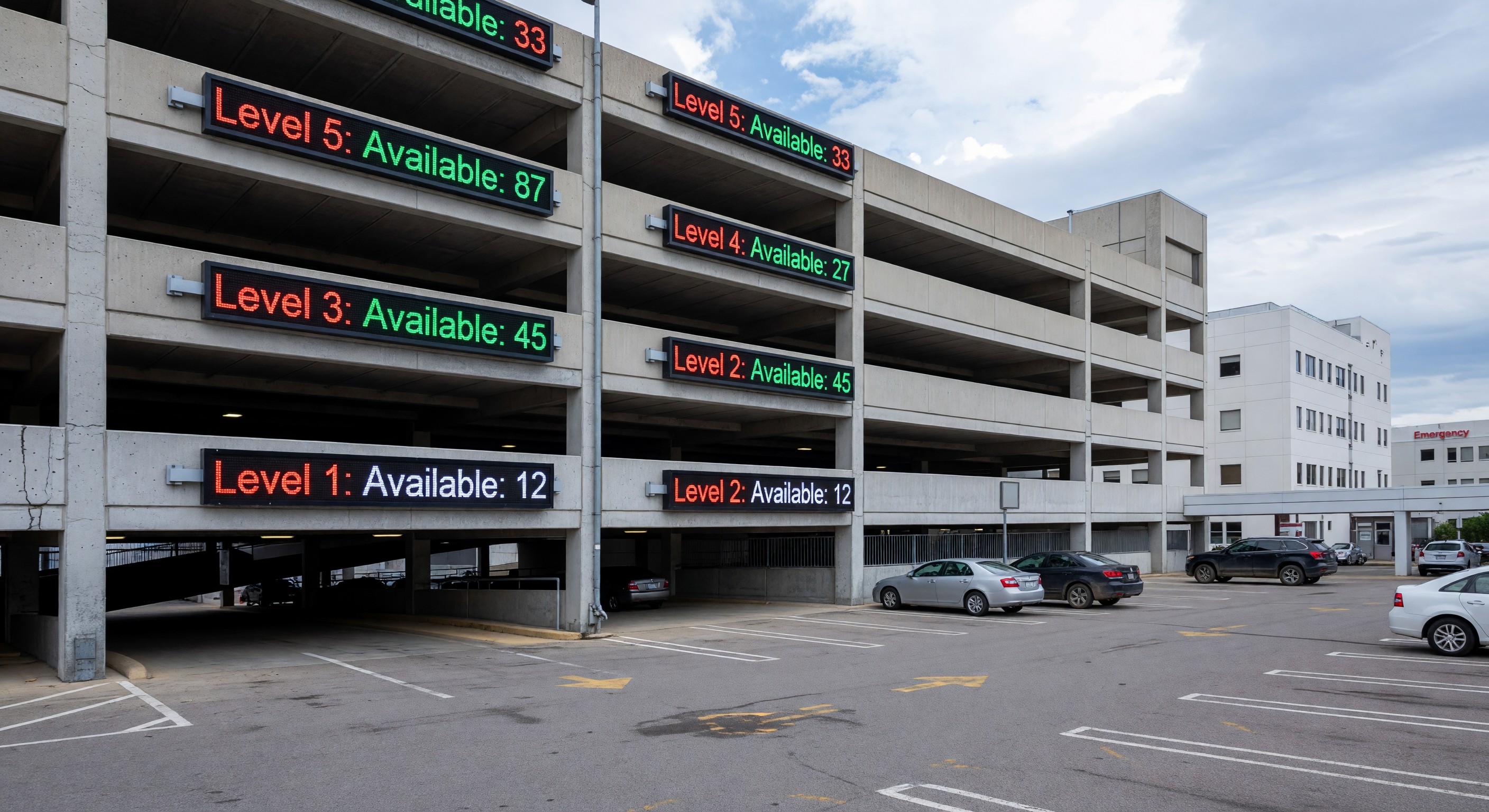
Dynamic signage — LED displays at structure entrances, level entries, and zone intersections showing available space counts in real time. Green/red indicators above individual spaces (in high-investment installations) guide drivers directly to open spaces.
Parking availability feeds — APIs that expose real-time space availability to mobile apps, hospital websites, navigation systems, and appointment reminder communications.
Vehicle location recording — Systems that note where a vehicle parked (either by space number or by camera record of the space location) and allow retrieval via license plate or mobile ticket for patients who cannot remember where they parked.
Integration with parking management — Connection to the PARCS system to correlate space availability data with revenue control, permit validation, and time-limit enforcement.
Technology Options and Hospital Fit
Ultrasonic space sensors are the most common guidance technology in structured parking. Individual sensors mounted on the ceiling above each space detect vehicle presence using ultrasonic echo. They are highly accurate, have no moving parts, and can include red/green indicator lights visible to drivers approaching the aisle. Battery-powered wireless sensors avoid the need for power runs to every space. Typical installation cost: $150–$300 per space.
Camera-based occupancy (computer vision) uses overhead cameras with AI analysis to detect vehicle presence in multiple spaces per camera. Lower cost per space than individual sensors in large open-span garages. Requires reliable network connectivity and adequate lighting. Camera systems that store images enable post-event vehicle location lookup.
Entry/exit counting is the lowest-cost approach: loop counters or cameras at each aisle entry and exit calculate net space availability by counting entering and exiting vehicles. Provides floor-level count accuracy rather than individual space location. Adequate for level-select signage at a fraction of the cost of space-by-space sensors.
For hospital applications, the technology choice should match the specific use case:
- Patient access and patient satisfaction: space-by-space sensors or camera systems that can direct patients to specific open spaces
- Operational management: entry/exit counting providing level-level availability for signage
- Enforcement: camera systems that enable vehicle location lookup
Patient Experience Integration
The highest-value integration for hospital parking guidance is with patient appointment systems:
Pre-arrival parking information — When a patient confirms an appointment via the patient portal, they receive information specific to their destination: which parking structure serves their clinic, how to access validation, and current typical availability during their appointment time window. This sets expectations before arrival.
Real-time availability in appointment reminders — Text and email appointment reminders that include a link showing current parking availability (from the guidance system API) allow patients to adjust arrival time if their preferred structure is showing as nearly full.
Navigation integration — Parking availability data fed to Google Maps and Apple Maps allows patients to navigate directly to available parking rather than to the building address. This requires an API connection between the guidance system and the navigation platform, now supported by several parking guidance vendors.
“Find my car” capability — Patients who cannot remember where they parked — particularly elderly patients, patients who have received sedating medications, or patients in stressful situations — can retrieve their vehicle location by entering their license plate at a lobby kiosk or via mobile app.
Staff Operational Integration
For facility operations, smart parking guidance provides:
Utilization analytics — Historical occupancy patterns by zone, level, day of week, and time of day. This data informs zone allocation decisions, staffing of attended lots, and capital investment prioritization.
Overstay detection — Space sensors that have been occupied longer than the zone’s time limit generate enforcement alerts without requiring manual patrol. Enforcement staff can be dispatched to specific spaces rather than conducting full lot sweeps.
Permit zone utilization — Correlating permit zone space utilization with access control data identifies permit holders who rarely use their assigned zone, supporting permit reallocation and waitlist management.
ROI Analysis for Hospital Guidance Systems
ROI for smart parking guidance systems in hospitals comes from multiple sources:
Reduced search time — The average driver circling to find a space in an unguided parking structure spends 3–8 minutes searching. A guidance system that directs drivers immediately to available spaces eliminates this search time. For a structure with 500 patient arrivals per day and 4-minute average search time, guidance saves 2,000 minutes of patient time daily.
Improved patient satisfaction — Press Ganey and HCAHPS parking satisfaction items improve measurably in facilities with guidance systems, with downstream effects on overall patient satisfaction scores that affect reimbursement in value-based care models.
Reduced citation incidents — Frustrated drivers who circle without finding spaces are more likely to create parking incidents — parking in fire lanes, blocking emergency access, or escalating to confrontations. These incidents consume security staff time and create liability exposure.
Capital deferral — Facilities that believe they need additional parking supply may find through guidance system utilization data that the perception of parking scarcity is distribution rather than supply problem. Several hospital systems have deferred or eliminated parking structure projects after guidance data revealed adequate existing supply.
Frequently Asked Questions
How long does it take to see occupancy accuracy improve after installing space sensors? Space sensor systems are typically accurate from day one if properly installed and calibrated. The learning period is for the management team and clinical departments — it takes 30–60 days of utilization data before actionable patterns emerge. Set realistic expectations with clinical leadership: the system provides data to improve operations, but operational improvement requires management action on the data.
Can we integrate parking guidance with our campus app? Most major campus navigation app vendors (Gozio Health, Phunware, Medici) support parking availability integration from guidance systems with standard APIs. The integration requires your guidance system vendor to provide an API endpoint, and your app vendor to build the integration. Confirm both vendor capabilities before assuming this integration is plug-and-play.
Should we deploy guidance in surface lots or only structured parking? Space sensors for surface lots are practical and increasingly common. Wireless sensors embedded in pavement or mounted on poles above parking spaces provide the same occupancy data as structured parking sensors. The business case is strongest for surface lots with more than 200 spaces where circling behavior is observable and where availability data would meaningfully change driver behavior.
What is the best way to phase a smart parking guidance system deployment? Phase 1: Entry-level count displays at structure entrances and level-entry signage using entry/exit counting technology (lowest cost, immediate benefit for drivers choosing between structures). Phase 2: Space-level sensors in highest-priority patient zones (closest to patient entrances). Phase 3: Remaining structured parking coverage. Phase 4: Surface lot coverage and mobile integration. Each phase provides standalone value, allowing ROI demonstration before committing to full deployment.