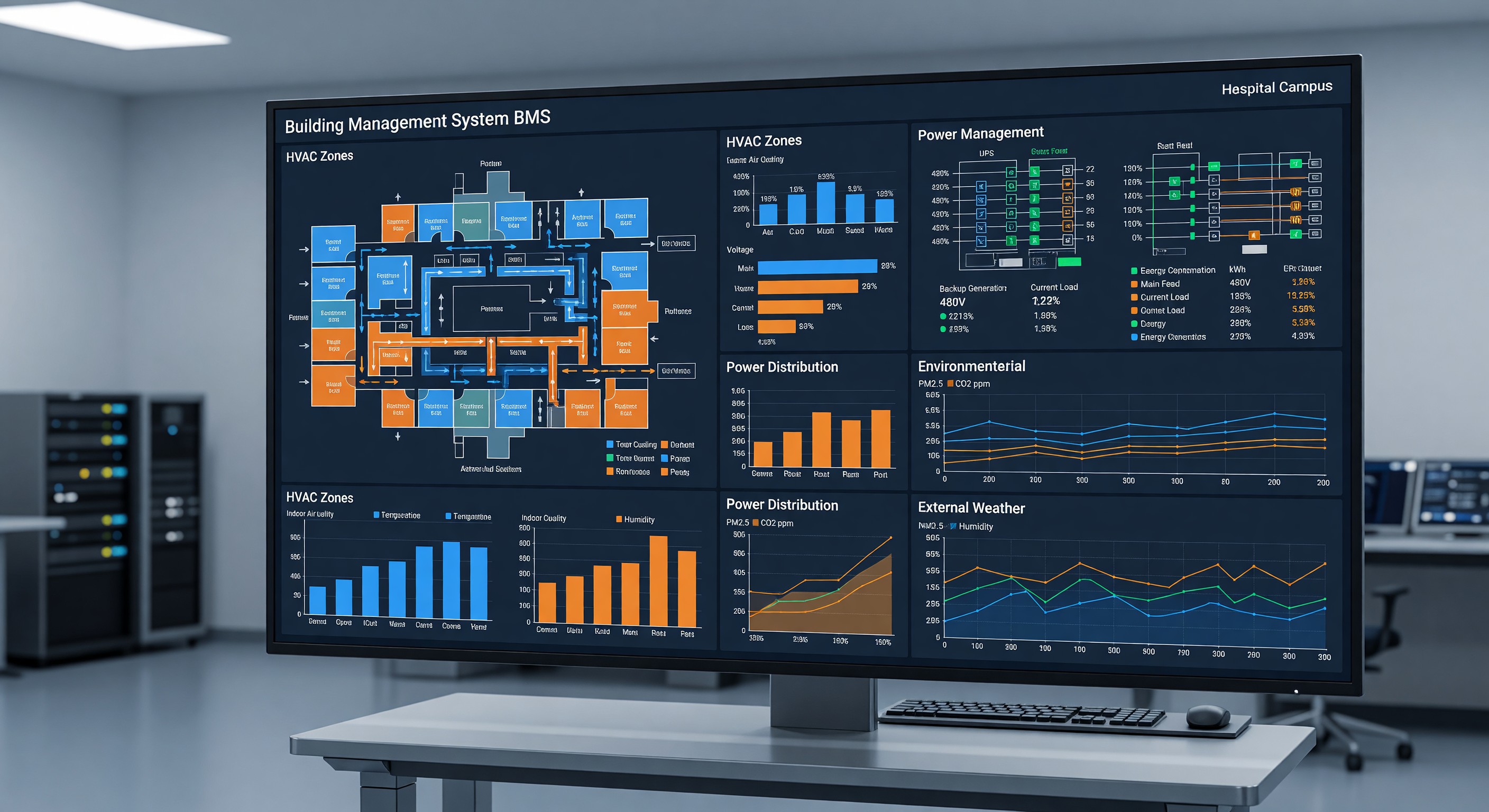
The phrase “smart building” has been applied to everything from programmable thermostats to fully integrated digital twins. In healthcare, smart building technology has a specific and consequential meaning: the ability to monitor, control, and optimize building systems in ways that directly support patient safety, regulatory compliance, and operational efficiency.
For facility directors leading hospital campuses, the building management system (BMS) is increasingly the command center of the physical plant — and extending it with IoT sensors, analytics platforms, and interoperability standards is rapidly moving from innovation to expectation.
The Building Management System as Healthcare Infrastructure
A building management system (also called a building automation system, or BAS) integrates control of HVAC, electrical distribution, lighting, plumbing and irrigation, fire alarm monitoring, and in some configurations, access control and security. In healthcare, the BMS serves as both the operational control layer and the compliance documentation platform.
Core functions of a healthcare BMS:
Environmental monitoring — Real-time tracking of temperature, humidity, and pressure in clinical spaces. Alarms when parameters drift outside acceptable ranges. Audit logs for HVAC compliance documentation.
Equipment scheduling and automation — Setback during unoccupied periods, optimized start-up sequences, demand response participation, and preventive maintenance scheduling triggers.
Fault detection and diagnostics (FDD) — Algorithms that identify abnormal equipment behavior before failure. A chiller running 8% above normal energy consumption for three days is a detectable anomaly that predicts mechanical failure.
Energy metering and reporting — Utility consumption monitoring at the building, floor, and system level. Supports energy benchmarking, ENERGY STAR certification, and sustainability reporting.
COVID-19 and the BMS Stress Test (2020)
The pandemic stress-tested building management systems in ways facility teams had not anticipated. HVAC reconfiguration requirements, rapid conversion of general wards to isolation units, and increased outdoor air demands all required BMS adjustments on extremely compressed timescales.
Facilities with modern, vendor-agnostic BMS platforms were able to push setpoint changes and schedule modifications remotely. Those relying on aging, proprietary systems — some of which required vendor technician visits for even minor changes — faced significant delays.
The pandemic also revealed gaps in environmental monitoring. Many older facilities lacked continuous digital monitoring of isolation room pressure differentials, relying instead on manual checks. The operational demand of COVID-19 patient surge made manual monitoring impractical, driving emergency investment in digital pressure monitoring with automated alarm capability.
IoT Sensors: Extending BMS Reach
Traditional BMS installations rely on hardwired sensors at fixed locations — adequate for major equipment but insufficient for granular environmental monitoring across complex campuses. IoT sensors extend monitoring capability:
Wireless environmental sensors can be deployed in any room without conduit runs. Battery-powered units monitor temperature, humidity, CO2, particulate count, or pressure and transmit data to a gateway. Ideal for monitoring patient room temperature for comfort, corridor CO2 for ventilation adequacy, or storage room conditions for pharmaceutical compliance.
Equipment-mounted sensors attach to existing mechanical equipment to add condition monitoring where the equipment itself lacks native reporting. Vibration sensors on pump motors, temperature sensors on electrical panels, and flow meters on water distribution systems all provide data that feeds FDD analytics.
Occupancy sensors enable demand-controlled ventilation and lighting adjustment based on actual space utilization rather than scheduled occupancy estimates. In healthcare, they also provide data for space planning and capacity management.
Asset tracking sensors (a distinct application from BMS environmental sensors) use RFID or BLE beacons to locate mobile equipment within the facility. This overlaps with RTLS (Real-Time Location Systems) discussed separately.
Energy Management in Healthcare Facilities
Hospitals are the most energy-intensive building type in the commercial sector, consuming roughly 2.5 times the energy per square foot of a typical office building. Large acute care hospitals spend $2–5 million annually on energy — a significant operating expense with meaningful reduction potential.
Energy Use Intensity (EUI) benchmarking against the EPA’s ENERGY STAR for Healthcare provides a comparable metric. The national median hospital EUI is approximately 250 kBtu/sq ft/year. High performers achieve 160–180 kBtu/sq ft/year.
Energy management strategies that integrate with BMS include:
- Chilled water plant optimization — Chiller sequencing and cooling tower management represent the largest single energy opportunity in most hospitals. BMS-integrated optimization can reduce chilled water plant energy by 15–25%.
- Air handling unit (AHU) demand control — Variable frequency drives (VFDs) on fans allow supply air volume to track actual demand rather than running at design maximum continuously.
- Lighting control — LED fixtures with occupancy-based dimming in administrative and support spaces. Clinical spaces require special consideration for light quality and patient experience.
- Peak demand management — Participating in utility demand response programs during grid stress events, using BMS to temporarily shed non-critical loads.
Interoperability and Data Integration
A persistent challenge in healthcare building technology is the proliferation of proprietary systems from different vendors that do not communicate natively. The HVAC system uses one protocol, the lighting controls another, the fire alarm a third, and the access control system a fourth.
Open protocols — particularly BACnet (ASHRAE Standard 135) and LonTalk — enable communication across vendor systems. When specifying or procuring building system upgrades, require native BACnet or LonTalk support rather than accepting proprietary gateways that create long-term vendor dependency.
For organizations investing in modern platforms, open APIs and cloud-based data aggregation are enabling true integration across formerly siloed systems. Some facility teams are building operational dashboards that consolidate HVAC performance, energy consumption, and work order status in a single view — dramatically improving situational awareness for maintenance supervisors and directors.
Cybersecurity in Building Management Systems
BMS cybersecurity has become a significant concern following several high-profile incidents. A hospital BMS connected to the internet with default credentials is an accessible target — and a compromised BMS could theoretically alter environmental controls in patient care areas.
Requirements:
- Network segmentation — BMS should reside on a dedicated operational technology (OT) network segment, isolated from clinical IT networks
- Authentication — All BMS access must require unique user credentials; shared passwords and default credentials are unacceptable
- Patch management — BMS controllers require firmware updates, and a patching schedule must be maintained
- Vendor remote access — Should be limited to specific time windows and monitored; standing always-on VPN tunnels to vendors are a risk
Work with your IT/cybersecurity team and BMS vendor to complete a formal OT security assessment every two years.
Frequently Asked Questions
What is the difference between a BMS and a SCADA system in a healthcare context? A BMS (Building Management System) focuses on building environmental and utility systems — HVAC, lighting, plumbing. A SCADA (Supervisory Control and Data Acquisition) system typically refers to monitoring and control of industrial processes, and in healthcare might apply to central utility plants, cogeneration systems, or high-pressure steam distribution. Many modern facilities use the terms interchangeably for integrated control platforms.
How do we evaluate vendors for BMS replacement? Key criteria: open protocol support (BACnet required), cybersecurity architecture, healthcare facility references, technical support response time, total cost of ownership over 15 years (including software licensing), and training for your internal maintenance staff. Proprietary systems that lock you into a single vendor for ongoing maintenance represent significant long-term risk.
Can BMS data be used to support Joint Commission compliance documentation? Yes — and this is one of the most compelling applications. BMS environmental logs can automatically generate the pressure differential monitoring records, temperature logs, and alarm history that Joint Commission surveyors review. This eliminates manual logging, reduces documentation errors, and provides more granular data than any manual system could capture.
What is a reasonable budget for a BMS upgrade in a 300-bed hospital? Rough estimates range from $2–5 million for a comprehensive campus-wide BMS upgrade, depending on the number of control points, field device replacement requirements, and desired functionality. A phased approach — starting with the central plant and highest-risk clinical spaces — allows capital to be spread over 3–5 years.