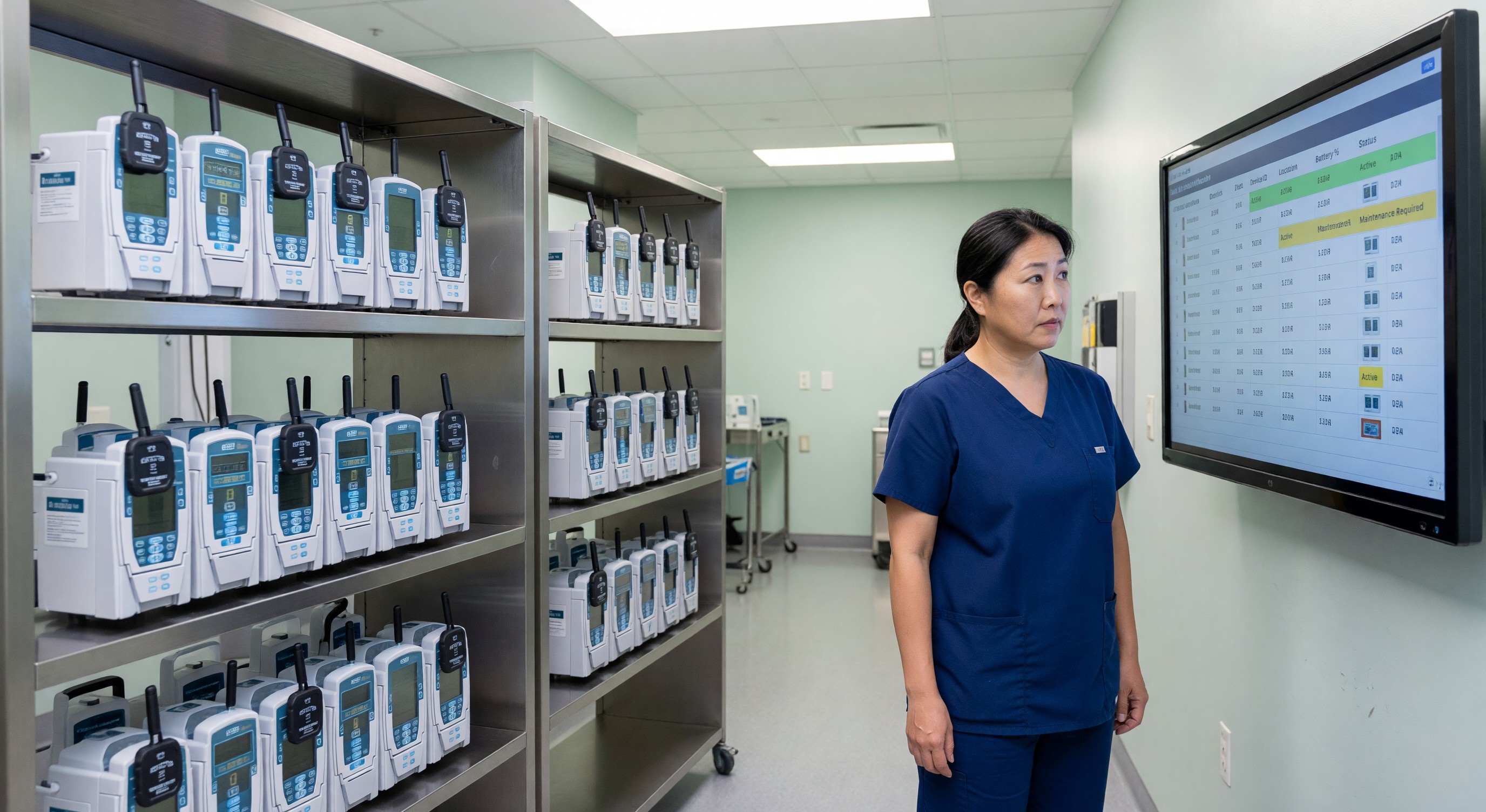
Every hospital loses time searching for equipment. A nurse spends 20 minutes looking for an available IV pump. A respiratory therapist tracks down a ventilator that was moved to another floor. A patient transport aide cannot locate a wheelchair for a discharge. Individually, these are minor inefficiencies. At scale, across a large hospital, they represent thousands of hours of clinical staff time annually — time that should be spent on patient care.
Real-Time Location Systems (RTLS) address this problem by continuously tracking the physical location of tagged assets throughout the facility. When implemented correctly, RTLS transforms equipment management from a reactive search function to a proactive logistics function.
RTLS Technology Options for Healthcare
RTLS in healthcare employs several distinct locating technologies, each with different accuracy, infrastructure requirements, and cost profiles:
Active RFID — Tags transmit their identity continuously or on a schedule. Readers positioned throughout the facility detect tag signals and report locations. Room-level accuracy (approximately 5–10 meters) is achievable with mid-range infrastructure investment. Active RFID tags require battery replacement every 3–5 years.
Bluetooth Low Energy (BLE) — BLE-based RTLS uses existing Wi-Fi access point infrastructure (if BLE-capable) or dedicated BLE readers. Accuracy varies from building-zone to room-level depending on reader density. Lower infrastructure cost when leveraging existing Wi-Fi hardware. BLE tags are small, inexpensive, and increasingly integrated into medical device manufacturers’ standard equipment.
Ultrasound (Ultrasonic) — Provides the highest accuracy (sub-room, approximately 1–2 meters). Tags emit inaudible ultrasound pulses detected by ceiling-mounted sensors. The infrastructure cost is higher, but the accuracy supports applications beyond simple equipment finding — including staff workflow analysis and infant security integration.
Ultra-Wideband (UWB) — The newest locating technology, providing centimeter-level accuracy. Used for highest-precision applications (surgical suite workflow, sterile field monitoring). High infrastructure and tag cost limits current deployment to focused high-value applications.
Passive RFID — Read-only tags activated by a reader’s radio field. No battery required. Used for inventory management (supply chain) rather than continuous RTLS, as passive tags cannot be read at a distance without infrastructure at every point.
What Healthcare RTLS Can Track
The most common RTLS applications in healthcare, by value delivered:
High-utilization equipment — IV pumps, ventilators, portable monitors, infusion pumps, wheelchairs, and stretchers. These assets are most frequently misplaced and most operationally critical. The search time saved by locating these assets has direct measurable financial value.
Temperature-sensitive storage — Medication refrigerators, blood bank storage, lab specimen areas. When combined with temperature sensors, RTLS provides location plus environmental monitoring. This is relevant for pharmaceutical supply chain compliance.
Medical gas cylinders — Oxygen and compressed air cylinders are frequently misplaced and represent both a safety and supply chain management challenge. RTLS enables inventory management of compressed gas assets.
Linen and reusable supplies — Clean linen carts, supply carts, and reusable procedure trays can be tracked to reduce losses and improve cart turnover management.
Staff and patient tracking — More sensitive applications with different governance requirements. Staff RTLS is used for workflow analysis, duress alarm response, and staff safety (lone worker protection). Patient tracking has clinical applications in behavioral health and pediatrics (elopement prevention) and operational applications in patient flow management.
Infant Security: A Specialized RTLS Application
Infant abduction prevention is a critical patient safety function in obstetric and neonatal units. Specialized RTLS systems designed for infant security use wristband tags on newborns that trigger alarms if the infant moves toward an exit, an elevator, or a stairwell.
The Joint Commission’s EC.02.01.01 (security management) and NPSG.07.05.01 (prevention of healthcare-associated infections in specific settings, including maternity) reference the need for infant security systems. Facilities accredited for obstetric services are expected to have implemented effective infant security programs.
Modern infant security RTLS integrates with access control to automatically lock doors if a tag-equipped infant approaches. Alarm response protocols, staff training, and regular drills are essential operational components.
COVID-19 created a specific challenge: visitor restriction policies that limited birth companions created situations where those companions were less familiar with the unit environment. Clear communication about infant security procedures — including the alarming system — became a patient education priority.
Implementation Planning
RTLS implementation requires a phased, structured approach:
Phase 1: Infrastructure assessment — Evaluate existing Wi-Fi coverage, potential mounting locations for RTLS readers or anchors, power availability, and network bandwidth. Engage your IT team early, as RTLS generates significant network traffic and requires security review.
Phase 2: Use case prioritization — Determine which assets and workflows will be tracked. Start with the highest-value use case (typically IV pumps or a similar high-search-frequency asset) rather than attempting to track everything simultaneously.
Phase 3: Tagging and deployment — Tag the target asset population, deploy infrastructure, configure the location software platform. A phased zone rollout is more manageable than a campus-wide simultaneous deployment.
Phase 4: Workflow integration — RTLS data is only valuable if it changes behavior. Integrate asset search into nursing workflows (a nurse queries the system before physically searching), charge capture processes (automatically associating equipment use with patient billing), and preventive maintenance (maintenance can locate equipment for scheduled service without manual tracking).
Phase 5: Analytics and expansion — Once baseline is established, use RTLS data to analyze utilization rates, identify over- and under-supply of equipment by zone, and justify equipment purchase or redeployment decisions.
ROI Modeling for RTLS Investment
RTLS ROI is typically modeled across three benefit categories:
Labor savings — Clinical staff time saved from equipment searches. If 100 nurses each spend an average of 30 minutes per shift searching for equipment, that is 50 hours of nursing time per shift — over $100,000 in annual labor cost at $40/hour blended wage. Even a 50% reduction in search time generates meaningful ROI.
Rental equipment reduction — Hospitals that rent IV pumps or other equipment to supplement owned inventory when utilization seems high often find through RTLS that equipment is hoarded in rooms or sitting in corridors unused. Utilization visibility can reduce equipment rental expense by 20–40%.
Capital purchase avoidance — Rather than purchasing additional units of equipment perceived as scarce, RTLS data may reveal that utilization gaps are distribution problems, not supply problems. Several health systems have deferred multi-million-dollar equipment purchases after RTLS data showed existing inventory was sufficient if better distributed.
Frequently Asked Questions
How long does a full RTLS implementation take? From contract execution to go-live for a single asset category in a single facility typically takes 3–6 months. Campus-wide, multi-asset implementations require 12–18 months. Plan for extended change management time — the technology deployment is often faster than the workflow adoption.
What staff training is required for RTLS adoption? Training should be role-specific and brief. Nurses need to know how to query the system to find assets. Biomed technicians need to know how to track assets for PM. Facilities needs to understand the infrastructure requirements. A 15-minute role-specific training module is usually sufficient for end users; system administrators need more extensive training.
Can RTLS data be shared with vendors for analytics? Review your HIPAA Business Associate Agreement requirements. If RTLS tracks patient location or patient-associated assets, PHI considerations apply. Pure equipment tracking typically does not implicate HIPAA, but vendor data sharing agreements should still be reviewed by your privacy officer.
What happens to RTLS tags when medical devices are cleaned or sterilized? Tags designed for healthcare applications are rated for cleaning with common disinfectants. Not all tags are rated for autoclave sterilization — verify the tag’s sterilization tolerance for any equipment that undergoes sterile processing. Some vendors offer separate tags for sterile instruments and non-sterile equipment.