Preventive maintenance — doing maintenance on a schedule regardless of equipment condition — was the state of the art for decades. Predictive maintenance (PdM) shifts the model: do maintenance when the equipment actually needs it, based on measured condition data. The result is less unnecessary maintenance of healthy equipment and, more importantly, intervention before equipment that is degrading actually fails.
In healthcare settings, where equipment failure can directly disrupt patient care, predictive maintenance offers compelling clinical and financial value. The technologies to implement it — vibration analysis, thermal imaging, oil analysis, and IoT condition sensors — are now accessible at price points that make PdM practical for facilities of all sizes.
Why Predictive Maintenance Matters in Healthcare
Unplanned equipment failures in healthcare settings have consequences that extend beyond the mechanical:
Operating room disruptions — A failed chiller that causes OR temperature to rise above acceptable limits forces surgical cancellations. A failed air handling unit affecting surgical suite pressure relationships requires immediate response that may interrupt active cases.
ICU environment failures — HVAC failures in intensive care units can create temperature and humidity conditions that affect both patient physiology and equipment operation.
Generator failures on demand — The generator that has not been maintained predictively and fails during an actual utility outage creates a patient safety emergency.
Medical gas compressor failures — A failing medical air compressor that is not identified before failure interrupts air supply to ventilators and other life-critical equipment.
The financial case for PdM in healthcare is also strong: planned maintenance is typically 5–10 times less expensive than emergency breakdown repair, which in a hospital also includes potential patient diversion and emergency rental equipment costs.
Core Predictive Maintenance Technologies
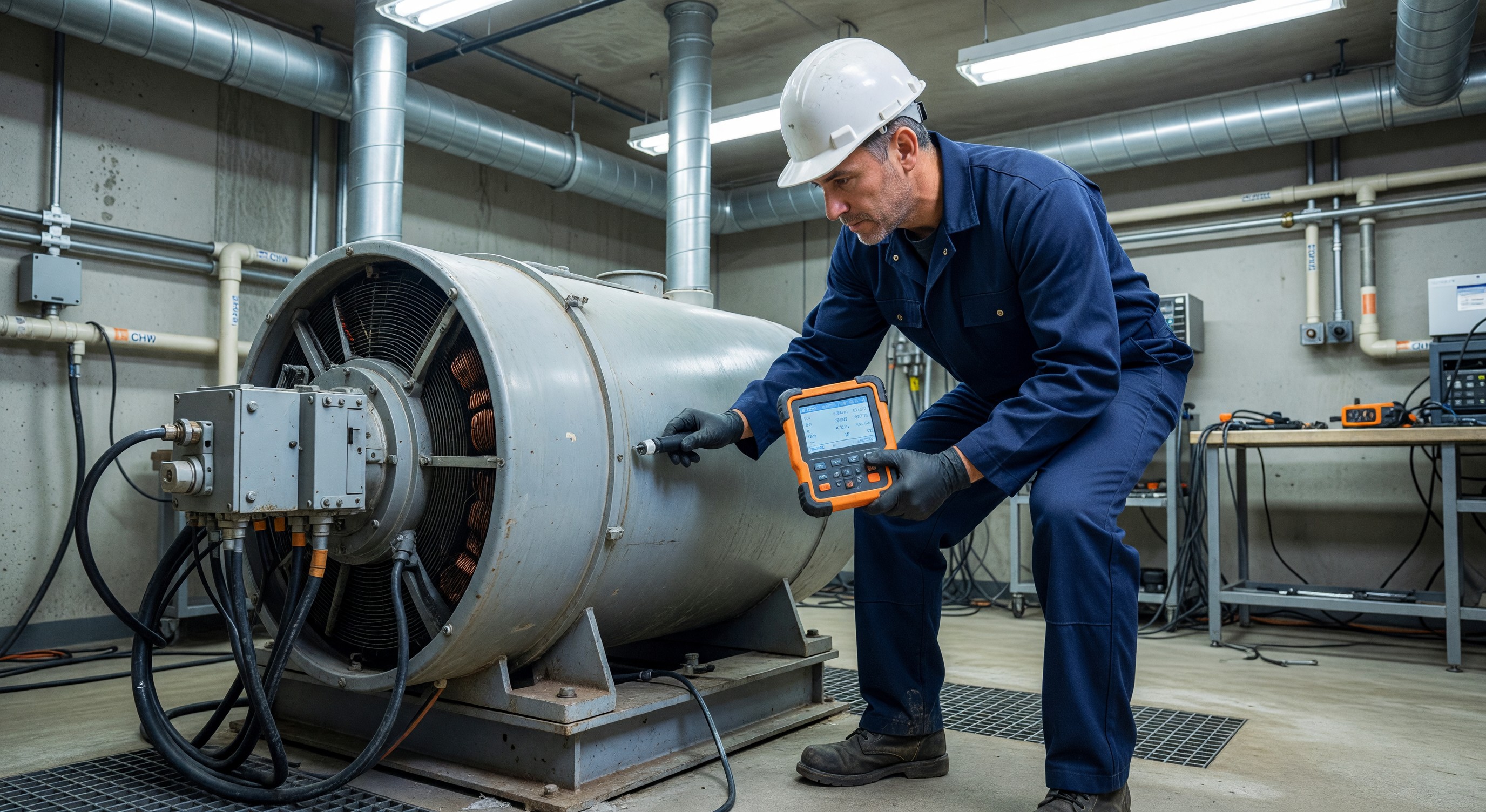
Vibration analysis is the most widely used PdM technology for rotating equipment. All rotating machinery (motors, pumps, fans, compressors) develops characteristic vibration signatures as components wear:
- Bearing defects create high-frequency vibration at frequencies predictable from bearing geometry
- Imbalance creates vibration at running speed frequency
- Misalignment creates vibration at twice running speed
- Looseness creates vibration at subharmonics
Vibration analysis tools range from handheld instruments used in periodic routes (technician visits each asset monthly and records vibration data) to permanently mounted wireless sensors that transmit continuous data to an analytics platform.
Thermal imaging (infrared thermography) identifies elevated temperatures that indicate developing problems:
- Electrical connections that are loose or corroded run hot and are fire hazards detectable months before failure
- Motor windings that are overloading show elevated winding temperature
- Switchgear components with failing contacts develop hot spots
- Heat exchanger fouling manifests as uneven temperature distribution
Infrared cameras produce images that make these temperature anomalies visible and quantifiable. Annual thermographic inspections of electrical switchgear, motor control centers, and critical equipment are standard PdM practice.
Oil analysis for lubricated equipment (gearboxes, compressors, hydraulic systems) measures the condition of the lubricant and detects particles that indicate wear of internal components. A gearbox shedding steel particles into its oil is indicating gear wear that will progress to failure — oil analysis detects this before failure occurs.
Ultrasonic testing detects high-frequency sound emissions from equipment defects invisible to the naked eye:
- Compressed gas and steam leaks (significant energy waste and safety hazard)
- Electrical arc and corona in switchgear (fire risk)
- Bearing defects (complements vibration analysis with early detection capability)
Motor current signature analysis (MCSA) analyzes the electrical current signature drawn by motors to detect internal motor faults, load variations, and mechanical problems — without requiring physical access to the motor.
Building a Healthcare PdM Program
PdM program implementation follows a structured process:
Phase 1: Asset criticality assessment — Define which assets warrant PdM investment. Focus on assets where failure would disrupt patient care, create safety risk, or result in expensive emergency repair. Chillers, central plant equipment, surgical suite AHUs, medical air compressors, and emergency generators are universally high-priority.
Phase 2: Baseline data collection — Before anomalies can be detected, normal condition data must be established. Collect vibration, temperature, and other baseline measurements on all target assets under normal operating conditions.
Phase 3: Route-based monitoring implementation — For assets not warranting continuous monitoring, establish periodic inspection routes where technicians collect condition data using handheld instruments. Monthly routes for high-criticality assets; quarterly for medium.
Phase 4: Alarm threshold definition — Define the condition thresholds that trigger maintenance action: a vibration level that exceeds a defined limit triggers a work order for further investigation and scheduled repair.
Phase 5: Analytics and trend tracking — PdM value comes from tracking trends over time, not just point-in-time measurements. A bearing whose vibration has increased 50% over three months is in a different condition than one with stable vibration.
COVID-19 Staffing and PdM (2022)
The healthcare facilities staffing crisis of 2021–2022 created both a challenge and an opportunity for PdM programs. The challenge: implementing a PdM program requires trained personnel capable of operating condition monitoring instruments and interpreting data.
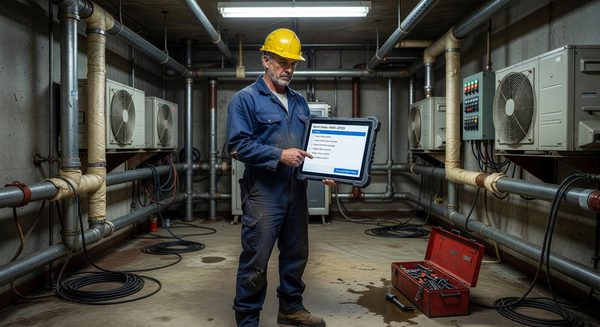
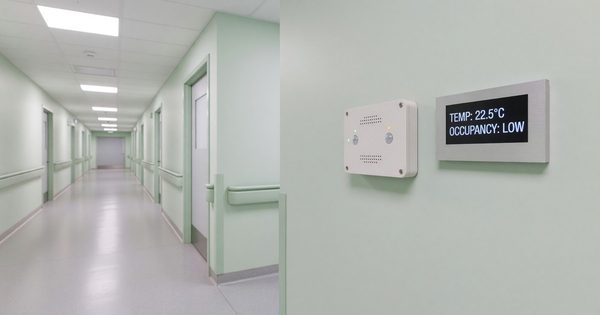
The opportunity: automated IoT sensor-based PdM reduces the labor demand compared to manual route-based programs. Wireless sensors continuously monitoring critical equipment transmit data to cloud analytics platforms that generate alerts without requiring regular technician visits. This technology becomes more valuable, not less, when staffing is constrained.
Facilities facing staffing shortages have found value in partnering with equipment manufacturers or specialized PdM service providers who remote-monitor critical equipment and provide regular condition reports — outsourcing the analytical work while retaining internal maintenance capability for the actual repairs.
Frequently Asked Questions
How do we get started with PdM if we have no existing program? Start with a single high-criticality asset class — central plant rotating equipment is most commonly first. Identify a vendor for condition monitoring services or equipment, establish baseline data collection, and begin monthly or quarterly route-based monitoring. Demonstrate value with the first prevented failure before expanding. A pilot program that prevents one chiller failure generates more institutional support than any business case document.
What is the typical ROI on a hospital PdM program? ROI studies from healthcare facilities consistently show that PdM programs generate 4:1 to 6:1 return on investment through avoided emergency repair costs, reduced planned maintenance costs (you stop doing PM on healthy equipment), improved equipment reliability, and energy efficiency improvements. Payback periods are typically 1–2 years for a well-implemented program.
Do PdM programs require significant capital investment? The range is wide. A handheld vibration analyzer and data recording software can be acquired for $5,000–$15,000, enabling a basic route-based PdM program for rotating equipment. IoT sensor platforms for continuous monitoring of a large central plant may cost $50,000–$200,000 for hardware and software. The capital investment should be sized to the criticality of the assets being monitored and the expected financial benefit from prevented failures.
Can we integrate PdM with our CMMS? Yes — and this integration is important for closing the loop between condition detection and maintenance execution. When a PdM alert indicates a developing problem, a work order should be automatically generated in the CMMS for investigation and scheduled maintenance. Without CMMS integration, PdM alerts may be identified but not tracked to completion.