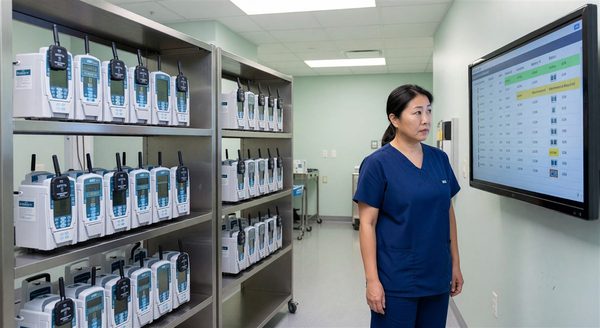
The Internet of Things has arrived in hospital operations — not as a futuristic concept but as deployed, operational infrastructure at progressive healthcare facilities across North America. Wireless sensors monitoring room temperatures, equipment vibration, medication refrigerator conditions, hand hygiene compliance, and occupancy are generating data streams that facility directors, infection control practitioners, and clinical engineers are using to improve operations and document compliance.
Understanding what IoT sensor technology can and cannot do — and how to build the infrastructure and data strategy to realize its value — is increasingly core competency for healthcare facility leadership.
The Hospital IoT Opportunity
Traditional facilities management relies on scheduled inspections, manual readings, and reactive response to equipment failures. IoT sensors shift this model toward continuous monitoring, exception-based alerting, and predictive intervention.
The healthcare IoT opportunity spans multiple operational domains:
Environmental compliance monitoring — Automated, continuous monitoring of temperature and humidity in clinical spaces (ORs, clean rooms, medication storage, isolation rooms) generates the compliance record that manual logs provide, but without the labor and without the gaps that occur when manual rounds are missed.
Equipment condition monitoring — Vibration sensors on motors, pumps, and fans detect the early signature of bearing wear, imbalance, or other mechanical degradation before equipment failure occurs. This is the foundation of predictive maintenance.
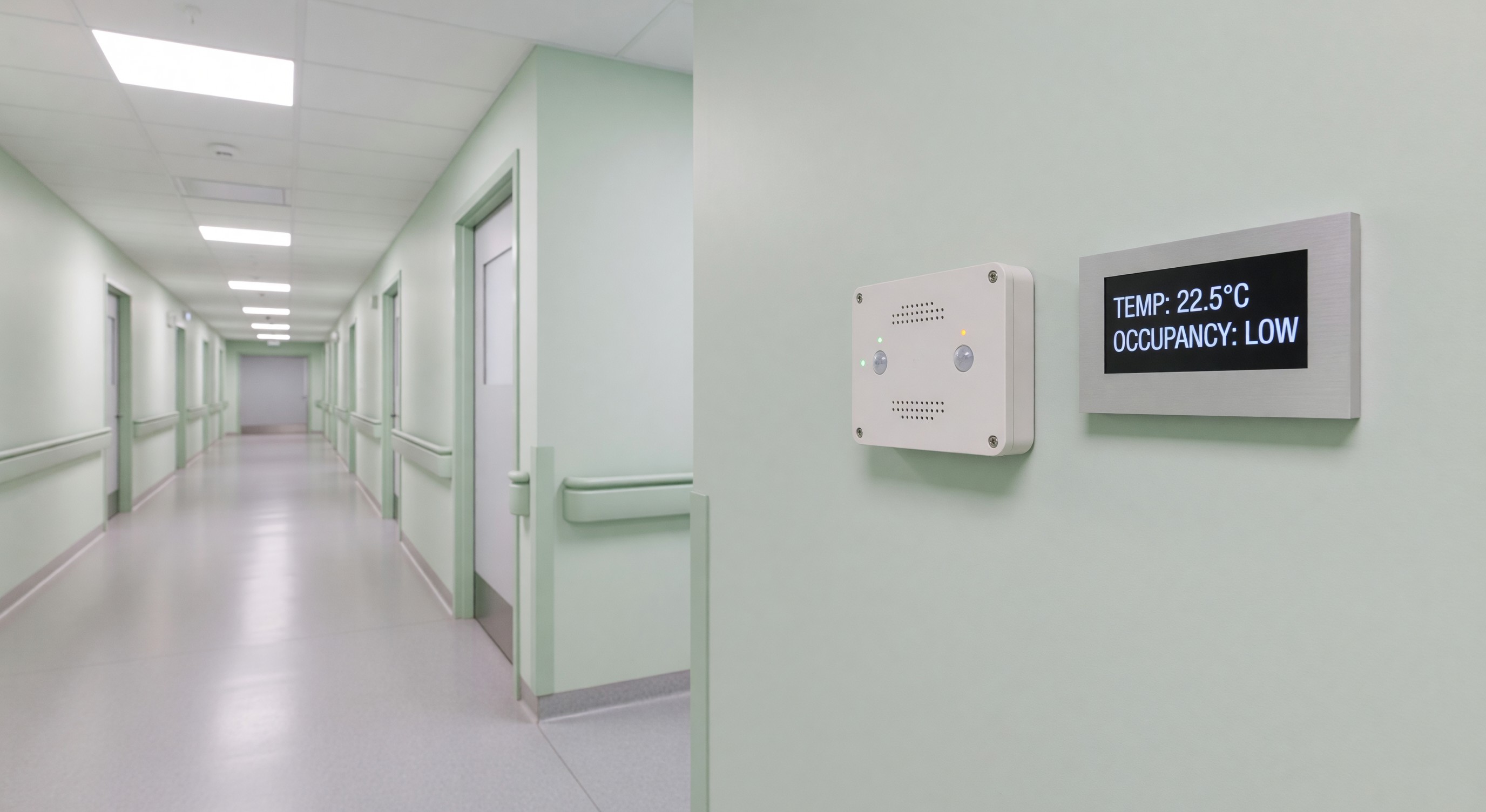
Energy optimization — Occupancy sensors enable demand-controlled ventilation and lighting, reducing energy waste in underoccupied spaces while maintaining compliance in occupied ones.
Infection control — Hand hygiene compliance sensors detect handwashing events and measure adherence rates. Some systems integrate direct observer data with electronic monitoring for comprehensive compliance analytics.
Supply chain and inventory — Smart cabinets and weight-sensing shelves in supply rooms automate inventory tracking, generating replenishment triggers without manual counts.
Environmental Monitoring: The Compliance Foundation
The most broadly adopted IoT sensor application in healthcare is environmental monitoring. The compliance driver is clear: clinical spaces must maintain specific temperature, humidity, and pressure ranges, and these conditions must be documented.
Historically, this documentation was maintained through manual rounding — a staff member checking thermometers and pressure gauges, recording readings on a paper log. Problems with this approach:
- Manual logs are only as good as the rounding frequency (most programs round twice daily at best)
- Staff under workload pressure sometimes record expected values rather than measured ones
- Gaps in documentation are common and create compliance exposure
- Manual logs do not generate alerts — a refrigerator that malfunctions between rounds may compromise medications or specimens before discovery
IoT environmental sensors address all of these gaps: they monitor continuously, generate alarms when conditions drift from acceptable ranges, and create tamper-resistant digital records that satisfy Joint Commission and CMS documentation requirements.
Applications include:
- Medication refrigerators and freezers — Temperature monitoring with automatic alarm escalation
- Blood bank storage — Temperature and humidity monitoring with chain-of-custody documentation
- OR pressure differential monitoring — Continuous pressure monitoring with alarm logging for ASHRAE 170 compliance
- Pharmacy clean room — ISO class monitoring with particle count and temperature
- Specimen storage — Temperature monitoring for pathology, chemistry, and microbiology specimens
Predictive Maintenance Enablement
Predictive maintenance (PdM) uses sensor data to identify equipment conditions that predict impending failure — allowing maintenance before failure rather than after. In healthcare, unplanned equipment failures can directly affect patient care:
- A chiller failure on a hot day can cause OR temperature to rise above acceptable limits for procedures
- A pump failure on a medical gas compressor can affect gas supply to patient areas
- A cooling failure in a data center can jeopardize EMR availability
Vibration analysis is the most common PdM sensor technology for rotating equipment. Vibration signatures contain information about bearing condition, imbalance, misalignment, and lubrication state. Analysis algorithms compare current vibration profiles against baseline and identify anomalies that precede failure.
Thermal imaging (IR cameras) can detect electrical hot spots in switchgear and panel boards that indicate failing connections or overloaded circuits — a fire risk that presents no symptoms visible to the naked eye.
The business case for PdM in healthcare is compelling: planned maintenance is typically 5–10 times less expensive than emergency repair plus consequential costs (patient diversions, rental equipment, business interruption).
Wireless Network Infrastructure for IoT
Hospital IoT sensor networks require dedicated network infrastructure planning. Options include:
Wi-Fi IoT (IEEE 802.11) — Leverages existing Wi-Fi infrastructure. Highest bandwidth, good coverage in areas with Wi-Fi. Battery life for wireless sensors may be limited depending on transmission frequency. Security segmentation from clinical IT networks required.
Bluetooth Low Energy (BLE) — Short range (up to 30 meters), low power, low cost. Appropriate for asset tracking and point-specific monitoring. BLE gateways aggregate sensor data from multiple sensors and transmit via wired or Wi-Fi connection.
Sub-GHz proprietary protocols (LoRa, Z-Wave, Zigbee) — Longer range, excellent battery life (1–10 years depending on reporting frequency), lower cost per sensor. Require dedicated gateway infrastructure. Excellent for large-campus environmental monitoring.
Cellular IoT (NB-IoT, LTE-M) — Operates on cellular networks. Useful for outdoor and remote locations not served by on-premise wireless infrastructure. Monthly carrier costs per device. Good for ambulance bay monitoring, outdoor generator monitoring, etc.
Work with your IT and network team before selecting IoT sensor technology — compatibility with existing infrastructure, cybersecurity requirements, and network management capabilities vary significantly by protocol.
Data Strategy and Analytics
Raw IoT data has limited value without a data strategy. Facility directors should define:
Data collection and storage — Where does sensor data live? On-premise historian, cloud platform, or hybrid? Retention requirements vary by data type and use case.
Alerting and alarm management — Which conditions trigger immediate alerts? Who receives alerts, by what means, and what is the escalation path if the alert is not acknowledged? Poor alarm management leads to alarm fatigue, where important alerts are ignored in a sea of false alarms.
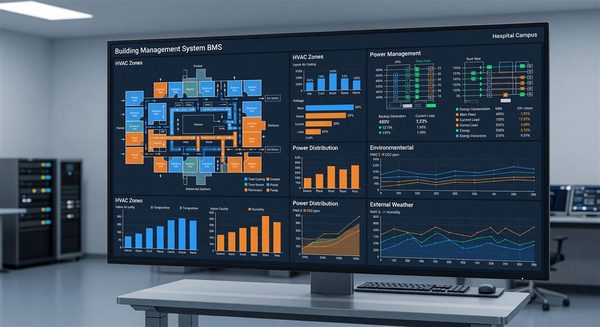
Reporting and dashboards — What operational metrics will be tracked and reviewed? Who reviews them and on what cadence? Facility directors who monitor HVAC compliance rates, refrigerator excursion frequency, and equipment alarm trends have actionable intelligence that reactive managers lack.
Integration with CMMS — Ideally, IoT sensor alerts should automatically generate work orders in the Computerized Maintenance Management System (CMMS), creating an end-to-end workflow from condition detection to maintenance completion.
Frequently Asked Questions
How do we justify the capital investment in IoT sensor infrastructure to hospital leadership? Build the ROI case on specific, quantified benefits: reduced manual rounding labor (hours per shift × wage × 365 days), reduced compliance exposure (cost of a Joint Commission finding or CMS deficiency), reduced emergency maintenance costs (cost differential between planned and unplanned repair), and energy savings from demand-based control. One documented compliance benefit (avoiding a medication loss event or a citation) can justify years of sensor network operational costs.
What cybersecurity concerns apply to hospital IoT sensors? IoT devices are a known vulnerability in healthcare networks. Key requirements: network segmentation (IoT devices on isolated VLANs, not on clinical networks), strong authentication for device management, firmware update capability and patch management, and inventory of all deployed IoT devices. The FDA has issued guidance on medical device cybersecurity that overlaps with IoT in some areas.
Can IoT sensors replace Joint Commission required manual inspection rounds? In many cases, IoT monitoring data satisfies or supplements documentation requirements. However, some Joint Commission standards require physical inspection that sensors cannot substitute for — visual inspection of fire extinguisher condition, physical testing of door hardware, and direct observation of staff practices require human presence. Review each specific standard requirement against what IoT monitoring can and cannot document.
What should we look for when selecting an IoT platform vendor for healthcare? Healthcare experience and references, HIPAA capability (if any patient-identifiable data flows through the platform), data ownership provisions (can you export your data if you change vendors?), open APIs for integration with CMMS and BMS, uptime SLA, and support response time. Avoid platforms that lock data in proprietary formats or restrict API access.