Hospital campus navigation is a patient experience failure point that directly affects satisfaction scores, on-time arrival rates, and first impressions of care quality. Healthcare campuses—with their complex of interconnected buildings, multiple floors, frequent construction changes, and dozens of service lines scattered across a large footprint—are among the most difficult environments to navigate without guidance.
Static signage has been the standard solution for decades, and it remains an essential layer of wayfinding. But static signage cannot update when construction reroutes paths, cannot guide visitors from the parking lot to a specific clinic room, and cannot communicate in multiple languages to a diverse patient population. Digital wayfinding technology addresses these limitations while creating new capabilities that improve the patient experience from the moment they leave home.
The Wayfinding Technology Ecosystem
Modern healthcare wayfinding involves a layered ecosystem of technologies working together:
Pre-Arrival Digital Guidance The wayfinding experience begins before the patient leaves home. Appointment confirmation emails and SMS messages with embedded maps, parking instructions, and campus-specific arrival guidance reduce pre-arrival anxiety and parking confusion. Integration between scheduling systems and campus maps allows patient communications to include directions to the specific building and entrance relevant to their appointment.
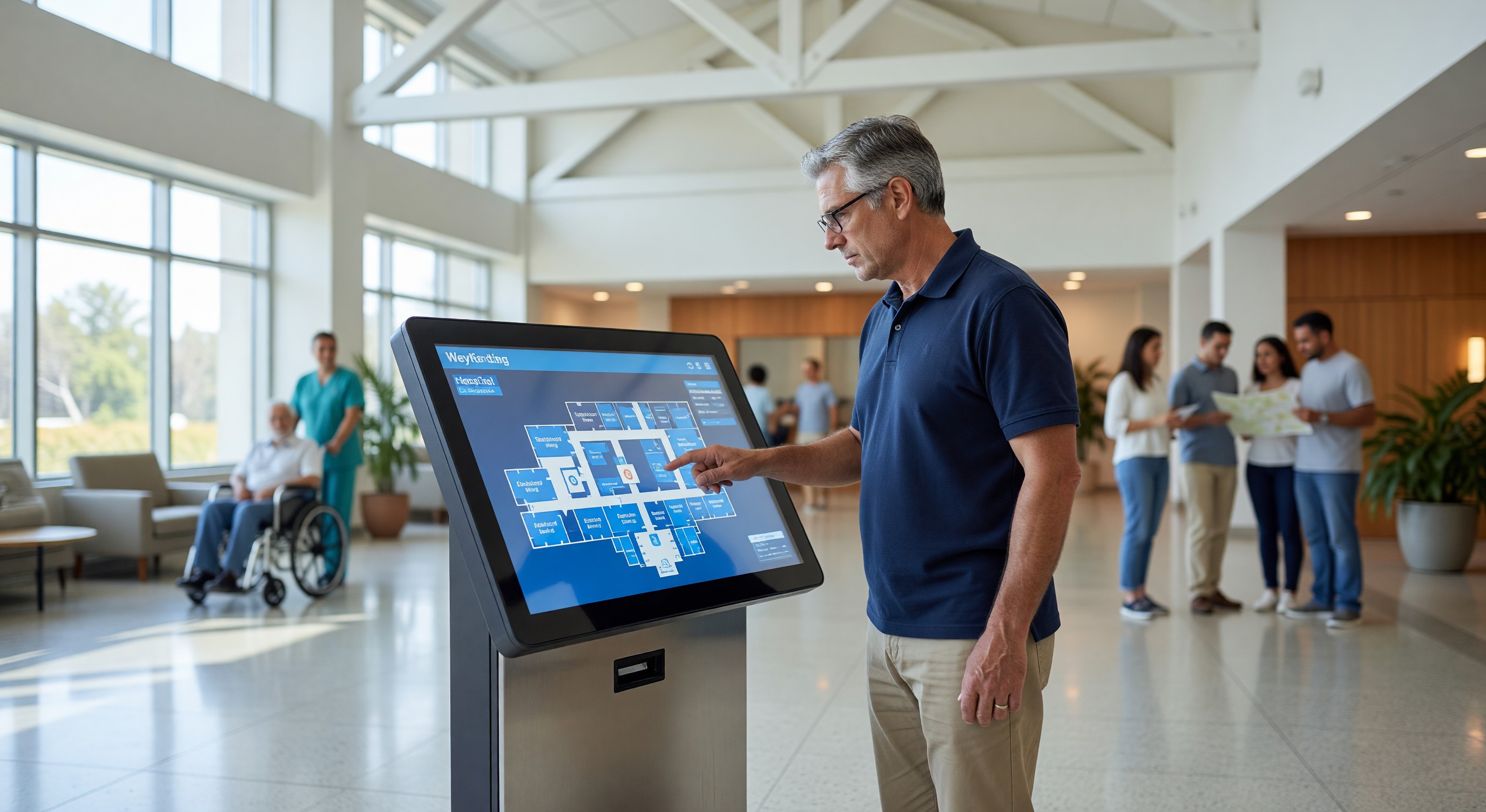
Digital Kiosks Interactive wayfinding kiosks at building entrances, lobbies, and major corridor intersections provide self-service navigation assistance. Patients can search for their provider, department, or service by name and receive turn-by-turn directions to their destination. High-quality kiosks offer multilingual interfaces, ADA-accessible height and controls, and print capability for patients who prefer a paper map of their route.
Mobile Wayfinding Applications Mobile apps that provide indoor navigation capability are increasingly deployed by healthcare organizations as part of their patient engagement platforms. Using Bluetooth Low Energy (BLE) beacons deployed throughout the facility for indoor positioning, mobile wayfinding apps guide patients from their car through the parking lot, through building entrances, and to their specific destination with the same turn-by-turn experience they’re accustomed to from consumer navigation apps.
Indoor Positioning Systems The enabling technology for real-time indoor navigation is indoor positioning. Unlike GPS (which doesn’t work indoors), indoor positioning systems use BLE beacons, WiFi signal triangulation, or ultra-wideband (UWB) technology to determine a mobile device’s location within a few meters. Healthcare organizations deploying mobile wayfinding must install and maintain the beacon infrastructure that makes indoor positioning possible.
Integrated Digital Signage Dynamic digital signage at key decision points—building entrances, elevator lobbies, corridor intersections—can display real-time wayfinding information: current clinic wait times, room assignment confirmations, temporary route adjustments for construction. Integration with the patient check-in system allows signage to greet arriving patients by name and direct them to their destination.
Integration with Patient Experience Systems
The most effective healthcare wayfinding implementations integrate with existing patient experience infrastructure:
EMR and Scheduling Integration When the wayfinding system knows a patient’s upcoming appointment, it can proactively send pre-arrival guidance specific to their destination. After check-in, the system can confirm the patient arrived at the right location and provide navigation assistance for any subsequent care locations during their visit.
Patient Arrival Notifications to Care Teams When integrated with nurse call and clinical communication systems, wayfinding apps that detect patient arrival in the building can automatically notify care teams that a patient has arrived—triggering clinical workflow preparation before the patient reaches the department.
Real-Time Room Assignment Updates If a patient is assigned a different room after check-in, integrated wayfinding can push an updated navigation route to their mobile app—preventing the frustrating experience of following initial directions to a location that’s been changed.
Implementation Considerations
Infrastructure Requirements Indoor positioning requires significant beacon infrastructure deployment—typically one BLE beacon per 30–50 square feet in areas where precise positioning is needed. This represents thousands of beacons in a large hospital, with associated installation, battery replacement, and management overhead.
Some newer implementations use Wi-Fi signal mapping or magnetic field mapping to reduce beacon infrastructure requirements, though at some cost to positioning accuracy.
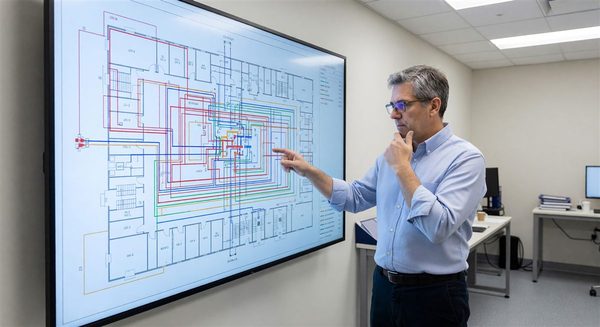
Content Management Digital wayfinding maps must be kept current as hospital space assignments, construction projects, and department locations change. Organizations deploying wayfinding technology must establish governance processes for map content management—typically assigning a facility or IT staff member responsibility for maintaining map accuracy and updating digital content when physical spaces change.
ADA Accessibility Wayfinding systems must provide accessible navigation options for patients with visual, hearing, or mobility limitations. Kiosk accessibility requires appropriate height, audio output for visually impaired users, and simplified interfaces for cognitive accessibility. Mobile wayfinding should integrate with screen reader capabilities on iOS and Android.
Language Support Healthcare organizations serving diverse populations must ensure wayfinding systems support the primary languages of their patient community. Leading wayfinding platforms support 10–30+ languages with both interface translation and voice guidance in multiple languages.
ROI of Digital Wayfinding Investment
Healthcare organizations typically evaluate wayfinding investment through several benefit lenses:
On-Time Appointment Arrival Facilities that have implemented digital wayfinding consistently report improvements in patient on-time arrival rates for scheduled appointments. Even modest improvements in on-time arrival (5–10 percentage points) have measurable productivity benefits for clinical departments and reduce the cascading delays that late arrivals create.
Volunteer and Information Desk Load Reduction Wayfinding is the most common question at hospital information desks and requires significant volunteer time at large campuses. Digital wayfinding that handles routine navigation questions reduces this load, allowing information desk staff and volunteers to focus on higher-complexity assistance needs.
Patient Satisfaction Consistently with research on service industries, patients who navigate healthcare campuses with less confusion and frustration report higher satisfaction with their overall experience. Wayfinding improvement has been demonstrated to positively affect HCAHPS “ease of getting to the facility” metrics.
New Revenue from Improved Access Patients who have difficulty navigating to appointments sometimes don’t come back. Reducing navigation barriers—particularly for complex multi-stop visits like oncology treatment days—reduces no-show rates and improves patient loyalty.
Frequently Asked Questions
What’s the typical implementation timeline for a hospital digital wayfinding system? A full-campus digital wayfinding implementation—including kiosks, indoor positioning infrastructure, and mobile app integration—typically requires 12–24 months from vendor selection to full operation. Simpler implementations (kiosks without indoor positioning) can be deployed more quickly. The critical path is usually map content development, which requires gathering and digitizing accurate floor plans and space assignments across all campus buildings.
How do healthcare organizations keep indoor maps current during active construction? Organizations with active construction programs should establish a workflow where construction project managers notify the wayfinding content management team of space changes, temporary route modifications, and new space openings on a defined timeline before the changes occur. Some platforms provide a staging environment where updated maps can be prepared and tested before publishing, allowing new configurations to go live coincident with physical changes.
Can digital wayfinding integrate with existing parking guidance systems? Yes. Wayfinding platforms that include outdoor campus navigation can integrate with parking guidance systems to provide a seamless experience from arriving at the campus perimeter through navigation to a clinical destination. The combined parking guidance and interior wayfinding experience eliminates the transition gap between external and internal navigation that confuses many patients.
What’s the role of traditional static signage when digital wayfinding is deployed? Static signage remains essential as the baseline wayfinding layer. Not all patients use smartphones, kiosk queue times may create delays during peak arrival periods, and digital systems occasionally fail. Static signage should be maintained and kept current alongside digital wayfinding deployment—digital and physical wayfinding are complementary, not either/or.