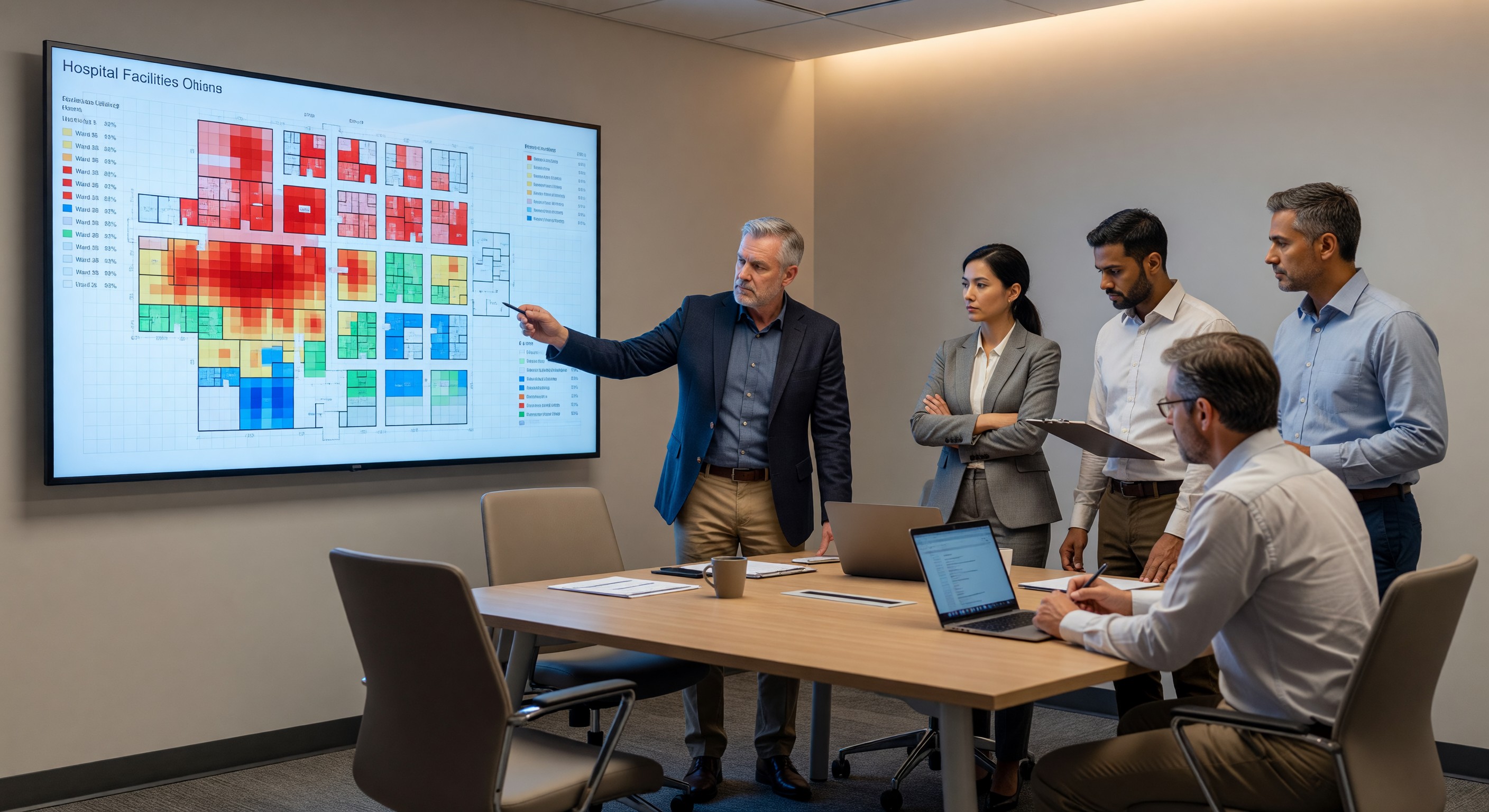
Healthcare facilities are among the most expensive real estate in any market. Clinical space — particularly procedure rooms, exam rooms, and specialty care areas — represents capital investment of hundreds of thousands of dollars per room, plus ongoing operating costs for maintenance, utilities, and staffing.
Yet many hospitals make space planning decisions based on anecdotal reports, department director advocacy, and historical allocation patterns rather than actual utilization data. The result is a common paradox: department directors reporting that they are out of space while observational studies reveal that many rooms sit empty for substantial portions of the day.
Space utilization analytics — using sensor data to measure actual occupancy patterns — provides the evidence base for better space planning decisions.
The Space Utilization Problem in Healthcare
Hospital space allocation is a political and operational problem. Departments that control physical space do not voluntarily yield it. New program proposals typically request additional space rather than proposing reorganization of existing space. The accumulated result of decades of space decisions made without utilization data is inefficient space use at significant financial cost.
Common space utilization problems in hospitals:
- Exam rooms in medical office buildings used at 40–50% occupancy while the scheduler shows them as fully booked (accounting for no-shows, early departures, gaps between appointments)
- Conference rooms with reserved meeting blocks that are not consistently used
- Procedure rooms with actual procedure time utilizing only 60% of room hours while teams report capacity constraints
- Office space allocated on a historical basis that does not reflect current team sizes or hybrid work patterns
Space utilization measurement provides the data to negotiate these conversations on objective rather than political terms.
Sensor Technologies for Occupancy Measurement
Passive infrared (PIR) motion sensors — The most common office occupancy sensor. Detects motion in the sensor field of view. False positives from HVAC airflow and false negatives from stationary occupants are limitations. Low cost, easy deployment, adequate for basic occupancy/vacancy detection.
Ultrasonic sensors — Detect presence even without motion by emitting and detecting ultrasonic signals. Better for stationary occupants (someone working quietly at a desk). Higher cost than PIR, better accuracy.
Time-of-flight sensors — Measure the time for an infrared pulse to return from objects in the field of view, allowing accurate counting of individuals in a space and detection of stationary occupants. Used in high-accuracy applications such as conference room counting and patient waiting area monitoring.
Computer vision (camera-based) — AI analysis of video feeds to detect occupancy, count individuals, and in some applications characterize activity type. Highest accuracy, most data-rich output, but raises privacy concerns that are particularly acute in healthcare settings.
Badge readers and room scheduling systems — Access control data (badge swipes at room entry) provides presence data without dedicated sensors. Room scheduling system data provides booking data that can be compared against sensor occupancy data to calculate actual vs. scheduled utilization.
Privacy Considerations in Healthcare Space Monitoring
Healthcare settings present specific privacy considerations for occupancy sensing technology:
Patient areas — Exam rooms, procedure rooms, and patient-facing spaces require particular care. Camera-based occupancy sensing in these areas is generally not appropriate due to HIPAA implications and patient expectation of privacy. Non-visual sensors (PIR, ultrasonic) are more appropriate.
Notice requirements — Employees have a reasonable expectation of notice about occupancy monitoring in their work areas. Policies and notices should be in place before sensor deployment.
Data limitations — Occupancy data should be used for space planning, not individual performance monitoring. The goal is aggregate patterns (what percentage of time is this room occupied?), not individual tracking (who was in this room and when?).
Work with your privacy officer before deploying occupancy sensing in any patient-facing or staff-only area.
Outpatient Scheduling and Room Utilization
In medical office and outpatient clinic settings, space utilization analytics can reveal the gap between scheduled utilization and actual utilization. A clinic that shows 90% booked utilization in the scheduling system may reveal only 65% actual occupancy when measured — because of no-shows, early completions, template over-blocking, and gap time between appointments.
This 25% gap represents significant recoverable capacity. A medical office building that currently feels “full” may have room to add 15–20% more patient volume without adding space — through scheduling optimization informed by actual utilization data.
Operations improvements driven by space utilization data:
- Eliminating unnecessary buffer time between appointments where actual room turnover data shows faster transitions
- Identifying exam room templates where actual use is consistently lower than blocking suggests and adjusting scheduling templates
- Identifying room types (large exam rooms, procedure rooms) that are over-allocated relative to their actual use rate
Conference and Collaboration Space
Non-clinical conference and collaboration space is the most straightforward application of space utilization analytics, with fewer privacy constraints than patient care areas.
Hospital conference rooms are famously over-reserved and under-used. A common finding in space utilization studies: conference rooms are reserved for 80% of available time but actually occupied for only 30–40% of reserved time, with most reservations for 60-minute blocks that end in 30 minutes.
Interventions enabled by space utilization data:
- Room booking systems that automatically release reservations if check-in is not completed within 15 minutes
- Identification of room sizes that are consistently overbooked (too-small rooms) versus under-booked (too-large rooms), informing renovation decisions
- Evidence-based discussion with department leaders about conference room allocation
Supporting Capital Decisions
The most strategic application of space utilization analytics is informing capital decisions. When a department requests additional space, the first question should be: what does utilization data say about existing space?
Building a culture of data-driven space decision-making requires:
- Consistent sensor coverage of the space portfolio
- Reporting cadence that provides utilization data to facility leadership regularly (not just when a capital request is being evaluated)
- Policy that makes utilization data a required component of space expansion requests
- Capital committee expectations that space requests address utilization of existing space before requesting new space
Frequently Asked Questions
What utilization rate should we consider “efficient” for different space types? Clinical exam rooms: 70–80% occupancy of scheduled hours is considered efficient. Conference rooms: 60–70% occupancy of scheduled hours. Office space: depends on hybrid work policy, but 50–70% workstation occupancy is typical for modern hybrid environments. These benchmarks vary by organization and space type.
How long does it take to collect meaningful space utilization data? At least 90 days of data is needed to establish baseline patterns accounting for day-of-week and time-of-day variation. Seasonal variation may require a full year of data for some spaces. Collect data before making major space decisions based on it.
Can space utilization data be used to reduce our real estate footprint? Yes — this is a primary application in multi-campus health systems. Utilization data identifies underused space that can be consolidated, subleased, or repurposed. Before any space reduction decision, verify that the utilization data is representative (not from an unusual period) and that the downstream impact of space reduction is fully modeled.
Should we hire a consultant for space utilization analysis or build internal capability? Both approaches work. A consultant engagement provides faster time to insight and external benchmark data but creates ongoing dependency if utilization monitoring continues. Building internal capability through a supported technology platform gives ongoing access to data for continuous management. Many organizations start with a consultant-led study to establish baselines and build internal processes simultaneously.