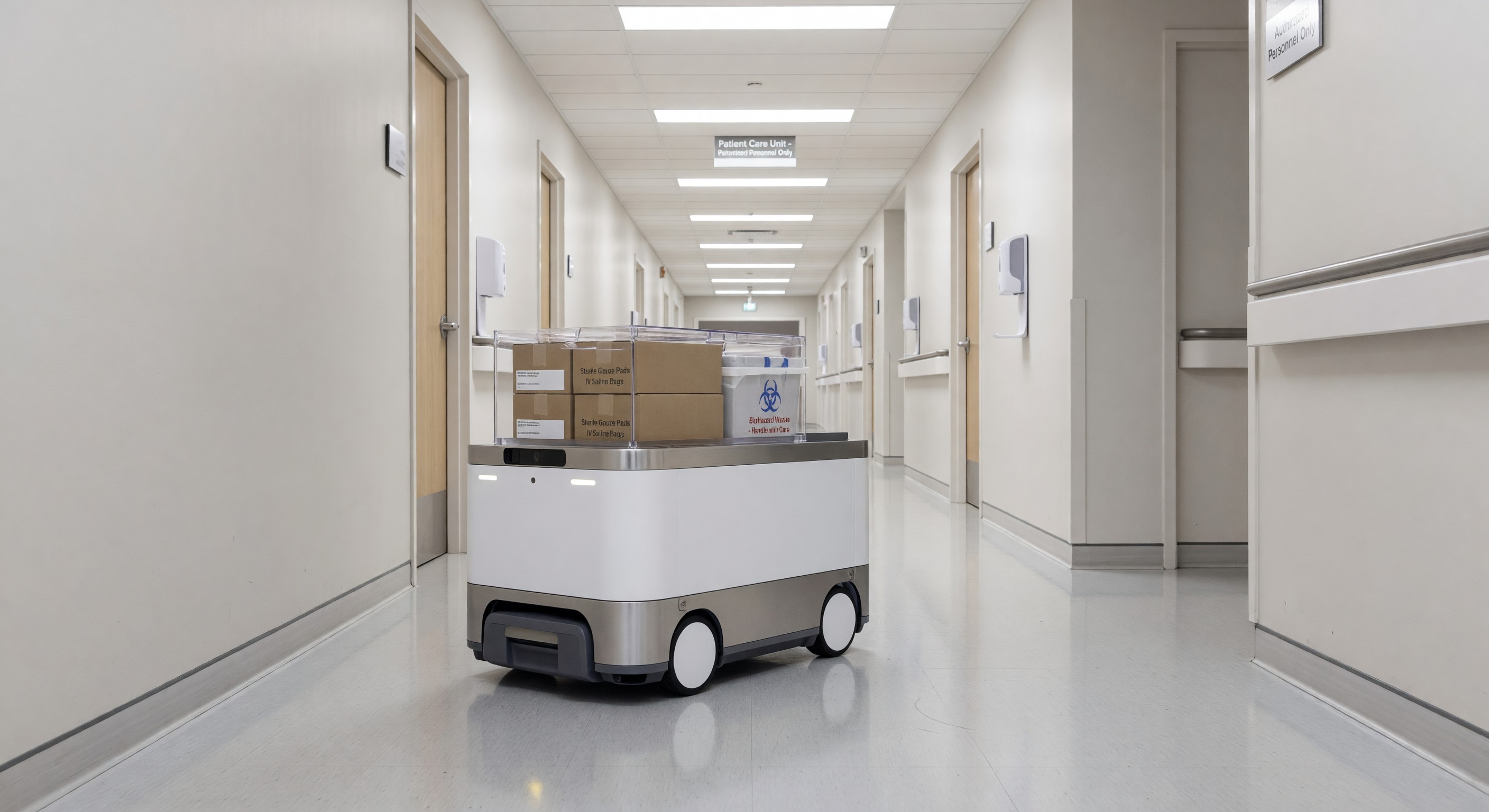
Autonomous mobile robots (AMRs) are operating in hospitals across the United States, moving medications, linens, laboratory specimens, meals, and waste through building corridors while clinical and support staff focus on higher-value work. What began as a technology curiosity a decade ago has reached operational maturity—dozens of health systems now operate robot fleets of 10–50+ units, and the operational and financial case for expansion is strengthening.
For healthcare facility directors, hospital robotics is not just a clinical operations question—it’s a facility infrastructure question. AMRs require specific building infrastructure to operate effectively: elevator integration, network connectivity, loading and unloading stations, and traffic management systems. These infrastructure requirements must be planned and built before or alongside robot deployment, or operational performance will fall short of expectations.
Current Hospital Robot Applications
Materials Transport Autonomous transport of supplies, medications, linens, sterile instruments, and biological specimens is the most mature AMR application in healthcare. Robots from vendors including Aethon (TUG), Swisslog (ARIO), and Vecna Robotics operate in hospitals as automated delivery vehicles, moving items on defined routes between receiving areas, sterile processing departments, pharmacies, and nursing units.
Key characteristics of transport AMRs:
- Navigate autonomously using laser-based mapping (LIDAR) and sensor fusion
- Communicate with elevator control systems to operate multi-floor routes
- Interact with door control systems in facilities where this integration is configured
- Transport capacity of 300–1,000+ pounds depending on model
- Average speeds of 2–4 mph in normal operation, automatically slowing in congested areas
Environmental Services Support Autonomous floor cleaning robots—UV disinfection robots (Xenex, UVD Robots) and floor scrubbing robots (Brain Corp, Avidbots)—are operating in hospitals for terminal cleaning and continuous floor maintenance.
UV disinfection robots that emit germicidal UV-C radiation for terminal room disinfection after patient discharge have been deployed to supplement manual terminal cleaning. Research has documented 50–70% reductions in pathogen burden in rooms following UV disinfection compared to manual cleaning alone.
Pharmacy Automation Robotic pharmacy dispensing systems (ScriptPro, Omnicell) automate medication picking and packaging within pharmacy departments. While these are fixed-installation systems rather than mobile robots, they represent a significant category of healthcare facility automation with specific infrastructure requirements (space, electrical, HVAC).
Infrastructure Requirements for AMR Deployment
Healthcare facility directors evaluating AMR deployment must plan for specific infrastructure requirements:
Elevator Integration Most hospital AMR applications require multi-floor operation, which requires elevator integration. AMRs communicate with elevator control systems via API or hardware interface to call elevators, hold doors while loading and unloading, and manage elevator access during high-traffic periods. Facility directors must work with elevator maintenance contractors and vendors to verify integration capability and plan the technical implementation.
Many hospital elevators, particularly older installations, require modernization of the elevator control panel interface to support AMR integration. This is often a hidden cost in AMR deployment planning that facility directors should identify and budget for early.
Network Connectivity AMRs require reliable wireless network coverage throughout all areas they operate in. Wi-Fi coverage gaps—common in stairwells, near elevator shafts, and in remote building sections—cause AMRs to stop and wait for connectivity, reducing operational efficiency. A Wi-Fi coverage survey of all planned AMR routes is an essential step before deployment planning is finalized.
Loading and Unloading Infrastructure AMRs that transport cargo require loading and unloading stations where items are placed in or removed from the robot’s cargo area. Depending on the robot type, this may require:
- Fixed docking stations at each pickup and delivery location
- Adjustable height work surfaces compatible with the robot’s loading height
- Sufficient aisle width adjacent to loading areas for robots to maneuver
Some AMR systems use automated docking and loading mechanisms that reduce the need for manual robot-to-storage-system interaction.
Traffic Management and Route Planning Hospitals with multiple robots operating simultaneously need to manage robot traffic to prevent congestion, collisions, and interference with patient and staff movement. This requires:
- Fleet management software that coordinates all robots and resolves traffic conflicts
- Clear corridor width standards (most AMR vendors require 6-foot minimum clear corridor width for two-way robot traffic, wider corridors recommended)
- Door interface planning to prevent robots from blocking emergency egress
- Human-robot interaction training for staff to understand how to interact with robots safely
Charging Infrastructure AMRs require regular charging. Charging stations—typically automatic docking charging pads located in service corridors or mechanical areas—require electrical service extension to these locations. Charging station placement must account for robot traffic patterns and minimize interference with other operations.
Operational Integration with Clinical Workflows
AMR operational value is maximized when robots are integrated into clinical workflows rather than operating as a parallel logistics system:
Pharmacy Workflow Integration Medication delivery robots integrated with the pharmacy dispensing system can be dispatched automatically when a medication order is ready for unit delivery, eliminating the manual dispatch process and providing real-time delivery status tracking.
Materials Management Integration AMRs integrated with inventory management systems can trigger automatic supply replenishment when unit supply levels fall below par, reducing nursing time spent on supply management and improving supply availability.
Environmental Services Scheduling UV disinfection robots integrated with patient discharge workflows can be automatically dispatched when patient discharge is documented in the EMR, reducing the time between discharge and room turnover.
ROI and Financial Justification
AMR deployment ROI in healthcare typically comes from multiple value streams:
Labor Cost Offset Materials transport tasks currently performed by environmental services staff or supply chain personnel can be shifted to robots for high-volume, repetitive routes. The labor cost offset calculation depends on the volume of transport tasks, current staff cost, and how many tasks the robot can handle per shift.
Reduced Supply Chain Errors Automated transport with electronic chain of custody reduces medication and supply delivery errors. While error rates vary by current process maturity, reducing delivery errors has documented financial value through avoided clinical consequences, waste reduction, and regulatory documentation benefits.
Faster Throughput UV disinfection robots that reduce room turnaround time between patients have measurable throughput value, particularly in high-occupancy environments where faster room turnaround allows more patient admissions.
Staff Satisfaction and Retention Shifting physically demanding transport work to robots is increasingly valued as a staff retention strategy in healthcare’s challenging labor environment. Facility directors can include estimated turnover cost reduction in AMR ROI calculations.
Frequently Asked Questions
What corridor width is required for hospital AMR operation? Most AMR vendors specify minimum corridor widths of 5–6 feet for one-way robot traffic and 8–10 feet for two-way robot and human traffic without requiring people to stop and move aside. Healthcare facilities with 8-foot minimum corridor widths (the NFPA 101 requirement for new health care occupancy corridors) generally accommodate AMR operation, though wider corridors provide better operational efficiency.
How do AMRs handle emergency situations—can they clear corridors quickly for emergency equipment? Well-designed AMRs are configured to recognize emergency alert signals (fire alarm, overhead page) and automatically move to the nearest safe position out of egress path. AMR fleet management systems should include emergency stop capability that immediately halts all robots and moves them to safe positions when activated by facility staff. Emergency procedures for AMR operation should be documented and included in hospital emergency response planning.
What’s the typical AMR fleet size for a 300-bed hospital? Fleet size depends on the scope of transport applications and campus configuration. Hospitals deploying AMRs primarily for supply chain transport typically start with 3–8 units and expand based on operational experience. Larger campuses with multi-building configurations and broader application scope may operate 15–25+ units. Most AMR vendors recommend starting with a pilot fleet on a limited set of routes before expanding to full campus coverage.
Do AMRs require dedicated staff support, or can they operate fully autonomously? AMRs require technical support staff for maintenance, fleet management, and exception handling—but not dedicated full-time operators for routine operation. Most AMR vendors provide remote monitoring and support as part of their service agreements. Healthcare facilities typically designate 0.25–0.5 FTE of existing materials management or facilities staff time for AMR fleet management tasks.