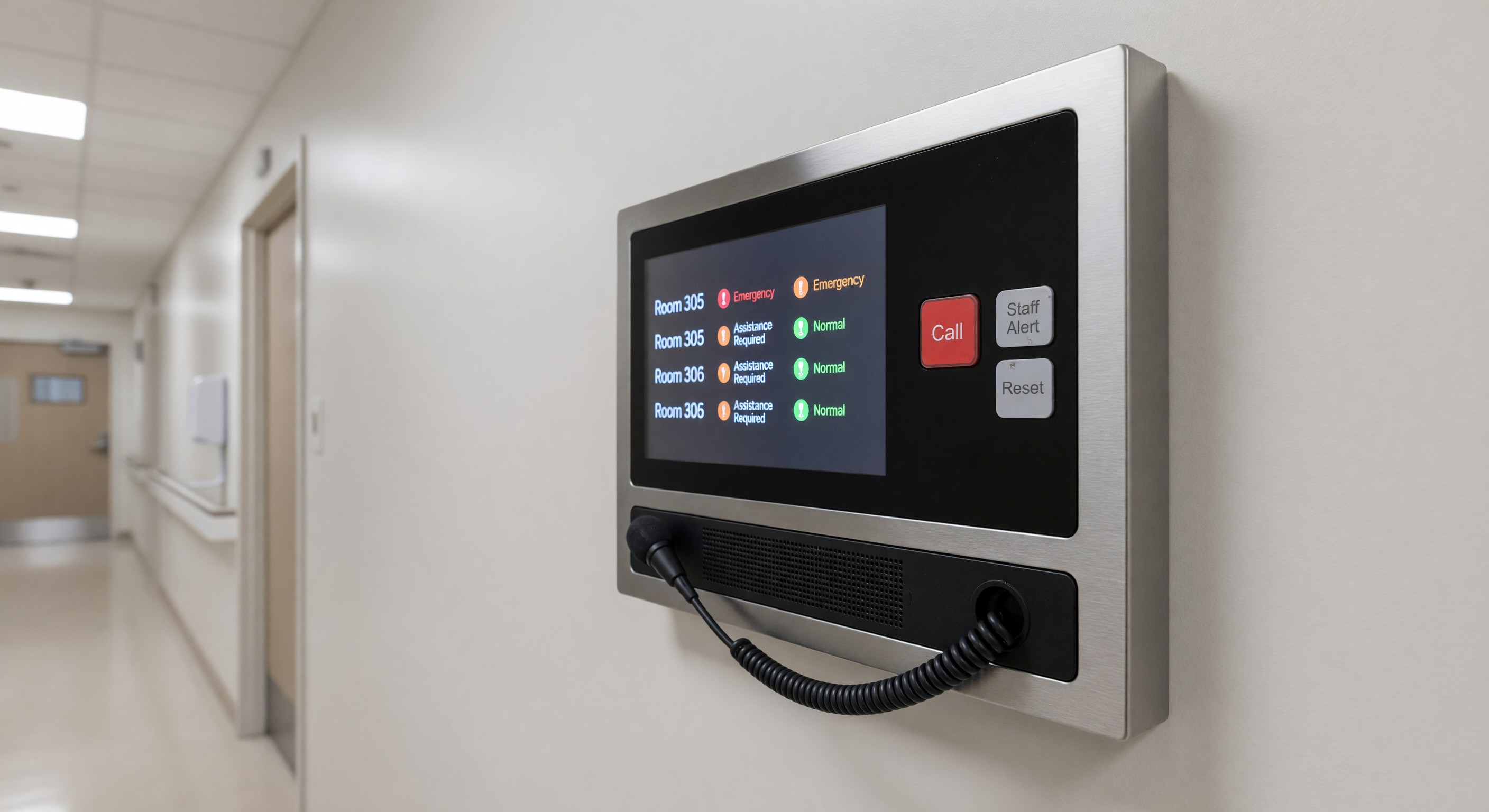
Nurse call systems are the communication infrastructure of patient care—the technical link between patients who need assistance and the clinical staff who provide it. What began as simple call buttons and corridor lights has evolved into integrated care communication platforms that connect nurse call events to staff communication devices, real-time location systems, workflow management software, and hospital analytics dashboards.
For healthcare facility directors, nurse call systems represent both a compliance obligation and a patient safety infrastructure investment. Joint Commission standards require that patients be able to call for assistance, and state health facility licensing standards specify nurse call system requirements for licensed beds. But the operational value of modern nurse call extends well beyond compliance—effective nurse call systems reduce response times, improve staff workflow efficiency, and directly influence patient satisfaction scores.
Nurse Call System Architecture
Modern healthcare nurse call systems consist of several integrated components:
Patient Unit Components
- Pillow speaker units or bedside call buttons (pillow speaker contains call button, TV/entertainment controls, and two-way audio capability)
- Bathroom pull-cord stations (ADA-required emergency call capability in all patient restrooms)
- Staff presence stations at each patient location
- Over-bed or over-door dome lights (visual indication of call type)
Station Components
- Nurse station master consoles (display and management of all call events in the unit)
- Staff call stations (staff-to-staff communication)
- Duty stations at staff work areas
Communications Integration Modern nurse call platforms route alerts to clinical staff through multiple channels simultaneously:
- Wireless phones (VoIP or DECT)
- Smartphones with nurse call integration apps
- Pagers (still common in some environments)
- Overhead paging (for unit-wide and facility-wide announcements)
Backend Platform Cloud-based or on-premises call management platform that receives, logs, routes, and tracks all call events, provides real-time dashboards for charge nurses and supervisors, and generates analytics reports on response times, call volumes, and staff performance.
Integration Capabilities of Modern Nurse Call
The distinguishing capability of modern nurse call platforms is integration with other clinical systems:
Real-Time Location System (RTLS) Integration When nurse call is integrated with RTLS that tracks staff badge locations, call events can be automatically routed to the closest available staff member based on real-time location rather than static assignment. When the patient in Room 412 presses the call button, the system identifies which nurse or tech is closest and sends the alert to that person’s device.
Electronic Health Record Integration Some nurse call platforms integrate with EHR systems to automatically log call events, response times, and resolution notes in the patient record. This integration supports documentation of patient assessment and response activities without requiring separate charting.
Fall Prevention Integration Bed exit alarms—sensors in patient beds that alert when a high-fall-risk patient attempts to get up—are integrated with nurse call systems to generate immediate response alerts when a patient repositions toward the bed edge. Integration with smart bed systems provides additional fall risk data.
Alarm Management Modern nurse call platforms participate in the facility’s broader alarm management strategy, providing nurse-to-nurse call escalation (if no one answers in X seconds, escalate to the next staff member), alarm suppression tools that reduce nuisance alerts, and performance analytics that identify call categories generating excessive response times.
Joint Commission and State Compliance Requirements
Joint Commission RC Standards Joint Commission Provision of Care standards require that patients be informed of the means of calling for nursing assistance and have access to a functioning call system. Nurse call systems that are malfunctioning or inadequately maintained create compliance exposure.
NFPA 99 Requirements NFPA 99 includes provisions for patient care call systems, requiring that call systems be maintained in functional condition and that there is a means for patients to call for assistance from their beds and from patient bathrooms.
State Licensing Standards Most states specify nurse call system requirements in their health facility licensing regulations, including requirements for licensed acute care beds and licensed long-term care rooms. These requirements typically specify minimum functionality—visible call indication in the corridor, audible/visible indication at the nursing station—but may not require modern integrated platform functionality.
FGI Guidelines The Facility Guidelines Institute Guidelines for Design and Construction of Hospitals include nurse call system design requirements incorporated into state licensing through adoption of the Guidelines. New construction and major renovation projects must comply with FGI requirements for nurse call system design.
Technology Refresh Planning
Nurse call systems are long-lived infrastructure—installed hardware often remains in service 15–20 years—but software platforms and integration capabilities evolve more rapidly. Healthcare organizations managing aging nurse call infrastructure should evaluate:
End-of-Life Assessment Manufacturer support timelines for current hardware, software version support, and parts availability for aging systems. Systems approaching end-of-life that can no longer receive security patches or feature updates present both operational and cybersecurity risks.
Integration Gap Assessment What integration capabilities does the current system lack that would improve clinical workflow or patient safety? RTLS integration, EHR documentation integration, and advanced alarm management are common gaps in legacy systems.
Phased Replacement vs. Full Replacement Some nurse call platforms allow phased replacement—replacing the management software and staff device integration while retaining bedside hardware—at lower cost than full system replacement. Evaluate whether this approach is appropriate for the current system age and condition.
Frequently Asked Questions
What’s the typical cost range for nurse call system replacement in a hospital? Full nurse call system replacement including hardware, software, installation, and integration typically runs $8,000–$15,000 per licensed bed for a mid-range modern platform in a standard acute care environment. Specialty environments (ICU, behavioral health, NICU) may cost more due to specialized hardware requirements.
How should healthcare facilities handle nurse call system maintenance and testing? Nurse call systems require annual functional testing of all call points, dome lights, and intercom functions. Manufacturer-recommended preventive maintenance intervals should be followed for electronic components. Response time analytics from the nurse call platform can reveal performance trends that indicate maintenance needs before equipment failures occur.
Can nurse call systems integrate with smart room technology? Yes. The concept of the “smart patient room” integrates nurse call with environmental controls, entertainment systems, patient education platforms, and care team communication. Modern nurse call platforms serve as the integration hub for smart room systems, unifying the patient-facing interface while connecting to multiple backend clinical and facility systems.
What’s the regulatory requirement for bathroom emergency call in healthcare patient rooms? ADA Standards for Accessible Design require emergency call systems in accessible patient bathrooms—floor-mounted pull cords or equivalent controls operable from both standing and floor level. State licensing regulations and the FGI Guidelines specify additional bathroom emergency call requirements for healthcare facilities. These requirements apply to all patient bathrooms, not just designated accessible bathrooms.