Battery energy storage systems (BESS) have entered the hospital facility manager’s toolkit as a genuine option rather than an emerging technology curiosity. Declining costs, improving performance, and the compounding value of grid resilience, demand charge management, and renewable energy integration have created compelling business cases at several healthcare institutions.
For facility directors evaluating BESS, the healthcare-specific considerations — patient safety requirements, fire safety, regulatory approval, and the interaction with existing emergency power systems — require careful navigation alongside the general energy analysis.
Why Healthcare Is Interested in Battery Storage
Backup power resilience — Hospitals depend on emergency generators for backup power. Generators have startup latency (10 seconds to close the automatic transfer switch), fuel storage limitations, and require maintenance that creates downtime risk. BESS can provide seamless, instantaneous backup power during the generator startup gap and can extend backup duration beyond on-site fuel storage limitations.
Demand charge reduction — Commercial utility rates typically include demand charges — monthly fees based on the highest 15-minute demand measured during the billing period. Hospitals with high peak demand pay significant demand charges. BESS charged during off-peak hours can discharge during peak demand periods, shaving the peak and reducing demand charges.
Renewable energy integration — Solar PV generates power only when the sun shines. BESS stores excess solar generation for use during cloudy periods or nighttime. This increases the useful fraction of solar generation and improves the economics of solar investment.
Demand response participation — Utilities pay large commercial customers to reduce demand during grid stress events. BESS enables hospitals to participate in demand response programs by discharging stored energy during curtailment events without disrupting clinical operations.
Microgrid resilience — BESS is a key component of healthcare microgrids — islanded energy systems that can operate independently of the utility grid during extended outages. A hospital with solar generation, BESS, and generator backup can potentially operate indefinitely during grid failures.
BESS Technology for Healthcare
The dominant technology for healthcare BESS deployments is lithium-ion (Li-ion) battery chemistry, with lithium iron phosphate (LiFePO4) receiving significant attention for healthcare applications due to its superior thermal stability and fire safety characteristics compared to other Li-ion chemistries.
Lithium Iron Phosphate (LFP) — The preferred chemistry for large-scale healthcare BESS. Lower energy density than NMC (nickel-manganese-cobalt) chemistries, but significantly better thermal runaway resistance. LFP is more thermally stable and less likely to experience the uncontrolled temperature escalation that makes other Li-ion chemistries a fire concern.
Capacity and configuration — Healthcare BESS systems range from 100 kWh (suitable for demand charge reduction at smaller facilities) to multi-megawatt-hour systems (for large campus resilience applications). Systems are modular, allowing phased capacity increases.
Expected cycle life — Modern Li-ion batteries are rated for 3,000–6,000 charge/discharge cycles (depending on chemistry and depth of discharge) before capacity degrades to 80% of rated capacity. At one cycle per day, this represents 8–16 years of operational life.
Fire Safety: The Critical Healthcare Consideration
Battery energy storage systems present fire safety considerations that are particularly significant in healthcare occupancies. Lithium-ion battery thermal runaway — a self-sustaining exothermic reaction triggered by cell damage, overcharging, or manufacturing defects — can produce intense heat, toxic gases, and fire that is difficult to extinguish with conventional suppression.
NFPA 855 (Standard for the Installation of Stationary Energy Storage Systems) governs BESS installation and fire protection requirements. Healthcare facility BESS installations must comply with NFPA 855 and obtain approval from:
- The authority having jurisdiction (AHJ) — typically the local fire marshal
- The Joint Commission (for systems that may affect Environment of Care compliance)
- CMS (may require review as part of physical environment compliance)
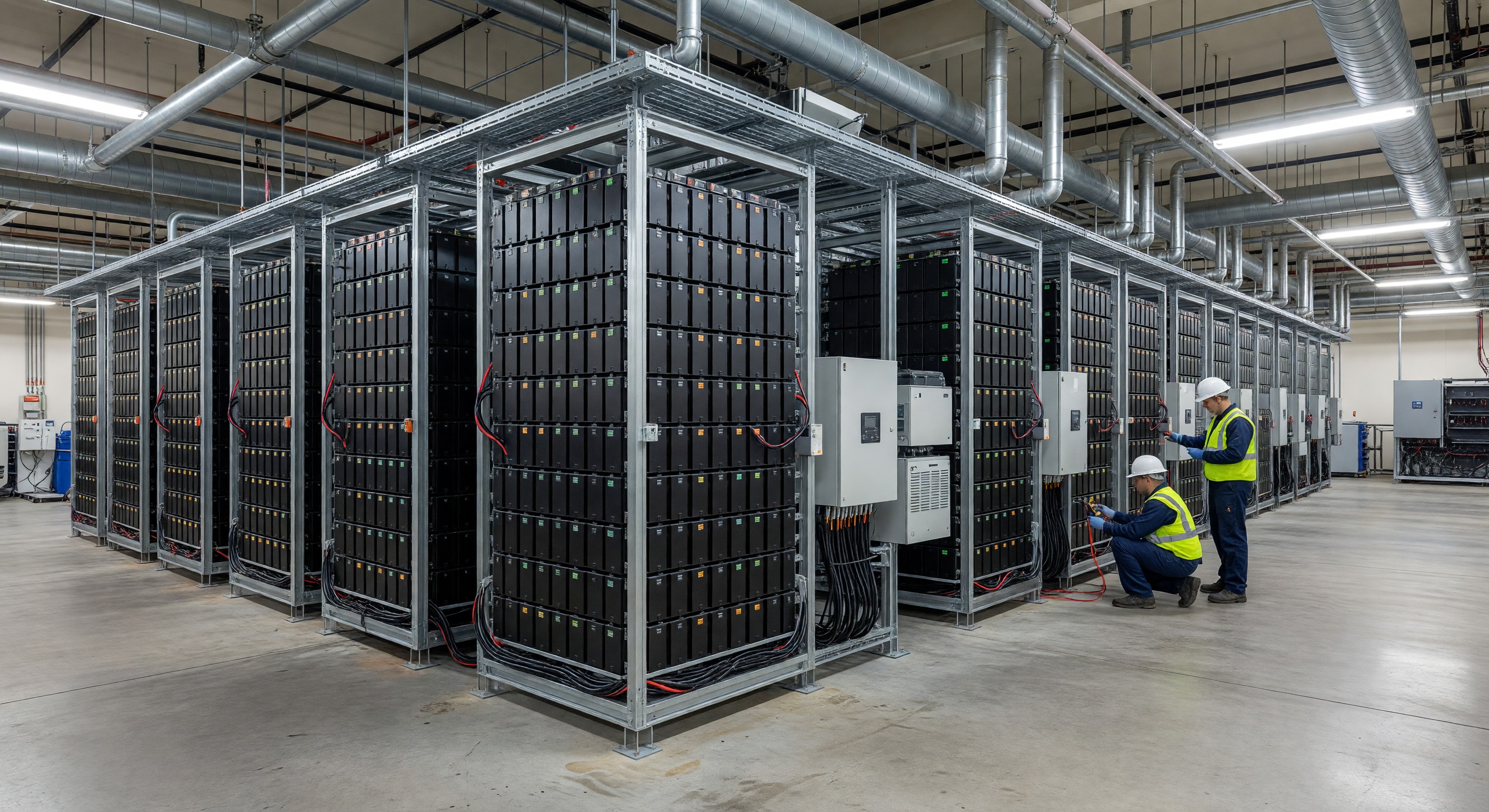
Location requirements — NFPA 855 requires that BESS above specified size thresholds be located in dedicated rooms with fire-rated construction, automatic sprinkler protection, and mechanical ventilation to manage off-gas from any thermal event. Locating BESS systems in a dedicated room isolated from clinical areas is strongly recommended.
Battery management systems (BMS) — Healthcare BESS must include sophisticated battery management systems that continuously monitor cell voltage, temperature, and state of charge, with automatic disconnect capability if any parameter exceeds safe limits.
Suppression systems — Large healthcare BESS installations typically include dedicated fire suppression systems (clean agent or water mist) within the battery room in addition to the building sprinkler system.
Integration with Existing Emergency Power Systems
BESS integration with existing hospital emergency power infrastructure (NFPA 99/110 systems) requires careful engineering:
Codes and standards — NFPA 110 and NFPA 99 EES requirements were written with generators in mind. BESS integration requires interpretation and in some cases an exception or equivalent means of compliance from the AHJ. Engage your engineer and AHJ early in the planning process.
UPS vs. long-duration storage — Short-duration (15-minute) BESS acting as a UPS bridge between utility failure and generator transfer is the most straightforward healthcare application. Long-duration (4-hour+) BESS as a primary backup source without generators is more complex to design and approve.
Transfer switch compatibility — The BESS must integrate with existing ATS infrastructure without compromising the 10-second Critical Branch transfer requirement. This requires careful electrical engineering design.
Frequently Asked Questions
What is the capital cost of a hospital BESS installation? Capital costs range from $400–$800 per kWh for the battery system, plus installation and integration costs that can add 30–50% to the system cost. A 1 MWh system (1,000 kWh) might cost $600,000–$1.2 million fully installed. Federal Investment Tax Credits (ITC) at 30% significantly reduce net cost. Utility rebates are available in some markets.
What is the ROI timeline for a hospital BESS? ROI depends heavily on local utility rate structure (demand charge rates, time-of-use rates, demand response program availability) and solar integration potential. Simple payback periods of 8–15 years are common without incentives; 5–10 years with full ITC and utility rebates. Facilities in markets with high demand charges or strong renewable incentives see faster payback.
How does a BESS affect our NFPA 110 generator testing requirements? NFPA 110 generator testing requirements apply to the generators regardless of whether BESS is also installed. If BESS is integrated in a way that changes how the EES functions, the AHJ and potentially TJC will need to review the modified system design and establish testing requirements appropriate for the integrated system.
Are there healthcare-specific BESS installations we can learn from? Several major health systems have deployed BESS, including Kaiser Permanente (large-scale demand charge reduction and solar integration), Boston Children’s Hospital (backup power resilience), and Cleveland Clinic (campus energy management). Published case studies from these institutions provide practical lessons for facilities planning BESS deployments.