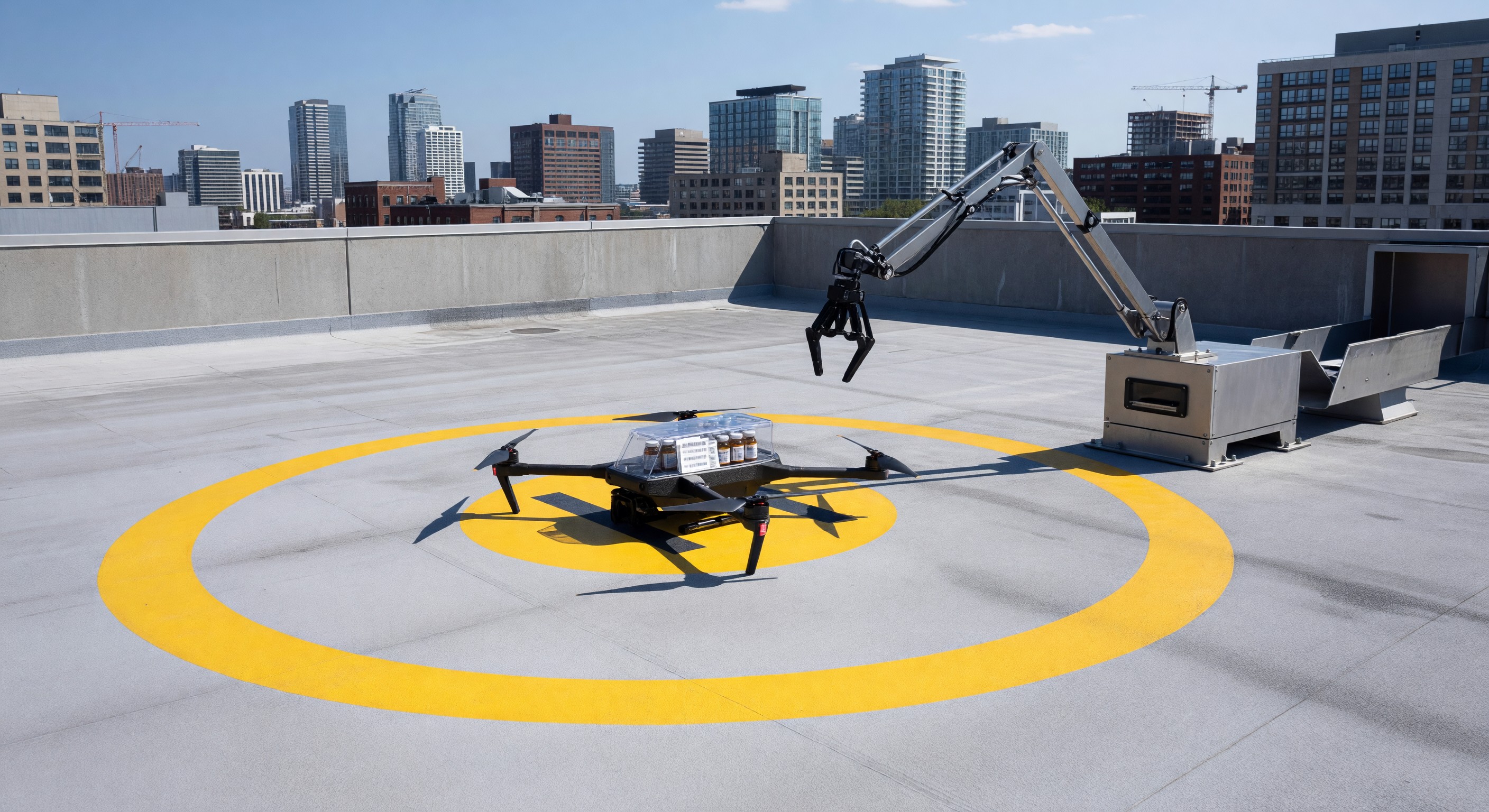
Autonomous drone delivery has moved from science fiction to operational reality in healthcare. Several hospital systems across the United States and internationally are now operating regular drone delivery programs for medications, laboratory specimens, blood products, and medical supplies—achieving delivery times measured in minutes for routes that would take 30–60 minutes by ground transportation.
For healthcare facility directors, drone delivery programs present a genuinely novel infrastructure planning challenge. Drone landing zones, rooftop infrastructure, counter-drone security measures, integration with existing materials management systems, and FAA compliance requirements all fall within the facility management scope in ways that require preparation well ahead of any specific program launch.
Current State of Hospital Drone Delivery
Healthcare drone delivery in the United States operates under FAA Part 135 Air Carrier certification for beyond-visual-line-of-sight (BVLOS) operations, which allows drones to operate beyond the range of direct visual observation. This certification framework has enabled commercial drone operators (Zipline, Wing, UPS Flight Forward, Amazon Prime Air) to establish operational programs with healthcare partners.
Healthcare applications currently in operation include:
Specimen and Sample Transport Point-to-point transport of laboratory specimens between collection locations and laboratory facilities—reducing specimen transit time from hours to minutes and enabling faster test results in time-sensitive situations.
Blood Product Delivery Transport of blood products from blood banks to remote healthcare locations, community hospitals, or disaster response staging areas. Drone blood delivery has been deployed in rural healthcare settings where ground transport is slow and weather-dependent.
Medication Delivery Pharmacy-to-patient or pharmacy-to-clinic delivery of medications, particularly for time-sensitive medications where rapid access directly affects patient outcomes.
Medical Supply Delivery Delivery of supplies (PPE, surgical supplies, IV products) between campus buildings or between a central distribution facility and satellite locations.
Physical Infrastructure Requirements
Healthcare facility directors planning for drone delivery must address several infrastructure domains:
Landing Zone Design Drone landing zones (vertiports) at healthcare facilities must accommodate the specific aircraft dimensions and approach requirements of the drone platform being used. Key design parameters:
- Landing pad dimensions (vary by aircraft, typically 10–30 feet in diameter or square)
- Approach and departure clearance zones (clear airspace corridors without overhead obstructions)
- Weight-bearing capacity for rooftop installations (drones plus landing infrastructure can add significant point loads to rooftop structures)
- Ground-level options for facilities where rooftop access isn’t feasible
Rooftop landing zones offer the cleanest approach corridors in congested urban environments but require structural analysis to verify rooftop load capacity, coordination with HVAC equipment on the roof, and access pathways that allow safe transfer of delivered items from the landing pad to building interiors.
Ground-level landing zones in parking areas or dedicated campus open spaces require airspace clearance from adjacent structures and may require temporary airspace closure procedures for conventional aircraft at facilities with helipad operations.
Environmental and Weather Monitoring Drone operations are sensitive to wind speed, precipitation, and low visibility conditions. Healthcare drone operations require integration of weather monitoring systems that provide real-time data on operational conditions and can automatically suspend flights when conditions exceed safe operating parameters.
Security Infrastructure Drone landing zones at healthcare facilities require security measures to prevent unauthorized access to arriving aircraft, protect the cargo payload during transit and handoff, and detect unauthorized drone intrusions into campus airspace:
Counter-UAS systems: The growing threat of unauthorized drones near hospital campuses has driven interest in counter-drone technologies that can detect, track, and potentially neutralize unauthorized drones. Healthcare facilities must navigate federal legal constraints on counter-UAS systems (which are significantly limited for non-federal entities) and engage with FAA and relevant agencies about appropriate detection-only measures.
Landing zone access control: Barrier gates or access-controlled fencing around ground-level landing zones, combined with camera surveillance of rooftop landing pads, secure the landing zone from unauthorized access.
Power and Connectivity Drone landing zones require electrical power for drone charging (for return-trip ready charging), communication systems (data uplink for flight telemetry and cargo manifest), and landing zone management systems. Rooftop power infrastructure for landing zone use may require significant electrical service extension.
FAA Regulatory Framework
Healthcare drone operations in the US operate under FAA authority. Key regulatory considerations:
Part 135 Air Carrier Certification Commercial drone delivery for hire requires Part 135 certification, which commercial drone operators obtain—healthcare facilities typically partner with certified operators rather than establishing their own certification. However, healthcare facility staff who interact with drone operations must understand the regulatory environment and comply with FAA requirements for operational areas.
Airspace Coordination Healthcare facilities near airports, in controlled airspace, or in flight paths must coordinate drone operations with relevant air traffic control through FAA authorization processes. LAANC (Low Altitude Authorization and Notification Capability) provides near-real-time FAA authorization for drone operations in controlled airspace. Healthcare facilities in complex airspace may need facility-specific operational waivers.
Helipad Compatibility Healthcare facilities with active helicopter operations must carefully coordinate drone operations to prevent conflicts between helicopter and drone airspace use. Simultaneous use of rooftop helipads and drone landing zones requires specific operational procedures and communication protocols between drone operators and helipad operations staff.
Integration with Clinical and Supply Chain Operations
The operational value of drone delivery in healthcare depends heavily on integration with existing clinical and supply chain workflows:
Pharmacy Workflow Integration Drone-delivered medications must be integrated into pharmacy dispensing workflows, chain-of-custody documentation, and temperature monitoring requirements for cold chain products. The delivery handoff point—whether a rooftop receiving station or an automated ground-level locker—must provide the documented chain-of-custody evidence that pharmaceutical distribution requires.
Laboratory Specimen Management Drone-transported specimens must arrive with intact temperature monitoring records, proper labeling, and chain-of-custody documentation that meets accreditation requirements. Laboratory staff receiving drone-delivered specimens must verify these elements and integrate the specimens into existing receiving workflows.
Materials Management Coordination Ground-level drone delivery that arrives at the same locations as conventional ground delivery must be coordinated to avoid conflicts. Receiving dock operations may need modification to accommodate drone delivery alongside conventional shipping.
Frequently Asked Questions
What’s the realistic cost of establishing a healthcare drone delivery program? Costs vary significantly by program scope, facility configuration, and operator model. Partnering with an established commercial drone operator typically requires capital investment in landing infrastructure (rooftop or ground-level landing zone, $50,000–$500,000 depending on complexity) plus ongoing per-delivery fees to the drone operator. Smaller programs that piggyback on existing commercial drone network infrastructure have lower startup costs but less operational control.
Are there HIPAA implications for drone delivery of patient medications or specimens? Yes. Drone transport of patient medications or specimens involves protected health information associated with the delivery (patient name, medication, prescription) that must be handled in compliance with HIPAA privacy and security requirements. Evaluate drone operator data practices and ensure appropriate Business Associate Agreements cover the handling of patient-identifiable information associated with drone deliveries.
How should healthcare facilities handle drone delivery during extreme weather? Commercial drone operators include weather-based flight restriction protocols in their operational procedures—flights suspend automatically when conditions exceed operational parameters. Healthcare facilities that integrate drone delivery into time-sensitive clinical workflows (blood product delivery for active surgical cases, for example) must maintain conventional backup delivery capabilities for weather suspension periods.
What’s the timeline for drone delivery to become a mainstream capability in US healthcare? Drone delivery in US healthcare is in early commercial deployment as of 2024, with a small number of hospital systems operating regular programs. Expansion is constrained by FAA regulatory framework development, urban airspace management challenges, and infrastructure investment requirements. Healthcare infrastructure planning for the 2025–2030 horizon should include consideration of drone delivery infrastructure as an element of campus planning, even if operational deployment is still some years away for most facilities.