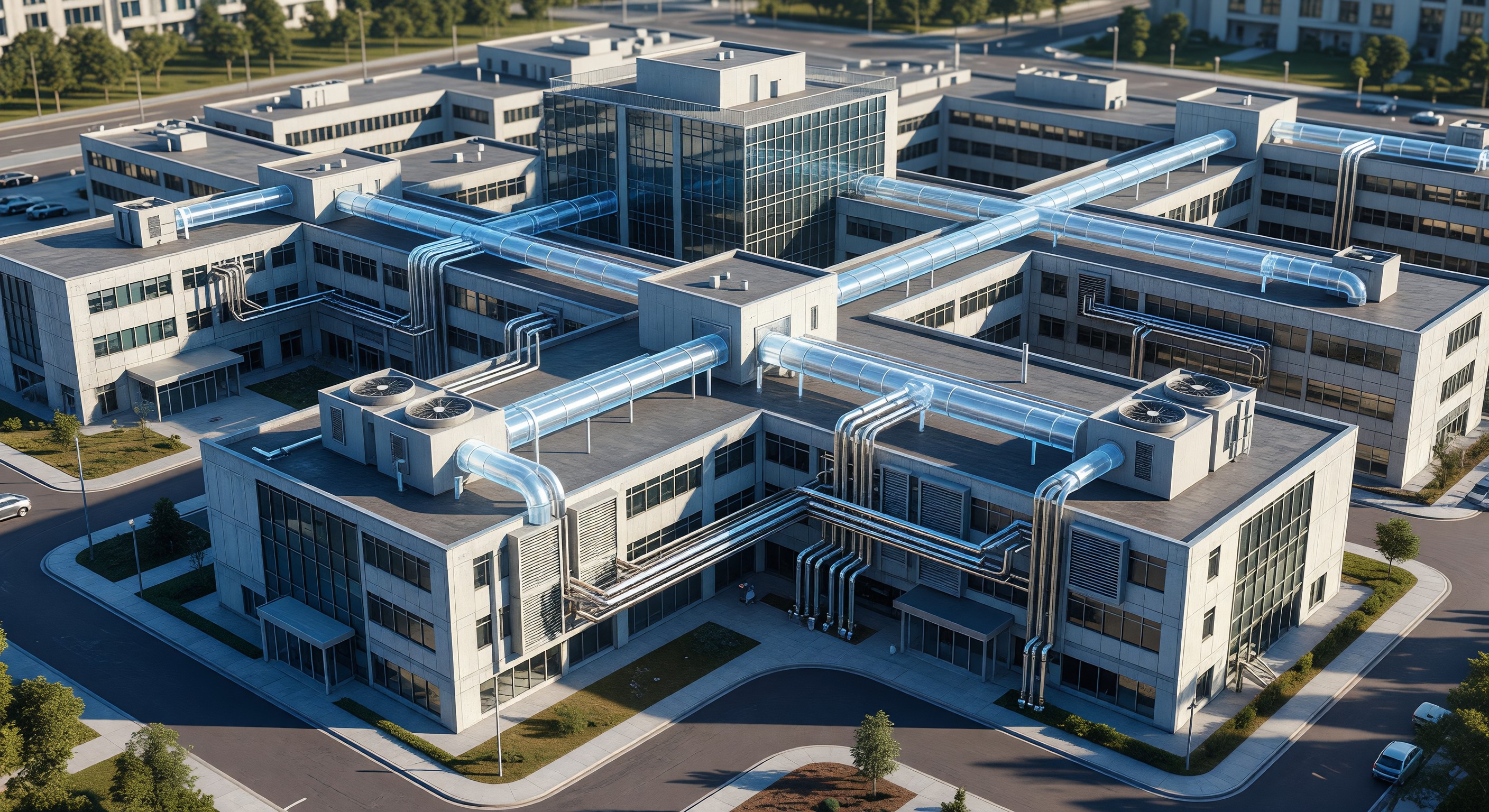
A digital twin is a virtual replica of a physical asset — in healthcare facility management, a continuously updated 3D model of a hospital building or campus that integrates live data from building systems, IoT sensors, and maintenance records. The concept has moved from research project to commercial deployment in progressive healthcare organizations, offering facility directors a tool for operations management that was simply not available a decade ago.
Understanding what digital twins can and cannot do — and where healthcare facility applications are most compelling — helps facility directors evaluate whether the investment is appropriate for their organization.
What Makes a Healthcare Facility Digital Twin
A basic Building Information Model (BIM) is a 3D digital representation of a building used in design and construction. A digital twin extends this model into operations:
Connected live data — The digital twin integrates real-time data from the BMS, IoT sensors, access control, and other building systems. The virtual model shows actual conditions (HVAC setpoints, door access events, equipment status) rather than design intent.
Maintenance and asset data integration — Equipment asset records, PM schedules, work order history, and warranty information are linked to the physical elements in the 3D model. Clicking on a piece of equipment in the model shows its maintenance history, upcoming PMs, and current condition data.
Simulation capability — The model can be used to simulate proposed changes before implementation: what happens to room pressurization if we change this AHU damper position? How does a proposed space renovation affect corridor egress compliance?
Predictive analytics — Integrated with ML-based analytics, the digital twin can surface patterns that predict maintenance needs, energy optimization opportunities, and operational anomalies.
Primary Healthcare Facility Digital Twin Applications
Space management — A 3D model with current space utilization data overlaid allows facility planners to visualize actual occupancy patterns against planned usage. Department heads can see proposed renovation impacts in the model before construction begins. Space planning decisions that would previously require multiple site visits and manual measurements can be made from the model.
HVAC and environmental compliance — The digital twin can visualize HVAC system operation, including airflow direction, pressure differential compliance, and temperature and humidity distribution through clinical spaces. Compliance documentation — proving that OR pressure differentials are maintained — can be generated automatically from connected sensor data.
Energy optimization — Energy consumption mapped to the 3D model reveals which buildings, floors, and zones are consuming energy above baseline. Combined with weather data and occupancy patterns, the twin supports targeted energy optimization decisions.
Emergency planning — Evacuation simulations using the digital twin model allow facility directors to test evacuation routes, identify bottlenecks, and plan for different emergency scenarios before they occur.
Commissioning and handoff — For new construction and renovation projects, a digital twin that is maintained from design through construction and into operations provides the facility team with a complete, as-built model at project handoff — addressing the common problem of as-built drawings that are incomplete or immediately become outdated.
Implementation Requirements and Challenges
BIM as foundation — Digital twin implementations start with a BIM model. Older facilities that do not have BIM models from original construction must either create them (costly and time-consuming) or work with simplified facility models that capture the most critical systems.
Data integration complexity — Connecting the 3D model to live building system data requires integration work between the digital twin platform and the BMS, IoT platforms, access control, and CMMS. Each integration has its own protocol and data structure. The data integration challenge is often underestimated in digital twin business cases.
Model maintenance — A digital twin that is not updated when physical changes occur becomes inaccurate and loses value. Model maintenance — keeping the digital representation current with physical reality — requires ongoing discipline and process. Every renovation, equipment replacement, or system modification must be reflected in the model.
Staff capability — Using a digital twin effectively requires staff who can navigate the 3D model interface, interpret the integrated data, and apply the insights to operational decisions. This is a new capability set for most facilities departments.
Cost — Digital twin platform licensing, implementation services, integration development, and model creation represent a significant investment. Healthcare-specific digital twin platforms (IBM Maximo Visual Inspection with BIM integration, Autodesk Tandem, others) range from $50,000–$500,000+ in initial implementation cost for a large facility, plus ongoing licensing.
Early Healthcare Digital Twin Implementations
Several major health systems have published results from digital twin implementations:
Memorial Hermann Health System has used digital twin technology for energy management and space planning across their Houston, Texas campus network. Integration of BMS data into the 3D model enabled identification of energy anomalies that were invisible in traditional flat data reporting.
Cleveland Clinic has explored digital twin applications for facility condition assessment and capital planning, using the model to prioritize infrastructure investment based on simulated failure scenarios.
Providence Health System has used BIM-based digital models to improve construction project coordination and reduce conflicts during capital projects.
Frequently Asked Questions
How is a digital twin different from a BAS/BMS? A BMS controls and monitors building systems in real time. A digital twin is a visualization and analytics layer that contextualizes BMS data in the 3D spatial model of the building. The BMS provides the data; the digital twin makes that data interpretable in its physical context. Some modern BMS platforms are adding digital twin visualization capabilities, blurring the distinction.
Do we need to have BIM models for our existing buildings to implement a digital twin? Not necessarily. Some digital twin platforms work with simplified 2D floor plans enhanced with system and equipment data, creating a lightweight “operational twin” that is less spatially precise than a full BIM-based twin but still provides significant operational value. Facilities without BIM models can start with simplified representations and invest in full BIM creation for highest-priority buildings.
Is the cybersecurity risk of a digital twin higher than our existing BMS? A digital twin aggregates data from multiple building systems and potentially exposes that data through an additional platform. Cybersecurity considerations include: who has access to the twin platform, whether the platform is cloud-based (adding cloud security considerations), what data the platform transmits externally (usage analytics, performance data), and how access credentials are managed. Review with your cybersecurity team before implementation.
What is a realistic time horizon to see ROI on a digital twin investment? For well-structured implementations in facilities with sufficient data infrastructure, ROI is typically demonstrated within 2–4 years through energy savings, maintenance cost reduction, and avoided capital spending from better space planning. More complex integrations or facilities with limited existing sensor infrastructure may have longer ROI timelines.