Hospitals are the most energy-intensive building category in the commercial sector. Continuous 24/7 operations, medical-grade HVAC requirements, high-density electrical loads from diagnostic and therapeutic equipment, and large domestic hot water demands combine to produce energy consumption profiles that dwarf comparable-sized office or retail buildings.
For healthcare facility directors, energy management is simultaneously a cost control priority, a sustainability obligation, and increasingly, a resilience strategy. The financial stakes are significant: a 300-bed hospital spending $3 million annually on energy can realistically target 15–25% reduction through systematic management — $450,000–$750,000 in annual savings.
Energy Use Intensity Benchmarking
Energy Use Intensity (EUI) — expressed in kBtu per square foot per year — is the primary benchmark metric for hospital energy performance. The EPA’s ENERGY STAR Portfolio Manager tracks hospital EUI against the national distribution, with a score of 75 or above eligible for ENERGY STAR certification.
Median U.S. hospital EUI (from ENERGY STAR data): approximately 250 kBtu/sq ft/year. Top-performing (75th percentile) hospitals achieve 175–200 kBtu/sq ft/year. The best performers are below 150 kBtu/sq ft/year.
Key variables that affect hospital EUI:
- Climate zone — Hospitals in extreme cold or heat climates consume more energy for conditioning
- Case mix — Facilities with high surgical volume have greater OR ventilation and lighting loads
- Age of building stock — Older buildings with less efficient envelopes and systems
- 24/7 vs. lower occupancy periods — Rural critical access hospitals with low overnight census have different profiles than urban medical centers operating at near-capacity continuously
Understanding where your facility stands relative to peers is the starting point for prioritizing efficiency investment.
Major Energy End Uses in Hospitals
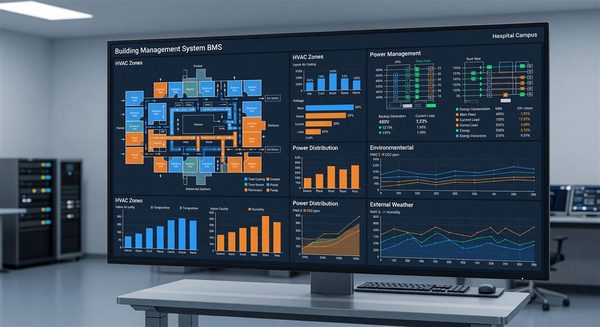
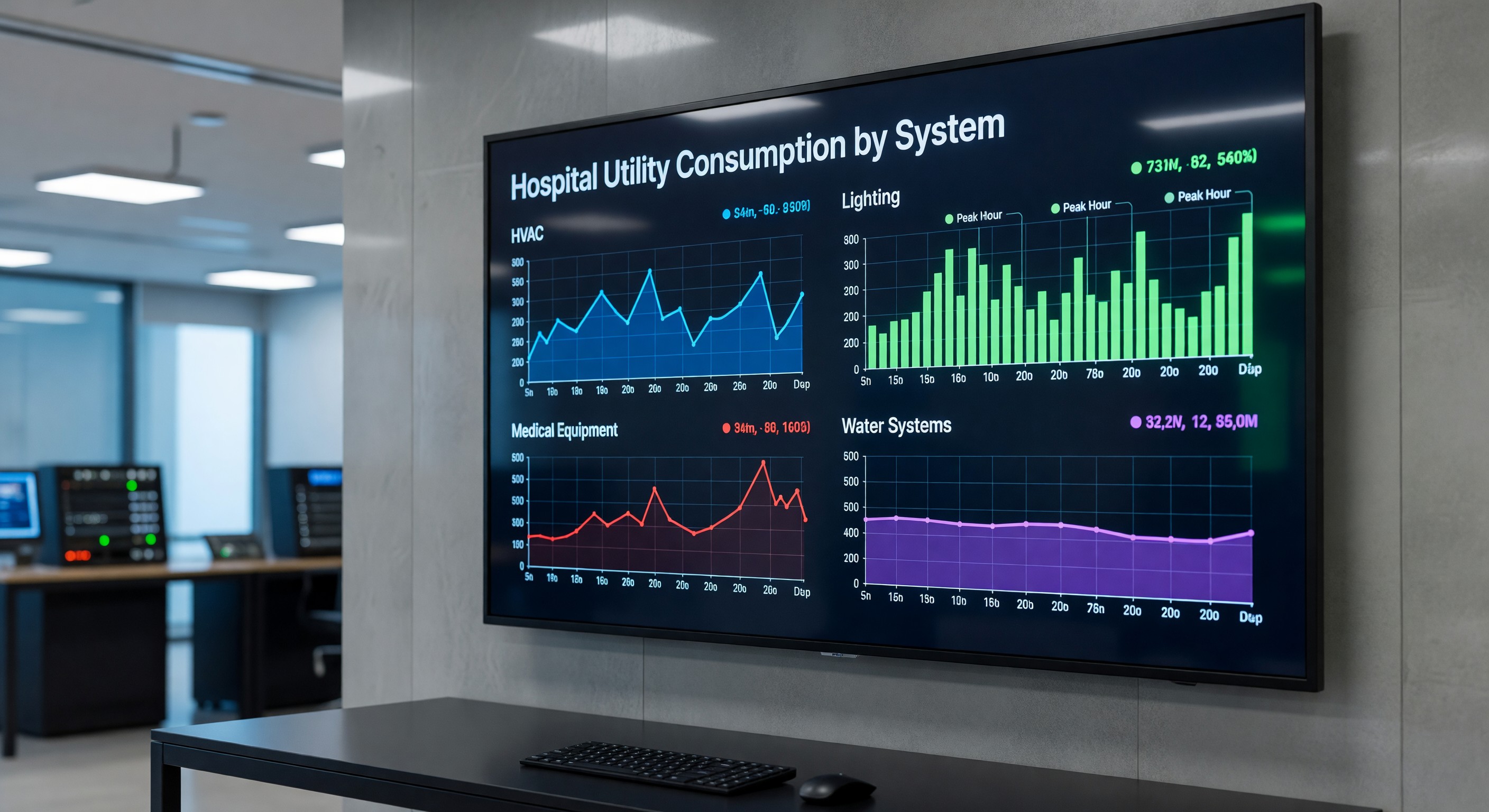
HVAC systems typically account for 40–50% of hospital energy consumption. The large outdoor air fraction required in clinical spaces, 24/7 operation, and high filtration resistance all contribute. The central chilled water plant (chillers, cooling towers, pumps) is typically the single largest energy end use.
Lighting accounts for 10–15% of hospital energy. Clinical spaces require high light levels that cannot be reduced on demand. Administrative and support spaces offer the best opportunity for occupancy-based controls and LED conversion.
Medical equipment — Imaging equipment (CT, MRI, X-ray), surgical equipment, and laboratory instruments contribute 15–20% of total energy. Much of this load is fixed by clinical demand, but idle state management (equipment in standby rather than fully powered when not in use) offers some reduction opportunity.
Domestic hot water — Hospitals maintain high hot water temperatures (120°F or above in many systems) for infection control. Water heating accounts for 5–10% of total energy. Heat recovery from other systems can significantly offset water heating costs.
Data centers and IT infrastructure — EMR servers, imaging data storage, and clinical applications require continuous power and cooling. Healthcare data centers have grown significantly with EMR adoption and are now a meaningful energy end use.
HVAC Optimization Strategies
The largest energy reduction opportunities in most hospitals are in the central plant and air handling systems:
Chiller sequencing optimization — Running fewer, fully-loaded chillers is more efficient than running many partially-loaded chillers. BMS-integrated optimization can reduce chilled water plant energy by 15–25%.
Cooling tower free cooling — During periods of cool outdoor temperatures, chilled water can be produced using cooling tower heat rejection without mechanical chiller operation. This economizer operation can provide “free” cooling for weeks or months in colder climates.
Variable air volume (VAV) systems — Replacing constant-volume air handlers with VAV systems in eligible clinical spaces allows airflow reduction during unoccupied or lower-demand periods. Not all clinical spaces are eligible (OR, AII rooms, and other pressure-sensitive spaces must maintain minimum airflows), but administrative and outpatient areas often offer significant opportunity.
Heat recovery — Energy recovery ventilators (ERV) recover heat and moisture from exhaust air streams to pre-condition incoming outdoor air. In hospitals exhausting large volumes of outdoor air, ERV can reduce the heating and cooling load on primary systems.
COVID-19 and Energy Management Tension (2020)
The pandemic created significant tension with hospital energy management programs. ASHRAE and HVAC engineers recommended increasing outdoor air fractions in clinical spaces to reduce COVID-19 transmission risk — a sound infection control measure that directly increased HVAC energy consumption.
Many facilities suspended energy efficiency programs temporarily in 2020, reverting to more conservative (higher-energy) operating modes to prioritize infection control. The incremental energy cost of running 100% outdoor air rather than recirculating some percentage of conditioned air is significant — potentially hundreds of thousands of dollars annually in a large facility.
Post-pandemic, facilities have worked to identify the minimum outdoor air increase that provides meaningful infection control benefit while managing energy impact. ASHRAE’s Position Document on Infectious Aerosols provides technical guidance on this balance.
Demand Response Participation
Hospital facilities represent attractive participants for utility demand response programs, which pay facilities to reduce load during grid stress events. However, healthcare’s continuous operations and patient safety obligations create constraints:
- Clinical loads (ventilators, monitoring, OR lighting) cannot participate
- Selective non-clinical load shedding (chillers to hot weather setpoints, lighting in non-patient areas, elevator dispatch optimization) is possible with advance planning
- Interruptible rate tariffs that pay facilities for load flexibility during emergencies can be financially attractive
- Backup generator dispatch during demand response events requires coordination with regulatory authorities and careful fuel management
Hospitals participating in demand response programs should have clearly documented load curtailment plans that exclude all patient safety-critical systems.
Renewable Energy Strategies
Many healthcare organizations have made public commitments to reduce carbon emissions and achieve net-zero by specific target years. Common strategies include:
On-site solar — Rooftop or carport solar on large hospital campuses can provide 2–10% of annual electricity consumption. Storage integration allows solar production to contribute to backup power resilience.
Power Purchase Agreements (PPAs) — Hospitals that cannot afford capital investment in on-site generation can purchase renewable electricity through a PPA, contracting for a fixed price from a developer’s solar or wind project.
Renewable Energy Certificates (RECs) — The simplest, least expensive path to renewable claims. RECs do not reduce actual consumption or emissions at the facility site.
Green building certification — LEED for Healthcare certification requires a sustainability performance framework including energy, water, and material metrics. Certified facilities demonstrate systematic sustainability management.
Frequently Asked Questions
What is the ROI on LED lighting conversion in a hospital? LED conversion typically delivers payback periods of 2–4 years in hospital settings, with energy savings of 40–60% compared to fluorescent and 70–80% compared to HID lighting. Additional savings from reduced maintenance (longer lamp life) can shorten payback further. Utility rebates of $0.10–$0.50 per kWh of annual savings are available in many regions.
How do we measure progress toward energy efficiency goals? Use normalized EUI that adjusts for weather (heating degree days and cooling degree days) and occupancy. Year-over-year raw kWh comparison is misleading if the facility added square footage, changed case mix, or experienced abnormal weather. ENERGY STAR Portfolio Manager performs weather normalization automatically.
Can we pursue energy efficiency upgrades while maintaining Joint Commission compliance? Yes — with careful planning. Energy efficiency projects that modify HVAC systems, lighting, or electrical distribution must be assessed for impacts on clinical spaces, pressure relationships, and emergency power. Engage both your energy engineering team and your Joint Commission compliance team before implementing changes in or near clinical areas.
What is a realistic annual energy cost reduction target for a hospital efficiency program? A well-managed, multi-year energy efficiency program can realistically achieve 1.5–3% annual energy cost reduction (weather-normalized) through operational improvements and low/no-cost measures. Capital-funded projects (chiller replacement, LED conversion, HVAC upgrades) can achieve 15–30% improvement over a 5–10 year horizon.