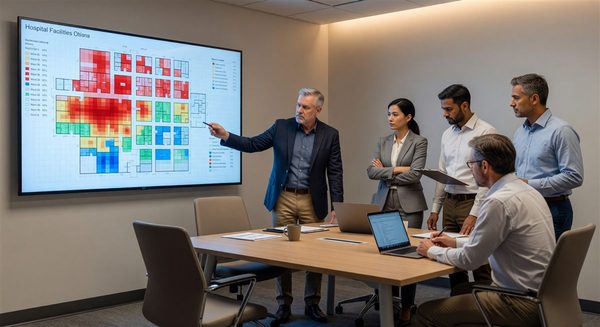
Artificial intelligence has arrived in healthcare facility management—but not uniformly, and not always with the transformative impact that vendor marketing suggests. In 2024, the honest assessment of AI in healthcare facility management is that certain applications have reached genuine operational maturity while others remain promising experiments, and facility directors would benefit from a clear-eyed view of both.
This overview evaluates AI facility management applications by category, distinguishing between what’s working at scale and what’s still in early deployment or overhyped, to help healthcare facility directors make informed decisions about where AI investment is worth pursuing now.
Mature AI Applications: Working at Scale
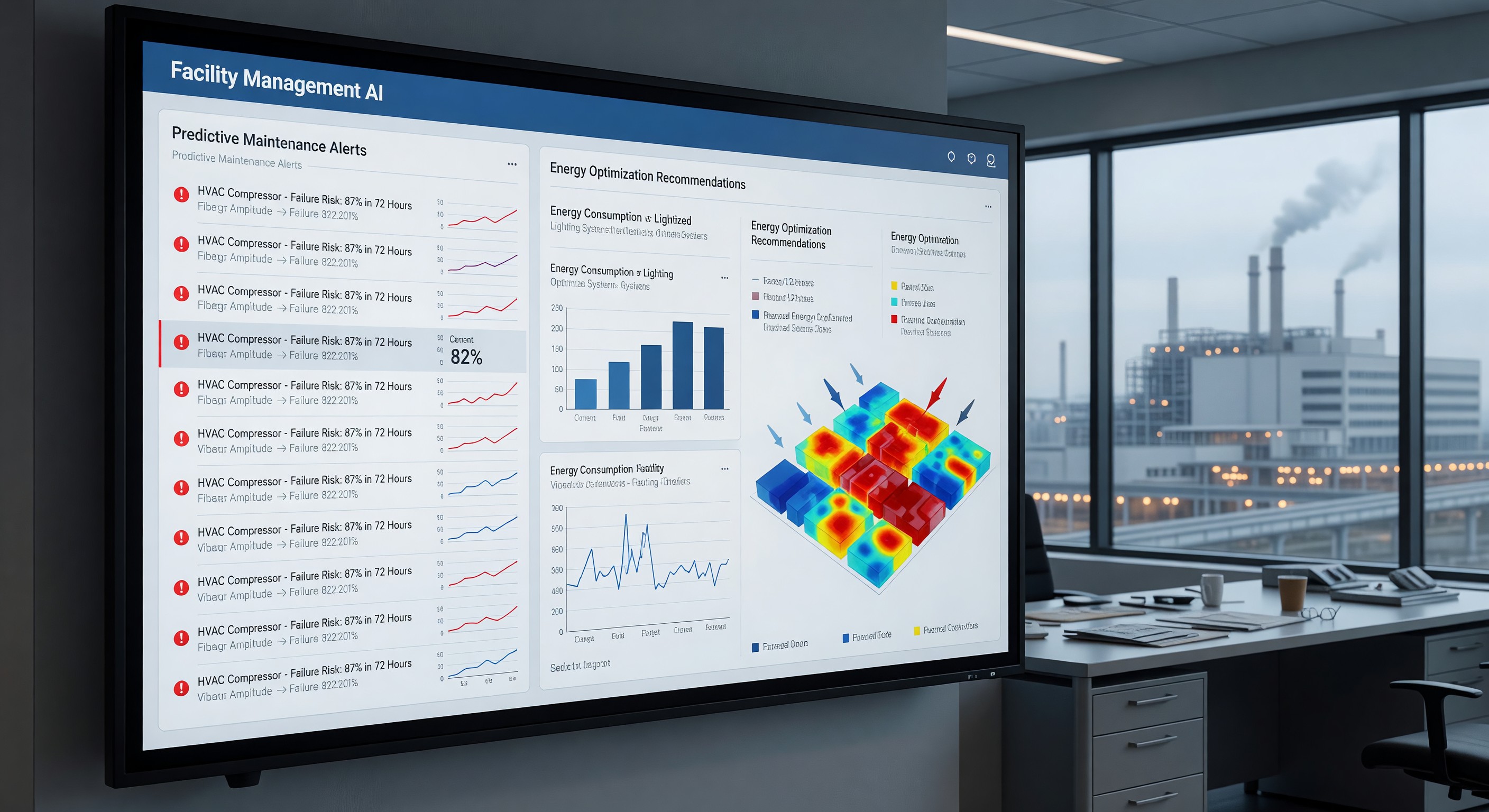
Fault Detection and Diagnostics (FDD) AI-powered FDD for HVAC systems has reached operational maturity and is arguably the most proven AI application in facility management. Machine learning models trained on equipment performance data identify specific fault conditions—stuck dampers, fouled coils, failing heat exchangers, improperly calibrated controls—with specificity and consistency that traditional alarm-based monitoring cannot match.
Healthcare-specific FDD implementations are producing documented results: 15–25% reductions in HVAC maintenance costs through better-targeted maintenance, significant reductions in emergency equipment failures, and improved clinical environment compliance through early detection of environmental control drift.
The key differentiation in FDD platforms is the quality of the fault library (how many fault types can the system recognize?) and the false positive rate (how often does the system generate alerts that turn out to be non-issues?). Healthcare facility directors evaluating FDD platforms should request reference customer data on both.
Energy Optimization AI energy optimization—adjusting HVAC setpoints, lighting levels, and equipment scheduling in real time based on occupancy, weather, and grid signals—has proven effective in commercial buildings and is being adapted for healthcare. Healthcare-specific constraints (clinical environmental requirements that can’t be compromised for energy savings, 24/7 critical operations) limit the optimization opportunities compared to commercial buildings, but meaningful energy reduction (5–15% in appropriately implemented systems) is achievable without clinical impact.
Predictive Maintenance for Asset-Specific Equipment AI-driven predictive maintenance for specific asset types—elevators, compressors, generators, large pumps—has reached maturity through equipment manufacturer programs. Elevator manufacturers (Otis, KONE, Schindler) offer AI-based predictive maintenance services that use embedded sensor data to predict component failures before they cause outages. Healthcare facility directors managing complex equipment portfolios should evaluate whether their major equipment vendors offer manufacturer-backed predictive maintenance programs.
Developing AI Applications: Promising but Emerging
Compliance Monitoring Automation AI tools that analyze compliance documentation and identify gaps, overdue activities, and documentation inconsistencies are moving from early pilots to broader deployment. These tools are demonstrating value in reducing the manual burden of compliance program management, though they require significant calibration to the specific regulatory environment and documentation practices of each facility.
The most mature compliance monitoring AI applications are focused on specific regulatory domains—water management monitoring, emergency lighting test tracking—where the compliance requirements are well-defined and the data inputs are consistent. Broader compliance program management AI that spans multiple regulatory frameworks is less mature.
Space Utilization Analytics AI analysis of occupancy sensor data and scheduling system data to optimize space utilization is being deployed in healthcare primarily in administrative and non-clinical areas where optimization doesn’t affect patient care. AI-driven space analytics can identify meeting rooms that are booked but unused, patient waiting areas that are consistently over- or under-capacity, and administrative space allocation mismatches.
Clinical space optimization is more complex because clinical space decisions involve care quality considerations that pure utilization data doesn’t capture. AI space utilization tools are most useful for identifying opportunities worth investigating rather than automatically making space allocation decisions.
Work Order Optimization AI-assisted work order management—prioritizing maintenance requests, routing work orders to the appropriate technician based on skill and location, and predicting how long tasks will take—is showing promise in early healthcare implementations. The ROI argument is straightforward: better work order routing improves technician productivity and reduces response time.
Aspirational AI Applications: Not Yet Ready
Autonomous Facility Management The vision of AI systems that manage facilities operations without human oversight—autonomously adjusting every environmental parameter, scheduling and dispatching maintenance, and managing compliance documentation—is technically aspirational rather than operationally available. The complexity of healthcare facility operations, the regulatory requirement for human accountability, and the current limitations of AI decision-making in high-consequence environments all prevent fully autonomous facility management from being appropriate for healthcare.
AI-Driven Construction and Renovation Planning AI tools that could optimize complex healthcare facility renovation sequencing—accounting for infection control requirements, clinical operations constraints, phasing efficiency, and regulatory compliance—are in early development but haven’t reached the point where healthcare facility directors would rely on them for actual project planning.
Practical Guidance for Healthcare Facility AI Investment
For facility directors evaluating AI investments:
Start with Data Infrastructure AI is only as good as the data it trains on and operates with. Before investing in AI analytics, invest in the sensor infrastructure (building IoT, equipment monitoring) and data integration (connecting CMMS, BAS, and facility management platforms) that will provide quality data for AI models to operate on.
Evaluate Proven Applications First FDD and predictive maintenance for specific equipment types have the clearest ROI documentation and the most mature product offerings. These should receive priority over less proven AI applications when capital is limited.
Require Healthcare-Specific References AI applications that perform well in commercial buildings may not translate directly to healthcare environments with their additional regulatory constraints, 24/7 operations, and clinical safety requirements. Evaluate AI products with reference customers from comparable healthcare settings.
Maintain Human Oversight Whatever AI applications are deployed in healthcare facilities, maintain clear human oversight and decision authority for all consequential actions. AI generates insights and recommendations; humans make decisions. This is both appropriate from a patient safety perspective and required by the liability and regulatory accountability structure of healthcare.
Frequently Asked Questions
What’s the realistic ROI timeline for AI facility management investment in healthcare? FDD applications with demonstrated fault reduction typically achieve positive ROI within 12–24 months. Energy optimization applications typically require 18–36 months for full ROI payback. More experimental AI applications with less established ROI evidence should be treated as innovation investments with longer, less certain payback horizons.
How should healthcare facility directors evaluate competing AI vendor claims? Request documented outcomes data from peer healthcare facilities—ideally facilities of comparable size and complexity to your own. Ask for data on false positive rates (alerts that turn out to be non-issues) as well as detected fault rates, since excessive false positives undermine operational trust in the system. Beware of vendor case studies that show only best-case outcomes; ask for average outcomes across the entire customer base.
What skills do healthcare facility management teams need to work effectively with AI tools? AI facility management tools require facility staff who can interpret AI-generated alerts, evaluate their significance, and determine appropriate responses. This requires the same equipment knowledge that experienced technicians have always needed—but adds data literacy (understanding what the AI model is actually measuring) and critical evaluation skills (assessing whether an AI recommendation makes operational sense). Organizations investing in AI facility management should invest in corresponding staff development.
Are there regulatory concerns about using AI for healthcare facility compliance monitoring? AI compliance monitoring tools support facility staff in managing compliance—they don’t replace the human accountability that regulatory frameworks require. Joint Commission, CMS, and OSHA hold healthcare organizations accountable for compliance, not the technology tools they use. AI tools that assist with compliance management are appropriate as long as human oversight of compliance decisions is maintained. AI recommendations that would affect patient safety (recommending a generator test when clinical operations are at risk, for example) must be reviewed by qualified human staff before execution.