Healthcare organizations have made public sustainability commitments at an accelerating pace. Health care institutions are increasingly expected to demonstrate environmental stewardship — both because climate change itself is a health equity issue and because healthcare organizations have the institutional credibility to model sustainable practice for their communities.
Parking infrastructure is a visible and substantial component of healthcare’s environmental footprint. Large surface lots generate stormwater runoff, create heat islands, consume land that could support greenspace, and generate significant vehicle emissions as patients and staff idle and circle. Transforming parking facilities from environmental liabilities to environmental assets is achievable with technologies that have well-documented ROI.
Solar Canopies: The Most Visible Green Parking Investment
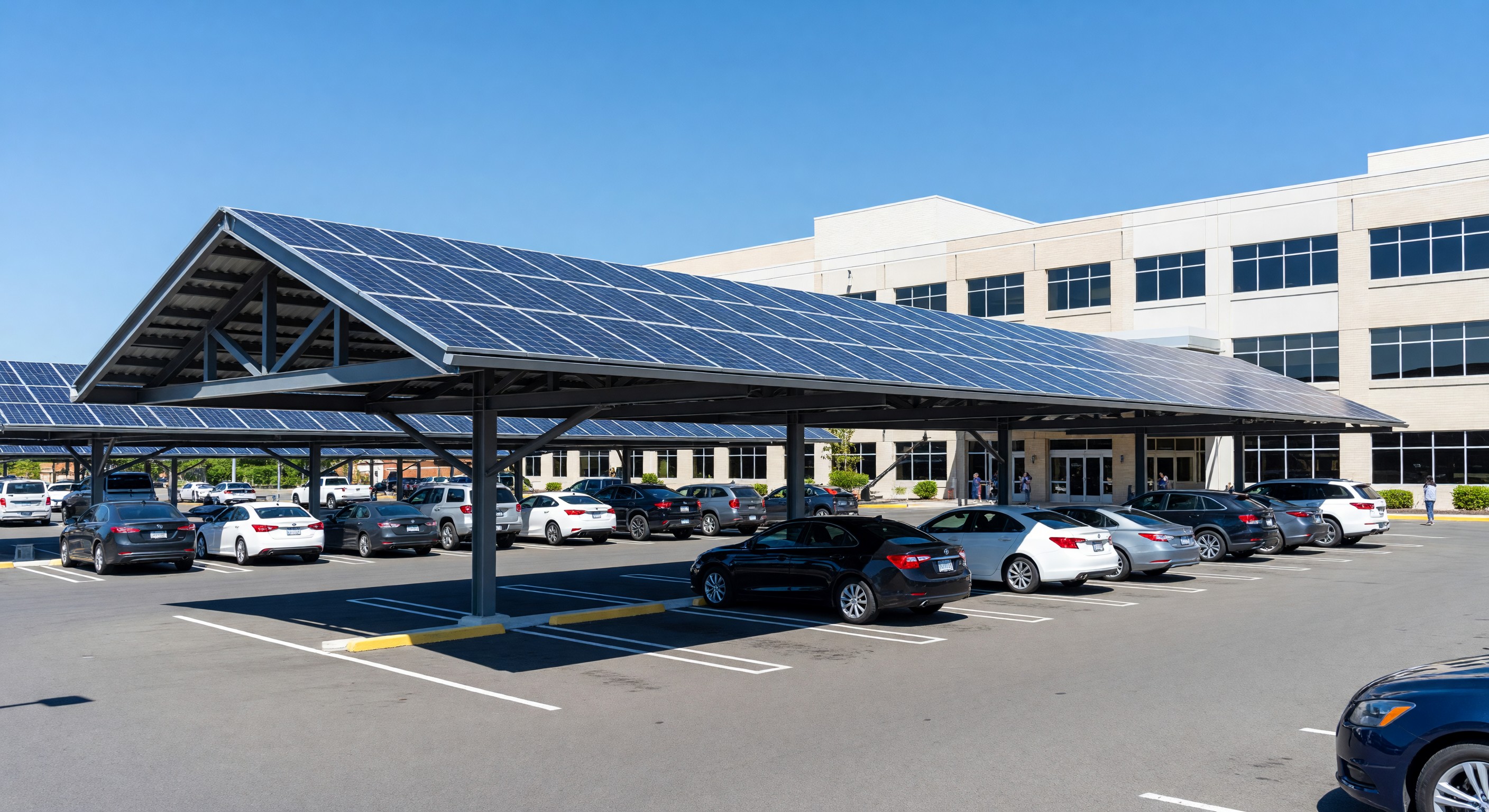
Solar carport canopies over parking areas simultaneously address two hospital priorities: shading vehicles (improving the patient and staff experience, particularly in warm climates) and generating renewable electricity.
A 200-space surface lot with solar canopy coverage generates approximately 800,000–1,200,000 kWh annually, depending on climate zone and panel efficiency. At a blended average electricity rate of $0.10–$0.15/kWh, this represents $80,000–$180,000 in annual energy value.
Financial structure options:
- Direct ownership — Hospital purchases the solar system outright. Federal ITC (30% of system cost) and MACRS depreciation make this attractive for for-profit healthcare. Nonprofit hospitals can benefit from direct pay provisions under the Inflation Reduction Act.
- Power Purchase Agreement (PPA) — A developer finances, installs, and owns the solar system. The hospital pays a per-kWh rate for power generated, typically below market retail rates. No capital required from the hospital; the developer captures the tax benefits.
- Solar lease — Similar to PPA but with a fixed monthly lease payment rather than per-kWh rate.
Integration with EV charging — Solar carport structures are natural platforms for EV charging equipment. Pairing solar generation with EV charging beneath the canopy creates a compelling “green island” and allows some level of solar-powered charging.
Permeable Paving and Stormwater Management
Traditional asphalt parking lots generate significant stormwater runoff — water that flows off the impervious surface carrying pollutants into stormwater systems and waterways. Large hospital campuses with multiple lots can generate millions of gallons of runoff annually.
Permeable paving alternatives — Permeable asphalt, pervious concrete, and interlocking permeable pavers allow rainfall to infiltrate through the surface, reducing runoff volume and improving water quality. Permeable paving is most appropriate in lower-traffic areas and surface lots (not drive lanes under heavy load).
Bioretention cells and rain gardens — Vegetated depressions at the perimeter of parking lots capture stormwater runoff, allow infiltration, and filter pollutants. Bioretention cells can serve as landscape amenities while managing stormwater.
Green roof parking structures — Multi-level parking structures offer rooftop area for green roofs or solar installations. A green roof on a parking structure provides stormwater management, reduces heat island effect, and improves the structure’s visual impact on the surrounding community.
Stormwater credits — Many jurisdictions offer utility rate reductions or fee credits for documented stormwater management improvements. Research available credits in your municipality before final design to potentially improve project ROI.
Heat Island Mitigation
Surface parking lots absorb solar radiation and re-emit it as heat, contributing to urban heat island effect that raises surrounding temperatures. This is both an environmental issue and a patient comfort issue — patients walking from a hot parking lot in a heat emergency climate are experiencing an adverse health condition before they reach care.
Shading — Trees, solar canopies, and building overhangs reduce solar absorption. A shaded parking lot can be 20–30°F cooler than an unshaded lot on a hot day.
Reflective paving materials — High-albedo paving materials (light-colored concrete, reflective sealers) reflect more solar radiation than standard asphalt, reducing heat absorption.
Green infrastructure perimeter — Landscaped buffers with trees and low-maintenance planting on lot perimeters provide shade, aesthetics, and bioretention while reducing the visual impact of large parking areas.
LEED and Green Building Certification
Parking infrastructure can contribute to LEED certification for healthcare facilities. Relevant LEED v4 credit categories:
Sustainable Sites — Access to transit (proximity to bus or rail), bicycle facilities, and alternative transportation infrastructure generate LEED points. Reduced parking supply in transit-accessible locations also contributes.
Energy and Atmosphere — On-site renewable energy from solar carports contributes to energy generation credits.
Water Efficiency — Stormwater management through permeable surfaces and bioretention supports water efficiency credits.
Electric Vehicle Infrastructure — EV charging-ready or installed infrastructure at a percentage of parking spaces generates an Innovation credit.
Healthcare-specific LEED certification (LEED for Healthcare) has parking and transportation elements that reward reduced parking supply, transit accessibility, and sustainable parking infrastructure.
Frequently Asked Questions
What is the typical per-space cost of a solar carport installation over a parking lot? Solar carport installation costs range from $2,000–$5,000 per parking space for the structural canopy plus solar panels, not including electrical balance of system. EV charging infrastructure adds $500–$2,000 per charging-capable space. The total can range from $500,000–$1.5 million for a 200-space lot. ITC and available rebates can reduce the net cost by 30–50%.
Does permeable paving hold up under hospital traffic and heavy vehicles? Permeable concrete and heavy-duty permeable paver systems are rated for heavy vehicle loads, including ambulances and delivery trucks, when properly designed. The subbase design is critical — a properly engineered structural section maintains load-bearing capacity while providing infiltration volume. Consult a pavement engineer with permeable paving experience for load-sensitive applications.
Can we get grant funding for sustainable parking infrastructure? Yes — several funding sources are relevant: EPA Clean Water State Revolving Fund for stormwater management projects, state clean energy revolving loan funds, utility rebates for both solar and EV charging, and Inflation Reduction Act direct pay provisions for tax-exempt nonprofit healthcare organizations. Engage a grant research professional familiar with healthcare sustainability programs before finalizing financing assumptions.
How do we balance sustainability investments in parking with the immediate patient experience needs? The best sustainable parking investments also improve the patient experience: shaded parking from solar canopies, EV charging for staff and patients, and better stormwater management that prevents lot flooding during storms. Frame sustainability investments in dual-benefit terms — the solar canopy isn’t just a carbon reduction measure, it’s a patient comfort improvement and an energy cost savings initiative. This framing tends to generate broader institutional support.