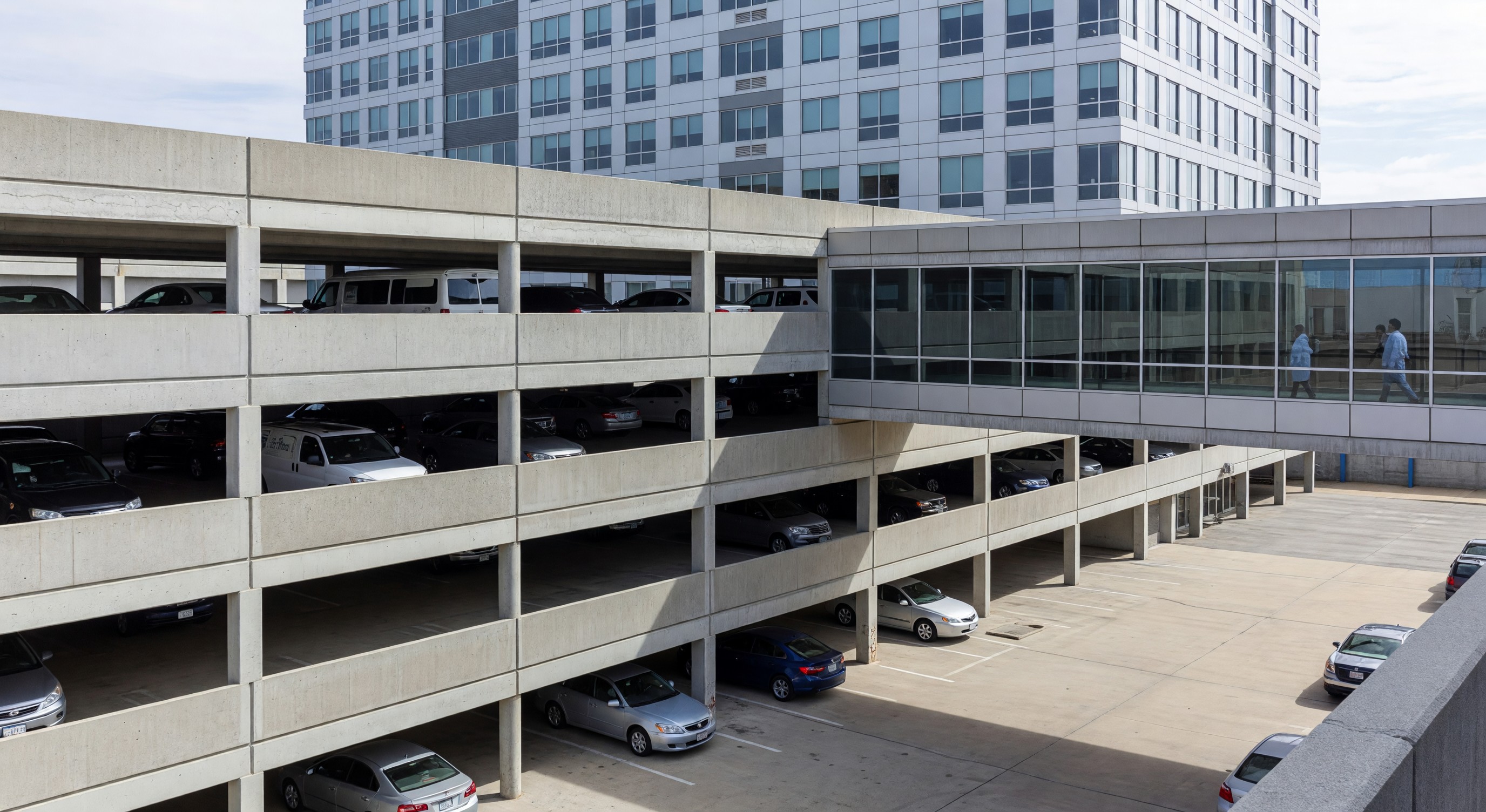
A parking structure on a hospital campus is a long-life, high-capital investment that will shape the patient and staff experience for 30–50 years. Unlike commercial parking structures, hospital parking structures must balance clinical access requirements, patient mobility limitations, 24/7 operational reliability, and the unique safety considerations of a healthcare environment.
For facility directors involved in parking structure planning — whether new construction, expansion, or significant renovation — understanding the healthcare-specific design requirements upfront prevents costly design changes later.
Site Positioning and Proximity
The single most consequential design decision for a hospital parking structure is its location relative to clinical buildings. Walk distance from parking to the point of care directly affects:
- Patient satisfaction with the parking experience
- Employee time spent commuting within campus
- Mobility-challenged patient accessibility
- Emergency services access patterns
Planning principle: Patient-facing parking should target a maximum of 300–400 feet of unassisted walking distance from vehicle to the clinical entrance. Beyond that distance, covered walkways, weather protection, or shuttle connections should be considered.
For large structures, pedestrian bridge or enclosed connection to the clinical building reduces weather exposure and navigation confusion. These connections add construction cost but significantly improve the patient experience and can be designed to accommodate future building expansion.
Floor level considerations: Patients in their least mobile states (post-surgical, managing chemotherapy side effects, elderly with limited ambulation) cannot comfortably walk significant distances or navigate multiple floor level changes. Reserve the closest spaces on the lowest easily accessed levels for patient parking. Employee and physician parking can be assigned to upper levels or more remote zones.
Structure Type Selection
Hospital parking structures are most commonly one of three structural types:
Cast-in-place concrete — The most durable and long-lived structure type. Well-designed cast-in-place concrete parking structures can last 50+ years with appropriate maintenance. Higher initial cost but lowest lifecycle cost. Preferred for high-volume hospital applications.
Precast concrete — Factory-produced structural components assembled on site. Faster construction than cast-in-place, similar lifecycle costs. Connection details between precast elements require careful design to resist water infiltration.
Post-tensioned concrete — Thinner floor slabs with embedded post-tensioning cables. Reduces structural weight and is economical in many markets. Requires careful maintenance of post-tensioning systems.
Steel structures are less common in healthcare parking due to higher maintenance requirements (painting, corrosion management) in hospital environments where exhaust, salt, and cleaning chemicals create aggressive corrosion conditions.
Clearance Height Requirements
Healthcare-specific clearance requirements differ from commercial parking:
Standard clearance: Minimum 7 feet, 2 inches clear height per most codes. This accommodates standard passenger vehicles.
Van-accessible clearance: At least one accessible route from parking to all accessible entries must provide 98 inches (8 feet, 2 inches) minimum clear height to accommodate wheelchair van lifts. ADA requires that all accessible parking spaces serve van-accessible routes.
Shuttle and transport vehicle access: Hospital campuses use large vans, patient transport vehicles, and shuttle buses that exceed standard vehicle height. Routes for these vehicles — including delivery areas and patient drop-off zones — must accommodate heights of 10–14 feet.
Loading dock access: If the parking structure includes a pharmacy receiving area, linen or supply loading dock, or other service function, it must accommodate delivery vehicles with appropriate height clearance.
Lighting and Safety Design
Hospital parking structures serve users at all hours, including late-night shift workers and visitors in high-stress situations. Lighting and safety design must address this reality:
Illumination levels: The Illuminating Engineering Society (IES) RP-20 standard provides lighting recommendations for parking facilities. Hospital parking structures should target minimum 1.0 footcandle on driving surfaces and 3.0 footcandles at pedestrian pathways and stairs. Higher levels at elevator lobbies and entry/exit points.
Emergency lighting: Battery-backed emergency lighting must illuminate egress paths and stairs for at least 90 minutes following power failure.
Visibility: Open architectural design — minimizing solid walls and closed levels — improves natural visibility, reduces hiding places, and supports surveillance camera coverage. Avoid design features that create concealed alcoves or poor sight lines.
Security cameras: Full coverage of all levels, stairwells, elevator lobbies, and pedestrian connections. Camera coverage should be designed into the structure, not added as an afterthought.
Emergency call stations: Blue-light emergency call stations at regular intervals (maximum 100 feet) on every level connect directly to security dispatch. Test regularly.
Phased Expansion Planning
Hospital campuses grow over time, and parking demand grows with them. Designing expansion capability into the initial structure significantly reduces the cost of future growth:
Structural capacity for additional floors: Design the initial structure’s foundation and vertical elements to support additional levels at a specified future load capacity. This adds minimal cost to the original structure but avoids costly strengthening when expansion occurs.
Expansion bays: Site planning that preserves an unobstructed expansion bay adjacent to the original structure allows horizontal expansion without demolition.
Infrastructure routing: Run empty conduit, stub-out utility connections, and plan vertical infrastructure locations to accommodate expansion without disruption to the operating structure.
Pay Station Integration
Entry and exit lane design must accommodate barrier gate equipment and pay stations with appropriate vehicle queue space:
- Minimum 40 feet of clear stack distance between the gate arm and the adjacent roadway
- Pay-on-foot kiosks staged within the structure rather than at exit lanes reduce lane dwell time
- Intercom connections at every entry and exit station to a staffed or monitored call center
- Card reader height compliance with ADA reach range requirements
Coordinate barrier gate specification with the entry lane design. Hospital parking systems that integrate barrier gate control with permit management, payment processing, and validation workflows require specific electrical, network, and physical space provisions that must be planned in the design phase.
Frequently Asked Questions
How many parking spaces should we plan per bed for a new hospital parking structure? The standard planning range is 3–4 spaces per licensed bed for acute care hospitals. Add spaces for the associated medical office building population (1 per physician and 1 per staff per shift) and any ambulatory care or diagnostic services not reflected in the bed count. Outpatient procedure volumes have grown significantly relative to inpatient days, making historical bed-count ratios increasingly unreliable.
What is the typical cost to construct a hospital parking structure? Construction cost for new hospital parking structures ranges from $20,000–$35,000 per space in most U.S. markets (2024), with urban markets at the higher end and areas with favorable labor and material costs at the lower end. Site preparation, design fees, utility connections, equipment, and operating startup costs add 20–30% to the per-space construction cost.
How do we manage parking operations during structure construction? Develop a temporary parking plan before construction begins: identify overflow capacity at nearby lots, negotiate temporary shared parking agreements, implement shuttle service, and communicate the plan to all staff and patients before disruption begins. Provide realistic construction timeline updates. Patient-facing communications should emphasize the improvement coming, not the inconvenience underway.
What certifications or sustainability standards apply to hospital parking structures? LEED certification can be pursued for parking structures, though standalone parking structure LEED certification is less common than whole-campus certification. LEED v4 credits relevant to parking include site access (proximity to transit), light pollution reduction, and electric vehicle infrastructure. Sustainable design features — rooftop solar, EV charging-ready conduit, water-permeable surfaces — can be incorporated without formal certification.