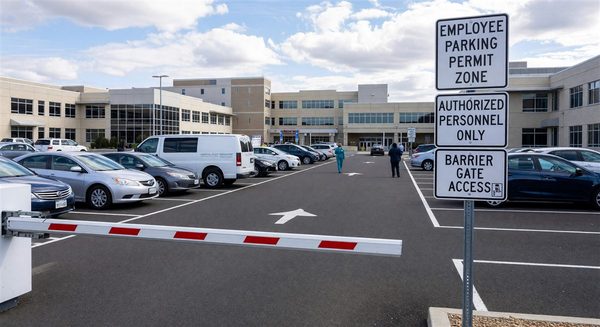
Healthcare parking demand is largely driven by staff commuting patterns. In most hospitals, employees account for 70–80% of daily parking transactions and occupy the majority of available spaces—leaving marginal capacity for the patients and visitors who are ultimately the facility’s purpose. Transportation demand management (TDM) programs that reduce single-occupant vehicle commuting by employees can measurably improve patient parking access without requiring costly new parking construction.
For healthcare facility directors, TDM is both a parking management tool and an employee benefits strategy. The clinical workforce that hospitals are competing to recruit and retain increasingly includes employees who value commuter benefits, sustainability commitments, and flexible transportation options. A well-designed TDM program addresses parking capacity while supporting employee satisfaction and organizational sustainability goals.
Core Components of Healthcare TDM Programs
Transit Subsidies Providing monthly transit passes or pre-tax transit benefit accounts to employees is the most common TDM incentive. Under current IRS rules, employers can provide up to $300/month in tax-free transit benefits, which represents meaningful compensation that encourages transit commuting where it’s feasible.
Healthcare campuses located near transit—particularly urban hospitals with bus and rail access—can meaningfully shift commuting patterns with transit subsidies. Facilities in areas with limited transit have fewer options for transit-based TDM, but may still find value in subsidizing park-and-ride programs.
Remote Parking with Shuttle Service Remote parking lots—located off-campus, typically within 0.5–2 miles—served by a shuttle or van service allow hospitals to meet employee parking demand without on-campus capacity. Remote lots on less expensive land significantly reduce the per-space cost of employee parking compared to on-campus structured parking.
Effective remote parking programs require reliable, frequent shuttle service that employees trust to get them to work on time. Shuttle frequency of 10 minutes or better during peak commute times, real-time tracking through a mobile app, and covered waiting areas at both ends are minimum requirements for programs that achieve meaningful adoption.
Vanpool Programs Employer-facilitated vanpool programs—where the employer arranges and subsidizes 12-15 person vans for groups of employees with compatible commutes—can shift employees in geographically concentrated suburbs from single-occupant vehicles to shared transportation. Healthcare organizations in markets with large employee populations commuting from specific suburban areas often find vanpool programs effective.
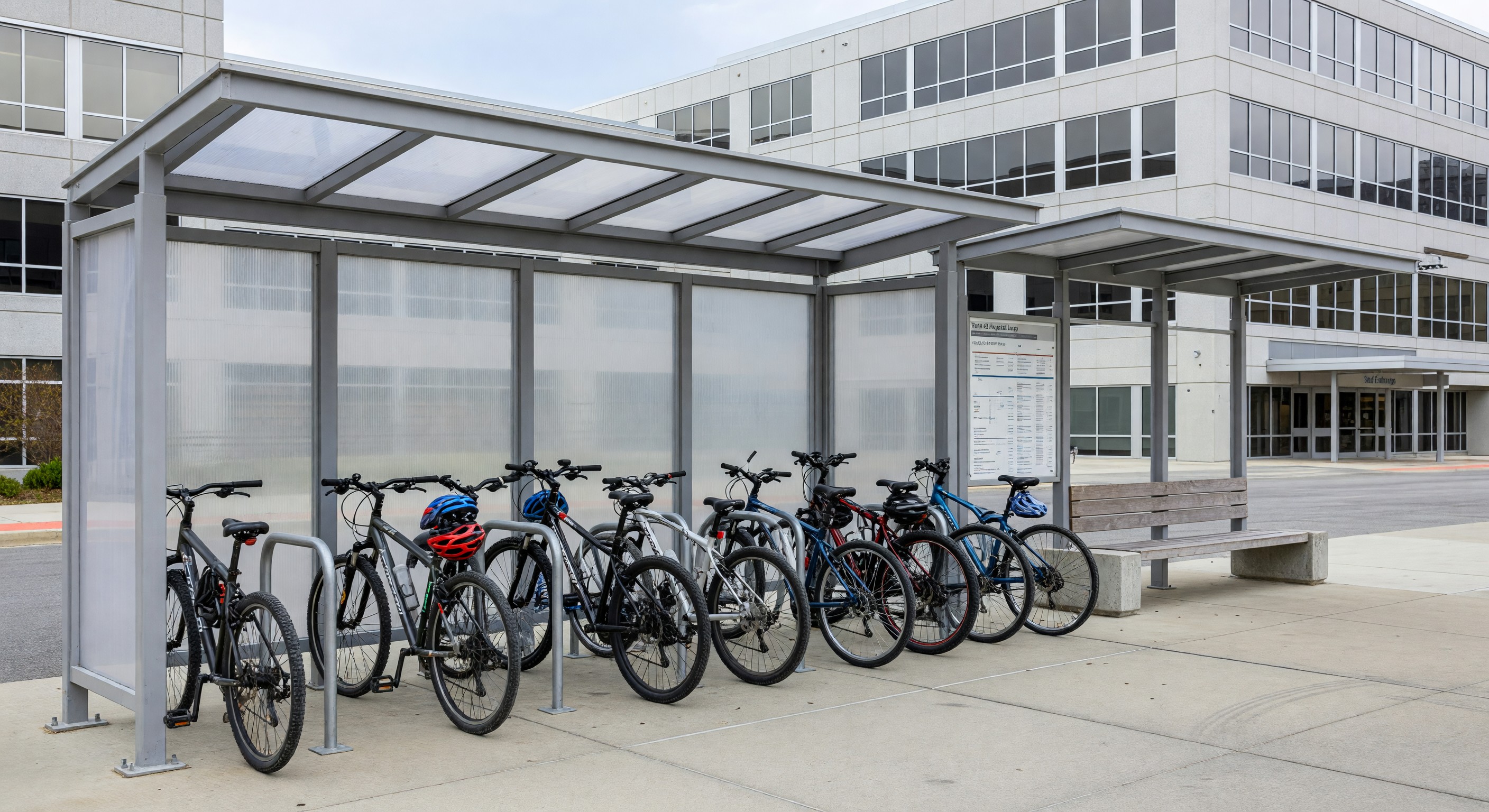
Bicycle Programs Bicycle commuting incentives—secure bicycle storage (including covered options), shower facilities, and per-mile financial incentives or commuter benefit payments—support commuting by bicycle for employees within cycling distance of the campus.
Healthcare campuses in bicycle-friendly cities with protected infrastructure can achieve meaningful bicycle commute mode shares (5–15%) with appropriate facilities. Campus-wide bicycle parking facilities—weatherproof, secure, with locker access for storage—signal organizational commitment to bicycle commuting.
Walk and E-Bike Programs For employees who live within walking or e-biking distance of the campus, financial incentives for active commuting (per-trip payments, fitness benefit credits) can shift some commuters out of parking lots.
Permit Pricing as a TDM Tool
Parking permit pricing is one of the most powerful TDM levers healthcare organizations have—but also one of the most politically sensitive. Increasing employee parking permit prices reduces demand for parking permits, encourages alternative transportation adoption, and generates additional revenue, but creates employee relations challenges if not implemented carefully.
Effective permit pricing strategies for healthcare TDM:
Geographic Differentiation Premium-priced permits for closest parking, lower-priced permits for more distant surface lots, and lowest-priced permits for remote parking with shuttle service creates a pricing ladder that encourages employees to select the transportation option that reflects their actual needs rather than defaulting to the closest available space.
Market Rate Benchmarking Permit prices that are substantially below market rates for comparable local parking subsidize commuting in ways that encourage single-occupant vehicle use. Bringing permit prices toward market rates—while simultaneously improving transit and alternative commute support—addresses both the pricing and the alternatives simultaneously.
Income-Sensitive Pricing Parking permit programs that charge more to higher-income employees than to lower-income employees through income-based pricing tiers address the equity concern that price increases disproportionately affect lower-income workers. Some healthcare organizations implement this through means-tested permit pricing based on W-2 income brackets.
TDM Program Governance and Administration
Transportation Management Association Participation Many healthcare campuses in urban areas are located within Transportation Management Associations (TMAs)—nonprofit organizations that coordinate TDM programs for multiple employers in a geographic area. TMA participation provides access to shared programs (transit pass agreements, vanpool coordination, bike-share integration) that individual employers can’t establish on their own.
Program Marketing and Communication TDM programs that aren’t communicated don’t get used. Consistent marketing of alternative transportation options—during onboarding, through employee communications, at annual benefits enrollment—maintains awareness of available programs and makes adoption easier for interested employees.
Data Tracking and Outcome Measurement TDM programs should track mode shift outcomes: how many employees participate, what parking demand reduction is attributable to the program, and what the net financial impact is relative to the program cost. This data supports continued investment and program adjustment.
Linking TDM to Sustainability Goals
Healthcare organizations with formal sustainability commitments increasingly link TDM programs to carbon reduction targets. Employee commuting is a significant source of Scope 3 greenhouse gas emissions, and TDM programs that reduce single-occupant vehicle commuting directly reduce the organization’s Scope 3 carbon footprint.
For sustainability reporting purposes, healthcare organizations should track employee mode share data annually and quantify the carbon reduction attributable to TDM programs. This connects the parking management program to the organization’s broader sustainability narrative.
Frequently Asked Questions
What TDM incentives are most effective for night shift healthcare workers who can’t use transit? Night shift workers have limited transit options in most markets, making transit subsidies ineffective for this population. More effective alternatives include remote parking with dedicated night shuttle service, flexible permit arrangements that allow night workers to park on-campus when transit isn’t available, and carpool/vanpool programs paired with guaranteed ride home arrangements.
Can small community hospitals implement TDM programs cost-effectively? TDM programs scale down to smaller organizations. Even a modest transit benefit account program and secure bicycle parking—both low-cost interventions—can support mode shift for employees who already have transit access or live close enough to bicycle. Remote parking programs with shuttle service are viable for community hospitals with available off-campus land. The key is matching program components to what’s feasible given the campus location, employee geography, and available transit options.
How long does it take for TDM programs to meaningfully shift commuting patterns? Mode shift is a gradual behavioral change that typically shows meaningful results over 2–3 years of consistent program operation. Year-one results are often modest as employees learn about programs and begin to experiment with alternatives. Years two and three show accelerating adoption as success stories spread through the workforce. Organizations that expect immediate dramatic results are often disappointed; organizations that invest consistently over several years typically achieve the 10–25% commute demand reduction that TDM programs can realistically deliver.
How should hospitals handle employee relations concerns when implementing permit price increases? Price increases should be announced well in advance (6–12 months), implemented gradually over multiple years rather than all at once, paired simultaneously with improvements in alternative transportation options, and communicated with clear explanation of why the change is being made. Employee groups and unions should be engaged early if they represent affected employees. Price increase sensitivity is highest among lower-income employees, making income-sensitive pricing tiers a particularly important equity consideration.