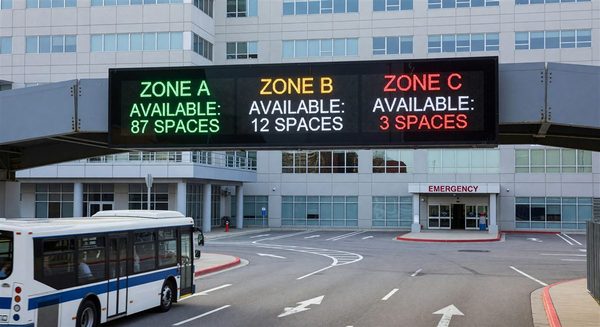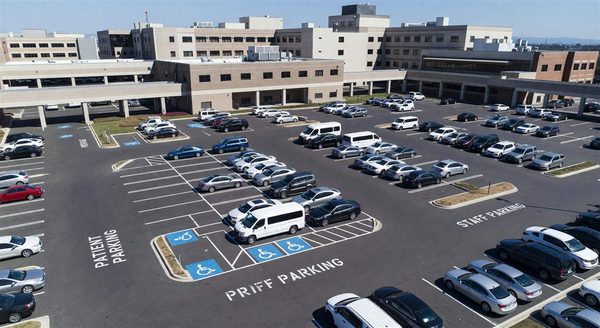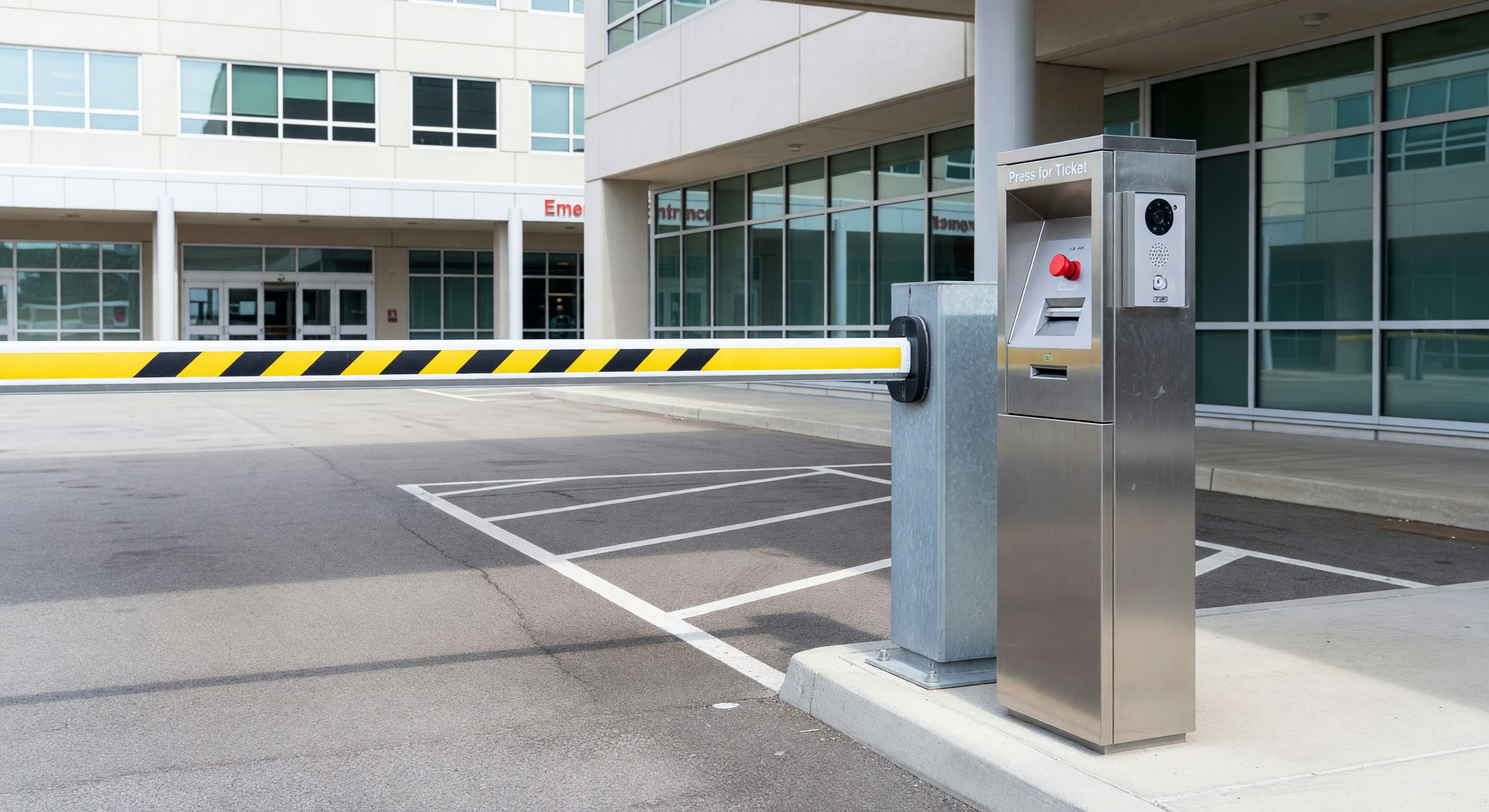
A Parking Access and Revenue Control System (PARCS) is the operational backbone of a hospital parking facility. It governs every vehicle transaction: entry, exit, payment, validation, permit verification, and exception handling. Selecting the right PARCS — and deploying it correctly — determines whether your parking operation runs efficiently or becomes a source of constant patient complaints and staff frustration.
What a PARCS Does in a Hospital Environment
At its core, a PARCS captures revenue, controls access, and generates operational data. In a hospital context, those functions must be executed reliably 24 hours a day, 365 days a year, in weather extremes, by visitors who may be distracted, stressed, or unfamiliar with parking technology.
Core PARCS components:
Entry stations — Issue tickets (paper, QR code, or license plate number upon entry) and grant access to permit holders who present valid credentials. Entry stations must have fast transaction speeds (under 10 seconds from pull-up to gate open) and reliable credential reading across technology types (magnetic stripe, proximity, barcode, QR, LPR).
Exit stations/cashiers — Process payment from transient visitors. Modern exit stations accept chip and tap credit cards, contactless mobile payment, and validate QR codes or barcodes. Pay-on-foot kiosks staged before exit lanes allow payment before reaching the exit, reducing lane dwell time.
Barrier gates — Physical control of vehicle access at entry and exit points. Gate arms must withstand high cycle counts (a busy hospital entry may cycle 1,000+ times per day), and the mechanism must be reliable in temperature ranges from -30°F to 115°F depending on geography. Fail-safe modes for network or power failures must be defined and tested. Hospital-grade barrier gate systems are engineered specifically for the high-volume, high-reliability demands of healthcare environments.
Management software — The platform that integrates all PARCS components, manages permits, processes revenue, generates operational reports, and integrates with validation systems. Software determines the system’s long-term flexibility and upgrade path.
Video intercoms — At minimum, a two-way video intercom at entry and exit stations allows remote assistance for visitors who need help, lost tickets, or equipment malfunctions. Hospital visitors in distress should never be stuck at a gate with no recourse.
Key Integration Requirements for Hospital PARCS
Hospital parking operations have more complex integration requirements than commercial parking:
Validation integration — Clinical departments validate parking for eligible patients. The PARCS must accept validation codes generated by clinical systems (hospital patient management, pharmacy systems, cancer center check-in) and apply the appropriate discount or free pass at exit without manual intervention.
Permit database integration — Employee permits are managed in HR or facilities systems. The PARCS should integrate via API so that permit status is always current. Terminated employees must be automatically blocked without manual credential revocation.
Revenue accounting integration — Parking revenue flows into the hospital’s accounting system. PARCS financial reporting must be compatible with your general ledger system and produce reconcilable revenue data.
Security camera integration — License plate capture at entry and exit creates a record of all vehicle transactions. Integrating with your campus security camera system provides additional evidence capability and reduces fraudulent claim risks.
Evaluating PARCS Vendors for Healthcare
When issuing an RFP for a hospital PARCS, evaluate vendors on:
Healthcare-specific references — Ask for references at hospitals with comparable facility characteristics (bed count, daily volume, mixed permit and transient population). A vendor with strong commercial parking experience but no healthcare references may underestimate the operational complexity.
Uptime guarantees — What is the vendor’s SLA for system availability? What is their response time for critical failures (gate stuck, payment system down)? For a hospital parking operation that cannot close, uptime guarantees should be contractually specified with penalty provisions.
Remote monitoring capability — Can the vendor’s technical team monitor your system remotely and diagnose problems before they escalate? Remote monitoring capability reduces on-site service calls and improves resolution speed.
Offline operation mode — What happens when the PARCS loses network connectivity to the central server? The system must be capable of processing transactions locally and reconciling when connectivity is restored.
PCI DSS compliance — If the system processes credit card payments, PCI DSS Level 1 or Level 2 compliance is required. Confirm the vendor’s current PCI certification and understand the scope of your facility’s compliance obligations within the PARCS payment chain.
Hardware replacement parts availability — Proprietary hardware with limited parts availability creates long-term risk. Confirm that replacement parts for critical components (gate mechanisms, payment terminals) are available within 24–48 hours.
Contactless Payment Transition (2020)
COVID-19 accelerated the transition to contactless payment in hospital parking. The concern about shared surfaces (touch screens, card slot inserts) prompted many facilities to prioritize QR code scanning and tap payment as the primary transaction methods.
Vendors who had already invested in contactless payment capability saw rapid adoption during 2020. Facilities that had not yet deployed contactless-capable pay stations faced pressure to retrofit or replace equipment sooner than their original capital plans had anticipated.
Pay-on-foot kiosks with QR code validation and contactless payment became the preferred architecture during COVID-19 because they eliminated the need for visitors to touch the exit lane equipment at all — payment was completed before reaching the lane.
Total Cost of Ownership Analysis
PARCS purchasing decisions should be evaluated on total cost of ownership (TCO) over a 10-year horizon, not acquisition cost alone. TCO components include:
- Hardware acquisition (entry stations, exit stations, gates, pay-on-foot kiosks, central servers)
- Software licensing (annual or subscription)
- Installation and commissioning
- Annual maintenance contract
- Expected hardware replacement cycles
- Software upgrade costs
- Integration development costs (validation, HR, accounting)
- Training costs
- Revenue from the system (net of processing fees)
A lower-cost initial system with high annual software licensing fees and expensive maintenance contracts may have a higher 10-year TCO than a higher-acquisition-cost system with better ongoing cost structure.
Frequently Asked Questions
How many lanes do we need at a hospital parking entry? Industry standard planning assumes 200–350 vehicles per hour per lane under normal conditions. Calculate your peak hour volume (typically morning shift change plus visitor arrival), add 20% for variance, and size lane count accordingly. For a facility with 1,000 peak hour entries, plan for 3–4 lanes.
Should we use pay-on-exit or pay-on-foot PARCS architecture? Pay-on-foot (visitor pays before returning to vehicle) reduces exit lane dwell time and eliminates the payment transaction from the exit gate entirely. This architecture is preferred for facilities with high volume where exit lane backup is a regular problem. Pay-on-exit is simpler to deploy and more familiar to visitors accustomed to traditional parking garages.
What happens when a visitor loses their parking ticket? Lost ticket procedures should be defined in your PARCS configuration and communicated to visitors at entry. Common approaches: charge the maximum daily rate; verify entry time via LPR camera and charge accordingly; require staff assistance via intercom. Whatever the procedure, ensure it can be executed quickly — a visitor disputing a lost ticket at an exit lane during shift change is a significant operational problem.
How do we handle a PARCS vendor that goes out of business? Source code escrow agreements protect access to the software if a vendor ceases operations. Additionally, open API documentation ensures that integrations and data can be migrated to alternative platforms. Before contract execution, understand what happens to your data and system operability in a vendor continuity failure scenario.