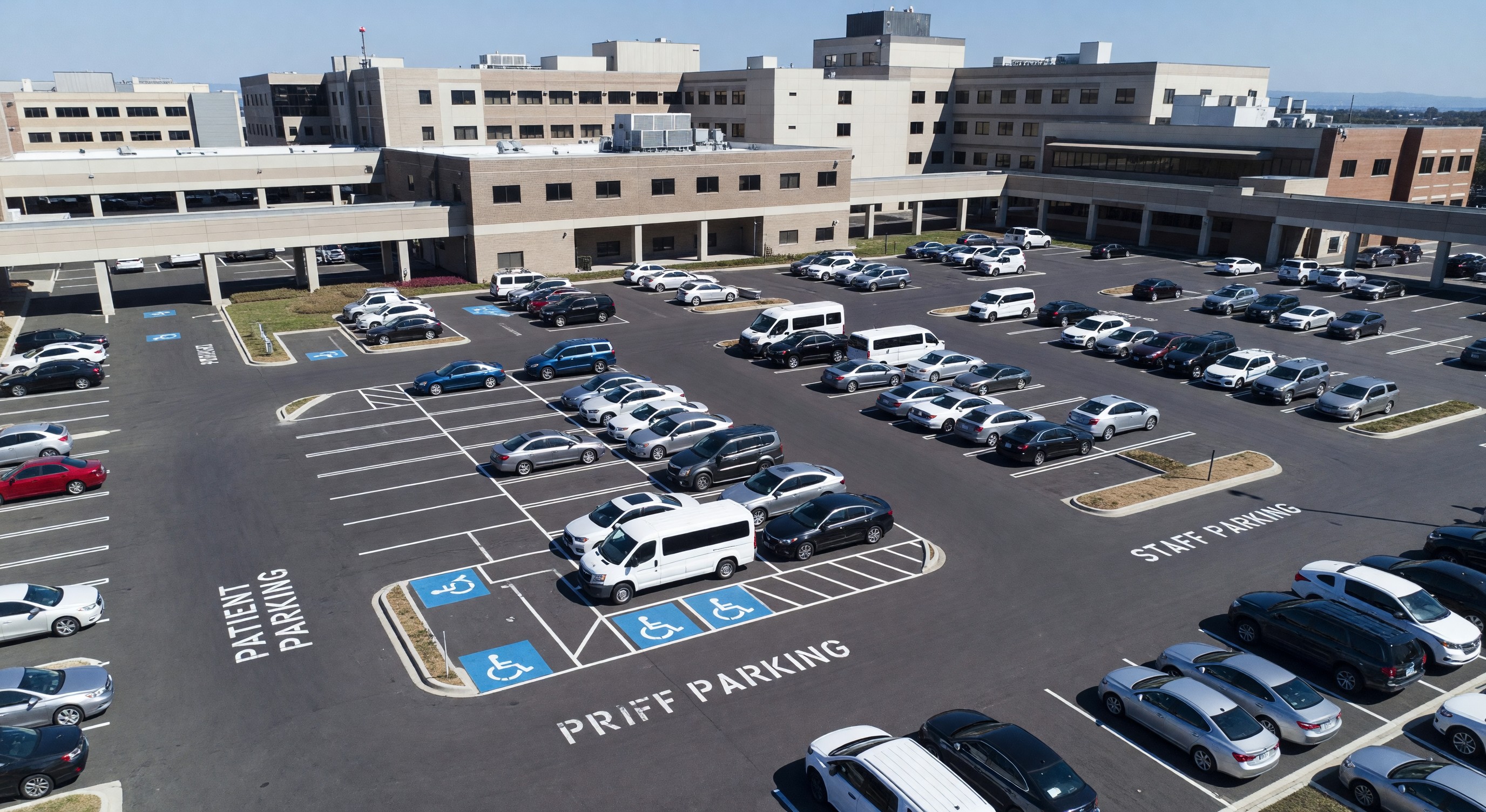
Hospital parking is often the first and last touchpoint a patient has with your facility. Before they meet a nurse, before they check in at the front desk, before they receive a single moment of care — they park. That experience sets the emotional tone for everything that follows.
For facility directors and VP-level operations leaders, parking management is not simply a logistics function. It is a patient experience function, a revenue function, and increasingly, a technology function that intersects with access control, wayfinding, and capital planning.
Why Hospital Parking Deserves Strategic Attention
Many healthcare organizations underinvest in parking infrastructure relative to its operational and reputational impact. Consider the data: patient satisfaction surveys consistently list parking difficulty among the top five complaints at urban and suburban hospitals. Delayed arrival caused by parking confusion contributes to appointment no-shows. Staff parking inadequacy drives turnover at a time when healthcare faces historic workforce shortages.
At the same time, parking can be a meaningful revenue center. A 500-space facility with thoughtful rate structures and enforcement generates hundreds of thousands of dollars annually — funds that can offset operating costs or fund capital improvements.
Core Operational Zones in a Hospital Parking System
Effective hospital parking divides supply into clearly defined operational zones:
Patient and Visitor Parking should be closest to main entrances, emergency departments, and specialty care clinics. Time limits or validation programs reduce long-term occupancy by non-patients. Signage must meet ADA requirements and be legible at a distance.
Employee Parking is typically assigned to surface lots or upper deck levels farther from entrances. Permit systems, tiered by department or seniority, are common. Some facilities have moved to dynamic allocation — pooling spaces and using license plate recognition to enforce reserved zones only during peak hours.
Physician and Medical Staff Parking often requires dedicated, gated areas with 24/7 access. These physicians are generating significant revenue for the facility and expect frictionless access at any hour.
Emergency Department Adjacency demands special consideration. Short-term drop-off lanes, clearly marked ambulance bays, and quick turnover in the nearest patient spaces reduce friction during high-stress visits.
The Role of Entry Systems and Pay Stations
The entry and exit experience defines the operational tempo of any parking facility. Barrier gates, pay stations, and the software connecting them must work together with minimal downtime.
Modern hospital parking entry systems support PARCS (Parking Access and Revenue Control Systems) that integrate with validation workflows, staff permit databases, and visitor time tracking. When evaluating entry hardware, facility directors should assess:
- Transaction speed: A gate that takes more than five seconds to cycle degrades throughput and causes backup during shift changes
- Offline resilience: Systems must function if network connectivity is disrupted
- ADA compliance: Pay stations must meet height, reach range, and audio requirements under ADA Standards for Accessible Design
- Weather durability: Equipment rated for your region’s temperature extremes reduces maintenance calls
Barrier gate systems designed for healthcare campuses offer the durability and integration capabilities that high-volume hospital environments demand, including fail-safe open modes for emergency situations and remote management capabilities.
Validation and Wayfinding Integration
Parking validation — whether paper ticket, barcode, QR code, or license plate — must be tightly integrated with your entry/exit hardware. Many facilities now offer validation at lobby kiosks, pharmacy counters, or via mobile app, reducing patient frustration at exit lanes.
Wayfinding begins before a patient enters the facility. Digital signage on approach roads, real-time space availability on parking structure displays, and mobile navigation integration all reduce circling and late arrivals. Some systems now push space-availability data directly to Google Maps and Apple Maps for patients navigating in.
Financial Modeling: Rates, Validation, and Cost Recovery
Parking rate structures in healthcare settings follow several models:
- Flat hourly rate — simplest to administer, least optimal for revenue
- Tiered daily maximums — rewards shorter visits, commonly used in outpatient settings
- Monthly permits — provides revenue predictability for employee zones
- Validation subsidies — discounts for patients, funded by clinical departments or donor programs
Cost recovery analysis should include equipment amortization, software licensing, staffing (if attended), maintenance contracts, and revenue from fines or citations. Many facilities find that automated, unattended operations reduce annual personnel costs by $80,000–$120,000 compared to staffed booths.
COVID-19 Impact on Hospital Parking (2020)
The COVID-19 pandemic created immediate operational disruptions in hospital parking. Visitor restrictions reduced daily volumes by 40–70% at many facilities during peak lockdown periods, eliminating a significant revenue stream. Simultaneously, screening tents and testing sites were erected in surface lots, consuming parking supply.
Contactless payment became an urgent priority. Facilities that had not yet deployed touch-free payment options scrambled to add tap-to-pay and QR code scanning at pay stations. The pandemic accelerated a technology transition that had been gradual — facilities that had deferred investment found themselves behind.
Access controls for COVID-19 screening zones required rapid reconfiguration of existing barrier gate infrastructure, including new lanes and credential management for screening personnel.
Planning for Capital Replacement
Most parking equipment has a useful life of 7–12 years depending on volume and environment. Hospital facility directors should maintain a capital replacement schedule that accounts for:
- Gate arm and barrier mechanisms (highest wear items)
- Pay station hardware and PCI compliance cycles
- PARCS software version currency
- Lighting systems and electrical infrastructure in structures
- Surface resurfacing cycles for asphalt lots
Deferred maintenance on parking infrastructure compounds quickly. A single inoperative lane at a busy entry point can cause 20-minute backups during shift change — a visible failure that affects staff morale and patient perception simultaneously.
Frequently Asked Questions
What is the optimal ratio of parking spaces to hospital beds? Industry benchmarks suggest 3–4 spaces per licensed bed for general acute care facilities, though this varies significantly by urban density, transit access, and outpatient volume. Ambulatory surgery centers may need 5–6 spaces per procedure room given the shorter visit duration and higher throughput.
How should we handle overflow parking during peak events? Develop written overflow protocols before you need them. Pre-identify adjacent lots or structures, negotiate shared-use agreements, and deploy signage and staff or traffic control officers in advance for planned high-volume days such as joint commission surveys or mass casualty training exercises.
What payment methods should hospital pay stations support? At minimum: credit and debit cards with chip and tap, and mobile payment (Apple Pay/Google Pay). QR code scanning for validation tickets and license plate recognition exit are rapidly becoming standard. Cash acceptance remains important for equity in many markets — review your patient population demographics before eliminating cash lanes.
How do we manage parking for patients receiving ongoing treatment such as chemotherapy or dialysis? Many facilities offer monthly or per-visit parking passes at reduced rates for patients in extended treatment programs. These are often administered through the clinical department and integrated with patient records. Communicate these programs proactively — a patient managing a serious illness should not face parking stress on top of their medical burden.