License plate recognition (LPR) technology has moved from law enforcement application to mainstream parking operations infrastructure. In hospital settings, LPR cameras at entry and exit points enable ticketless parking, frictionless permit verification, automated enforcement, and a detailed transaction record that supports both operational management and security investigations.
For hospital parking directors evaluating LPR as part of a PARCS upgrade or new installation, understanding both the capabilities and the operational requirements of LPR-integrated systems ensures realistic implementation expectations.
How LPR Works in Parking Applications
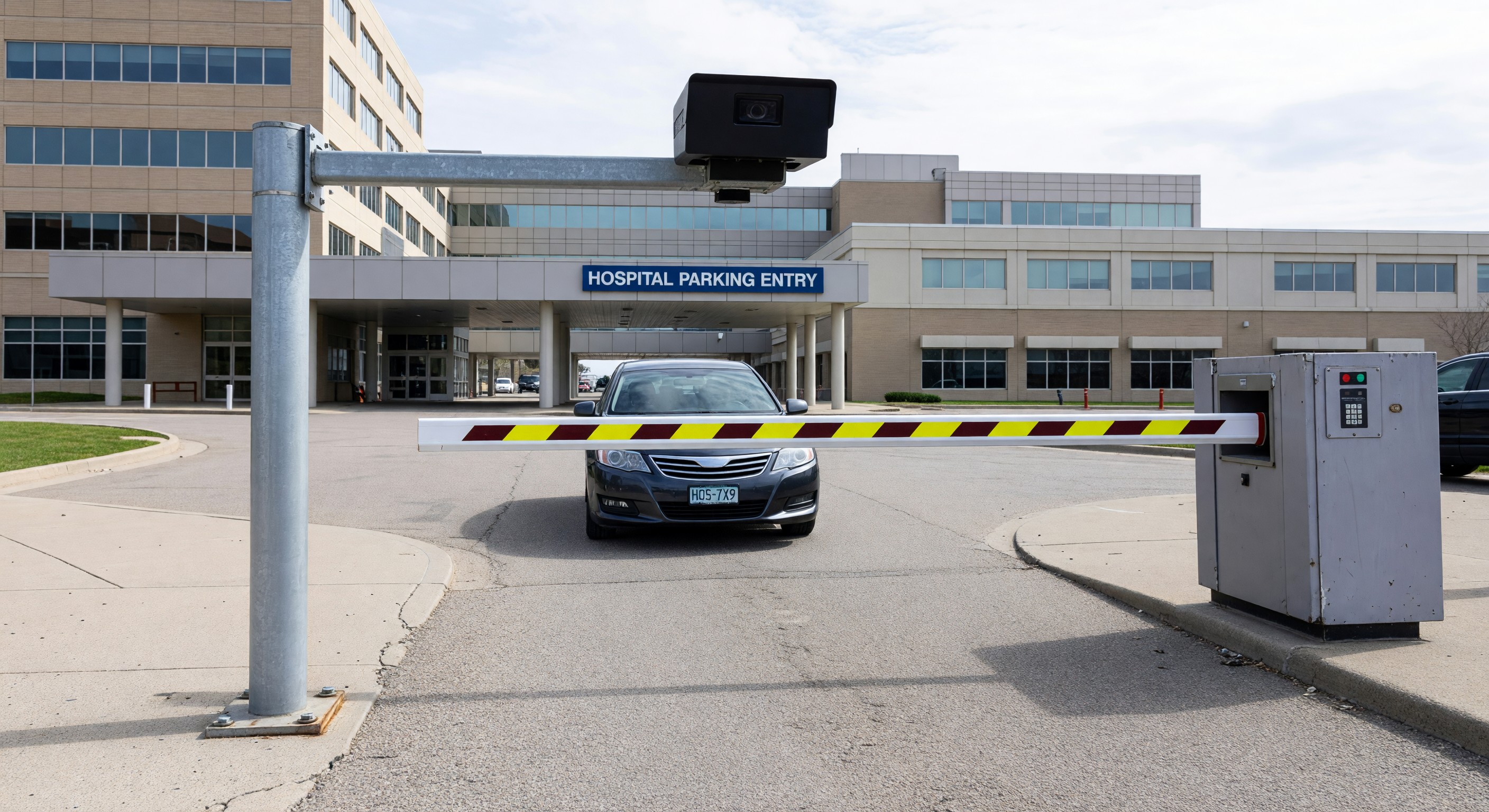
LPR systems use cameras mounted at entry and exit points (or at overhead positions within parking areas) to capture vehicle images, extract the license plate alphanumeric characters using optical character recognition (OCR), and compare the plate against databases to determine the appropriate response.
At entry: The system reads the plate, checks it against the permit database. A valid permit holder receives automatic gate opening without stopping or presenting a credential. A transient visitor is assigned a virtual “ticket” — their plate number becomes the entry record, allowing ticketless parking where payment occurs at pay-on-foot kiosks or via license plate at exit.
At exit: The system reads the plate, retrieves the transaction record (entry time, permit status, validation applied), calculates the fee if applicable, and opens the gate. For permit holders, the gate opens automatically. For transient visitors who prepaid at a kiosk, the gate opens upon plate recognition.
Within the facility: Overhead LPR cameras positioned throughout a parking structure can locate specific vehicles by plate number — useful for security investigations, customer assistance, and enforcement.
Benefits in Hospital Parking Operations
Permit management simplification — LPR eliminates the need for physical permit stickers or hang tags. Employees register their plate numbers in the permit management portal; the system recognizes their vehicle automatically at entry. New vehicles can be added by the employee, within defined limits. Lost or stolen permit concerns are eliminated.
Throughput improvement — LPR entry processing is faster than traditional ticket-dispensing entry for permit holders, who simply approach and receive gate opening within seconds. This is particularly valuable at shift-change entry peaks.
Frictionless exit for validated transients — Patients who received QR code validation at a clinical kiosk can complete their exit simply by driving to the exit lane and having their plate read. No ticket to present, no kiosk interaction — the system matches the plate to the validated transaction and opens the gate.
Enforcement improvement — LPR cameras can continuously scan plates within the facility and flag vehicles that are not permitted for a zone, vehicles that have exceeded time limits, or vehicles that entered without a valid transaction. This automated enforcement is more consistent than manual patrol and generates documented enforcement records.
Security record — LPR creates a timestamped visual and plate record of every vehicle entering and exiting the facility. This record supports investigations of theft, accidents, suspicious vehicle reports, and visitor identification needs.
Integration Requirements
LPR value is fully realized only when the camera system is integrated with the PARCS management software, permit database, validation system, and if relevant, the security camera system.
PARCS integration — The LPR system must communicate with the PARCS software in real time, querying the permit database for each plate read and returning the gate-open decision within a fraction of a second. Any communication latency causes driver hesitation and throughput degradation.
Validation integration — When a patient validates their parking in a clinical department system, that validation must be associated with a plate number (entered by the patient or provided by a pre-registration system) so that LPR can apply the validation at exit.
Permit portal — Employees need a self-service portal to register plate numbers, update vehicle information (rental car, new vehicle), and manage vehicle limits. This portal must feed the LPR permit database in real time.
Audit trail — All LPR events — plates read, gate decisions, exceptions — should be logged with timestamps in a searchable database retained for at least 90 days.
Accuracy and Error Management
LPR accuracy in hospital parking applications is typically 95–99% under good lighting and camera positioning conditions. Causes of read failures include:
- Temporary obscuring of the plate (dirt, snow, rack-mounted equipment, obscured plate position on some vehicles)
- Non-standard plate formats (some states, certain specialty plates)
- Poor lighting conditions (low-angle sun, nighttime glare)
- Camera positioning not optimized for the vehicle approach angle
Error handling must be designed into the system. Common approaches:
- An intercom at the entry or exit lane allows a missed-read driver to speak with a remote operator who can manually verify the plate and open the gate
- A fallback to traditional ticket or card transaction for vehicles that cannot be read
- Real-time monitoring alerts when read rates drop below thresholds (possible camera issue)
Privacy and Data Governance
License plate data is personal data under various state privacy regulations. A hospital’s collection of patient vehicle information through LPR may implicate healthcare privacy considerations if that information can be connected to patient visit records.
Governance requirements to address:
- Data retention policies (how long LPR records are retained)
- Access controls (who can query LPR records, under what conditions)
- Data sharing limitations (LPR data should not be shared with third parties without appropriate legal basis)
- Patient notification (consider whether LPR data collection should be disclosed in patient parking communications)
Work with your privacy officer and legal counsel to develop appropriate data governance for LPR before deployment.
Frequently Asked Questions
What happens if an employee has multiple vehicles (personal car, spouse’s car, rental)? Permit management systems typically allow employees to register 2–3 vehicles under a single permit record. For rental vehicles, most systems allow a temporary plate registration that expires after a defined period. The employee portal should make managing multiple vehicles straightforward.
Can LPR support enforcement of zone-specific restrictions (patient-only zones)? Yes — zone enforcement is one of the strongest LPR use cases for hospitals. Overhead or wall-mounted LPR cameras in patient-only parking zones scan for vehicles with staff permits and generate enforcement alerts. This is more effective and less confrontational than manual patrol enforcement, which often catches violations hours after they occur.
How does LPR perform in cold climates where plates may be obscured by snow? Snow and ice on license plates are significant accuracy challenges in cold climates. Infrared-capable cameras with heated housings perform better in cold conditions. Some facilities add a human verification step at entry during severe winter conditions. Driver communication (signage reminding drivers to keep plates clear) helps. LPR is generally not a complete substitute for traditional ticketed systems in climates with severe winter weather — it works best as the primary method with fallback alternatives.
What is the typical capital cost of an LPR system for a hospital parking facility? LPR camera and software costs vary significantly by vendor, configuration, and integration scope. A basic LPR entry/exit implementation for a single facility ranges from $15,000–$50,000 in camera and software licensing, plus installation. Integration with an existing PARCS system adds development cost that varies by the PARCS vendor’s API openness. Comprehensive campus-wide LPR with internal enforcement cameras can range from $100,000–$400,000+ depending on the number of access points and internal scan coverage desired.