Electric vehicle adoption has reached an inflection point. By 2022, EVs represented a meaningful and growing share of new vehicle sales, and hospital parking operations that had not yet developed EV charging strategies were beginning to face daily complaints from staff and patients who could not charge on campus.
For healthcare facility directors, EV charging is a capital planning, utility management, and patient/staff experience question that will only grow in significance. Getting ahead of the demand curve — rather than reacting to it — positions the facility as a progressive employer and healthcare provider while avoiding the premium costs of reactive, piecemeal charging installation.
The EV Demand Trajectory in Healthcare Settings
Healthcare worker populations have higher-than-average EV adoption rates in many markets. Healthcare professionals tend to have higher educational attainment, higher disposable income, and stronger environmental values than the general workforce — all factors associated with early EV adoption.
In 2022, a hospital system with 3,000 employees might have 200–400 EV-driving employees. By 2026–2027, that number may exceed 600–800 as EV prices decline and model availability broadens. The charging infrastructure question is not whether to invest, but when and how.
Patient and visitor EV demand is also growing. Patients receiving recurring outpatient treatment (oncology, dialysis, physical therapy) who own EVs will specifically notice whether the hospital provides charging during their multi-hour visits. This becomes a differentiating patient experience factor in competitive healthcare markets.
Infrastructure Tiers and Technology
EV charging equipment is available at three levels:
Level 1 (120V, 1.4 kW) — Standard household outlet charging. Adds approximately 4–5 miles of range per hour. Useful only for overnight or extended parking. Generally not appropriate for a hospital parking setting where vehicles may park for 8–12 hours at most.
Level 2 (240V, 6.2–19.2 kW) — The standard for workplace and destination charging. Adds 15–60 miles of range per hour depending on the charger power rating and vehicle acceptance rate. An 8-hour hospital parking stay can add 120–480 miles of range — sufficient to fully charge most EVs from a significantly depleted state.
DC Fast Charging (Level 3, 50–350 kW) — Ultra-fast charging that adds 100+ miles of range in 20–30 minutes. Appropriate for high-turnover public access locations but not typically necessary for hospital workplace or patient charging programs where vehicles are parked for longer periods. Higher capital and electrical infrastructure cost.
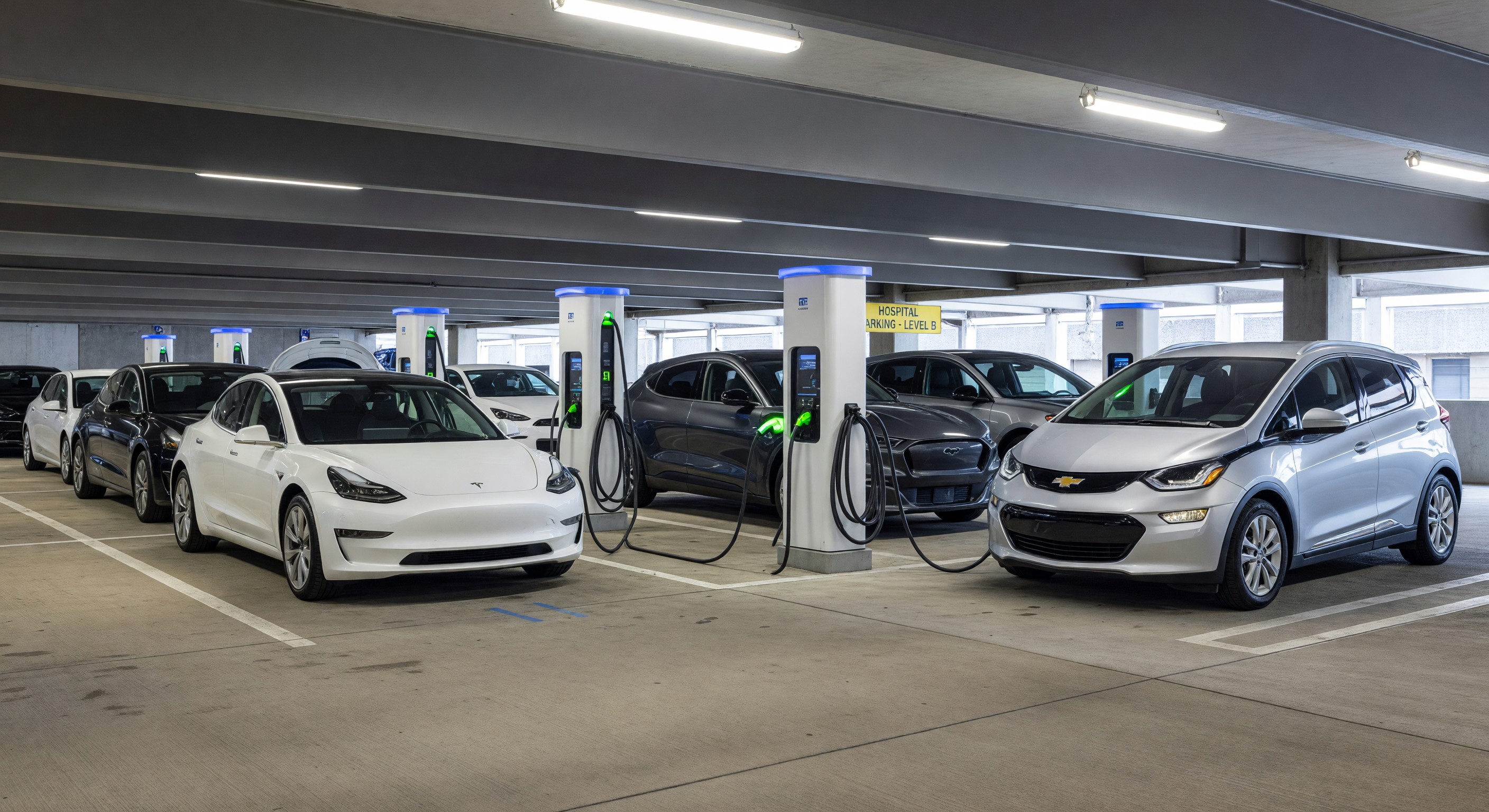
Most hospital EV charging deployments start with Level 2 at 7.2 kW or 11.2 kW — sufficient for staff who park for a full shift and for patients receiving extended treatments.
Electrical Infrastructure Planning
EV charging is a significant electrical load. Planning the electrical infrastructure to support EV charging is where facility directors and electrical engineers must engage early.
Load calculations — A 20-station Level 2 installation at 11.2 kW per charger represents 224 kW of connected load. Add to this the demand from other building systems to ensure the service entrance and distribution equipment can support the total load.
Smart charging and load management — Rather than providing the full rated power to every charger simultaneously (which would require very large service upgrades), smart charging systems manage the total load across the charger network — distributing available amperage across connected vehicles based on defined priorities. A fleet of 40 chargers might operate on 100 kW of controlled load rather than 400 kW of connected load, dramatically reducing infrastructure requirements.
Conduit and panel capacity (make-ready) — One of the most cost-effective EV infrastructure strategies is installing conduit, electrical panels, and infrastructure in excess of current charger count — creating capacity for future expansion without demolishing finished surfaces. Running conduit to 100 charger locations while installing 20 chargers today costs a fraction of expanding to 100 chargers later through retrospective installation.
Utility tariff considerations — High-power EV charging can trigger demand charges on commercial utility tariffs. Review your utility rate structure with your energy manager before sizing charger power levels. In some cases, lower-power (slower) chargers result in lower total operating cost due to demand charge avoidance.
Staff Charging Programs
Staff EV charging programs require policy decisions:
Free vs. fee-based — Providing free employee EV charging is a recruiting and retention benefit. Fee-based charging recovers electricity cost but may undercut the benefit value. Many hospitals offer free or subsidized charging as a formalized employee benefit, particularly in competitive labor markets.
Reservation systems — Popular charger stations will be oversubscribed. A reservation or time-limit policy ensures turnover and equity of access. Mobile app or kiosk-based reservation systems integrated with the charger network are available from all major EVSE vendors.
Priority policies — Some facilities prioritize charging access by permit tier (medical staff first, then nursing, then support staff) while others use first-come, first-served. Transparent policy prevents conflict.
Patient and Visitor EV Charging
Patient-facing EV charging should be positioned prominently near patient parking entrances, with clear signage from approach roads. Key considerations:
Pricing — Patient charging should be reasonably priced and clearly communicated. Free or nominally priced charging (enough to cover electricity cost) is more patient-friendly than commercial retail rates.
Time limits — Patient-facing chargers in spaces with time limits should have charger time limits that align with typical visit duration. A 4-hour charger limit in a 4-hour patient parking zone makes sense; a 2-hour limit in a space where oncology patients park for 6 hours does not.
ADA accessible EV spaces — ADA accessible EV charging spaces require the same accessibility provisions as standard accessible parking plus the accessible route to the charger equipment. The EVCS must also meet ADA reach range and operability requirements.
Frequently Asked Questions
How many EV chargers should we install to meet current demand? As a starting benchmark, plan for 1 charger per 10–15 EV-owning employees based on your current EV employee population estimate, plus patient/visitor chargers at 1–2% of patient-facing parking spaces. Design infrastructure for 3–5x this initial count to support future growth.
What is the capital cost of an EV charging installation? Level 2 charger hardware ranges from $500–$3,000 per charger (single-port) to $3,000–$8,000 (dual-port commercial). Installation costs are highly variable: $2,000–$5,000 per charger in a parking structure with nearby electrical infrastructure; $5,000–$15,000+ per charger when significant trenching or electrical panel upgrades are required. Federal tax credits (30C Business Energy Investment Tax Credit) and utility rebates can reduce net cost substantially.
What network management platform should we use? The major EVSE network platforms (ChargePoint, Blink, Tesla, EV Connect, and others) offer fleet management dashboards, usage reporting, billing capability, and smart charging load management. Evaluate platforms based on: API openness (for integration with parking management systems), reliability record, healthcare customer references, support quality, and total cost of ownership including per-station software fees.
Can EV chargers be integrated with our solar energy generation? Yes — this combination is increasingly common. Solar carport structures over hospital parking areas simultaneously provide shade (valued by patients and staff) and generate renewable electricity that can directly supply EV chargers through smart energy management. The combination typically has a payback period of 7–12 years without incentives, shorter with available federal and state incentives.