Artificial intelligence is moving from hospital clinical systems into facility operations, and parking management is an early beneficiary. Healthcare campuses—with their complex mix of patients, visitors, staff, and vendors arriving across multiple shifts—present exactly the kind of dynamic, high-volume problem that AI-powered systems are designed to solve.
For facility directors managing multiple parking structures and surface lots across a large campus, AI-assisted parking management offers something genuinely new: the ability to anticipate demand rather than react to it.
What AI Actually Does in Parking Management
The term “AI” covers a range of capabilities in the parking management context. Understanding what current systems can actually do helps facility directors evaluate vendor claims and set realistic expectations.
Machine Learning for Demand Forecasting The most mature AI application in healthcare parking is demand forecasting. By training on historical occupancy data, appointment volumes, shift schedules, weather, and calendar patterns, machine learning models can predict parking demand with meaningful accuracy 24–72 hours out. Hospitals using these systems can pre-position messaging—alerting staff to expected congestion before it develops and directing early arrivals to overflow lots when primary structures are predicted to fill.
Computer Vision for Occupancy and Enforcement Camera systems equipped with computer vision can count vehicles, track occupancy in real time, and—increasingly—identify permit violations by cross-referencing license plates against permit databases. Systems trained on large datasets can distinguish vehicle types, flag ambulance bay encroachments, and alert security to vehicles parked in fire lanes without requiring a human to monitor camera feeds.
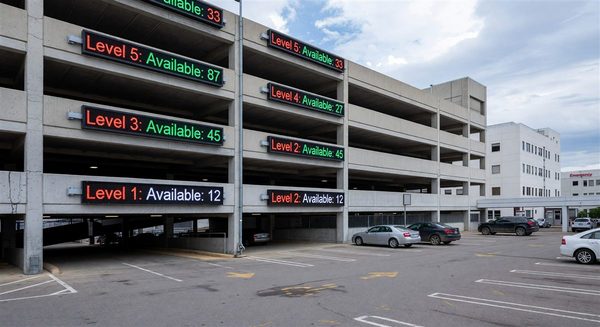
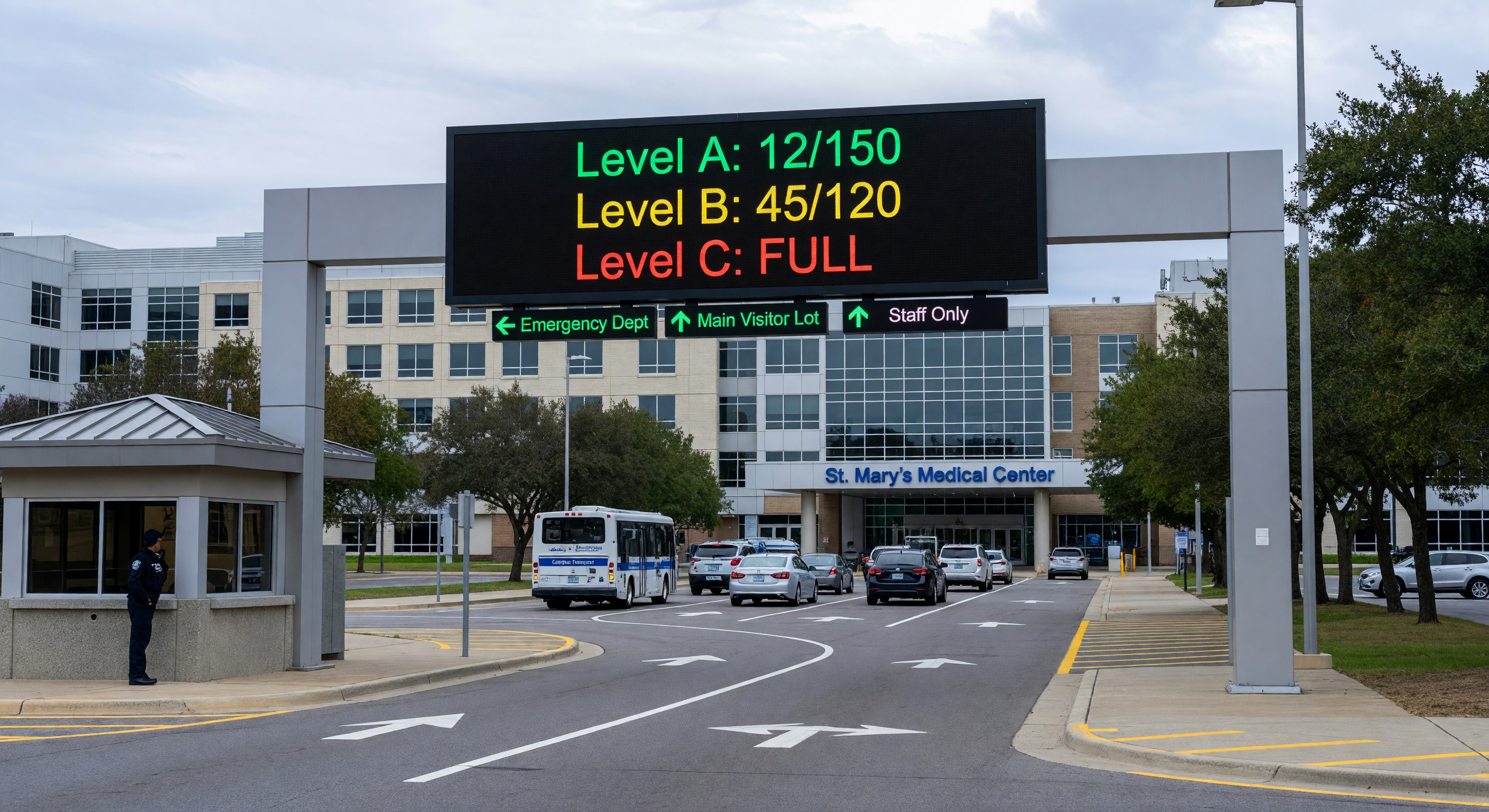
Dynamic Routing and Guidance AI-enhanced wayfinding systems update parking guidance in real time based on occupancy data, routing incoming traffic to the most appropriate available area. Unlike static signage, these systems adjust guidance every few minutes as conditions change, preventing the “full lot, no alternate” failures that create congestion at hospital campus entrances.
Predictive Maintenance for Parking Infrastructure Gate arms, ticket dispensers, payment kiosks, and elevator systems within parking structures all generate operational data. AI-driven maintenance platforms analyze this data to predict equipment failures before they occur—scheduling preventive service during low-demand windows rather than responding to breakdowns during peak hours.
Integration with Hospital Operations Systems
AI parking management delivers its greatest value when integrated with existing hospital operational systems rather than operating as a standalone platform.
Appointment System Integration When the parking management platform can access (or receive a feed from) the hospital scheduling system, demand forecasting becomes significantly more accurate. A day with 40 scheduled surgical procedures has different parking implications than a day with 80 outpatient clinic appointments, even if total patient volume is similar. Procedure duration, post-op recovery time, and visitor patterns vary by service line in predictable ways.
HR and Payroll Integration for Staff Permit Management AI-assisted permit management systems that integrate with HR can automatically suspend permits for employees on extended leave, flag permit holders who haven’t accessed their lots in 90+ days, and dynamically reallocate spaces as staffing patterns change. This addresses the chronic problem of “phantom permits”—allocated spaces that go unused because the permit holder has left the organization or changed commuting behavior.
Shuttle and Transit Coordination For large academic medical centers operating remote parking facilities with shuttle service, AI scheduling can optimize shuttle dispatch based on real-time demand signals from parking structures. Rather than running fixed shuttle routes on fixed schedules, dynamic dispatch sends shuttles when and where demand warrants.
LPR Systems as the AI Foundation
License plate recognition (LPR) technology is increasingly the operational foundation for AI-driven parking management. Modern LPR cameras capture plates at entry and exit points with accuracy rates above 98%, creating a continuous data stream that enables multiple downstream AI applications:
- Automated permit verification without physical gate arm interaction
- Session duration tracking without ticketing hardware
- Fraud detection identifying vehicles sharing permit credentials
- Occupancy counting for lots without per-space sensors
- Historical pattern analysis for demand forecasting model training
The combination of LPR infrastructure and AI analytics is enabling some healthcare systems to operate parking facilities with significantly reduced staffing—replacing manual booth attendants with automated kiosks backed by remote customer service centers for exception handling.
Patient Experience Implications
For patients arriving at healthcare facilities, the parking experience sets the tone for their entire visit. AI-driven parking improvements that patients notice include:
Pre-Arrival Guidance Hospitals can push real-time parking availability information to patients via appointment reminder apps, text messages, or website widgets. Patients who know which lot to use before they arrive experience measurably less stress and arrive at registration with fewer delays.
Reduced Search Time Computer vision-based parking guidance that shows available spaces in real time eliminates the frustrating “driving in circles” experience that patients associate with hospital parking. Research consistently shows that parking search time is a primary driver of negative first impressions.
Faster Entry and Exit AI-enabled touchless entry and LPR-based exit—where validated parking is automatically applied to a patient’s account—eliminates payment friction at the most congested points in the patient journey: arrival before appointments and departure after treatment.
Implementation Realities for Facility Directors
Deploying AI-assisted parking management on a healthcare campus is not a plug-and-play project. Facility directors should expect:
Infrastructure Assessment First AI parking systems require camera infrastructure, reliable network connectivity throughout parking structures, and integration-capable PARCS equipment. Older facilities may need significant infrastructure investment before AI software can be deployed effectively.
Data Quality Before AI Accuracy Machine learning models are only as good as the data they’re trained on. Systems with inconsistent historical data, incomplete occupancy records, or poorly maintained permit databases will produce unreliable AI outputs. A data audit should precede any AI deployment.
Phased Rollout Most successful AI parking implementations start with a single high-volume structure or lot—deploying sensors, LPR, and the analytics platform—before expanding campus-wide. This allows the team to learn the system, validate forecast accuracy, and build stakeholder confidence before committing to full-scale deployment.
Vendor Selection Criteria Healthcare-specific parking technology vendors understand the unique operational requirements of hospital campuses: 24/7 operation, ADA compliance, integration with clinical systems, and security requirements for patient data. General commercial parking technology vendors may not have experience navigating HIPAA-adjacent data handling requirements or the complexity of multi-structure hospital campus operations.
Leading parking equipment manufacturers offer healthcare-grade access control solutions designed for hospital traffic volumes, with barrier gate systems built for high-cycle environments and integrated LPR and PARCS compatibility.
Frequently Asked Questions
Is AI parking management cost-effective for smaller hospitals and medical centers? AI parking management has historically been deployed at large academic medical centers with thousands of spaces. Smaller facilities are now gaining access through cloud-based SaaS platforms that offer analytics and forecasting tools without requiring on-premises server infrastructure, making the economics more accessible. Facilities with as few as 300–500 spaces can often justify a basic implementation.
How does AI parking handle emergency situations like mass casualty events? Well-designed AI parking platforms include manual override capabilities that allow facility managers or security teams to immediately redirect all guidance messaging, open all controlled access points, or implement emergency access protocols. AI-driven systems should always have human override capability for emergency situations.
What’s the accuracy of AI demand forecasting for hospital parking? Mature implementations with 12+ months of training data typically achieve demand forecast accuracy within 10–15% for 24-hour predictions and within 20–25% for 48–72 hour predictions. Accuracy improves over time as the model accumulates more data and learns facility-specific patterns.
Does AI parking management create privacy concerns with license plate data? LPR systems collect vehicle identification data, and healthcare facilities must establish clear data governance policies covering retention periods, access controls, and data sharing restrictions. Most healthcare organizations apply conservative data retention policies—typically 30–90 days for transaction records—and ensure LPR data is stored in systems separate from clinical data with appropriate access restrictions.