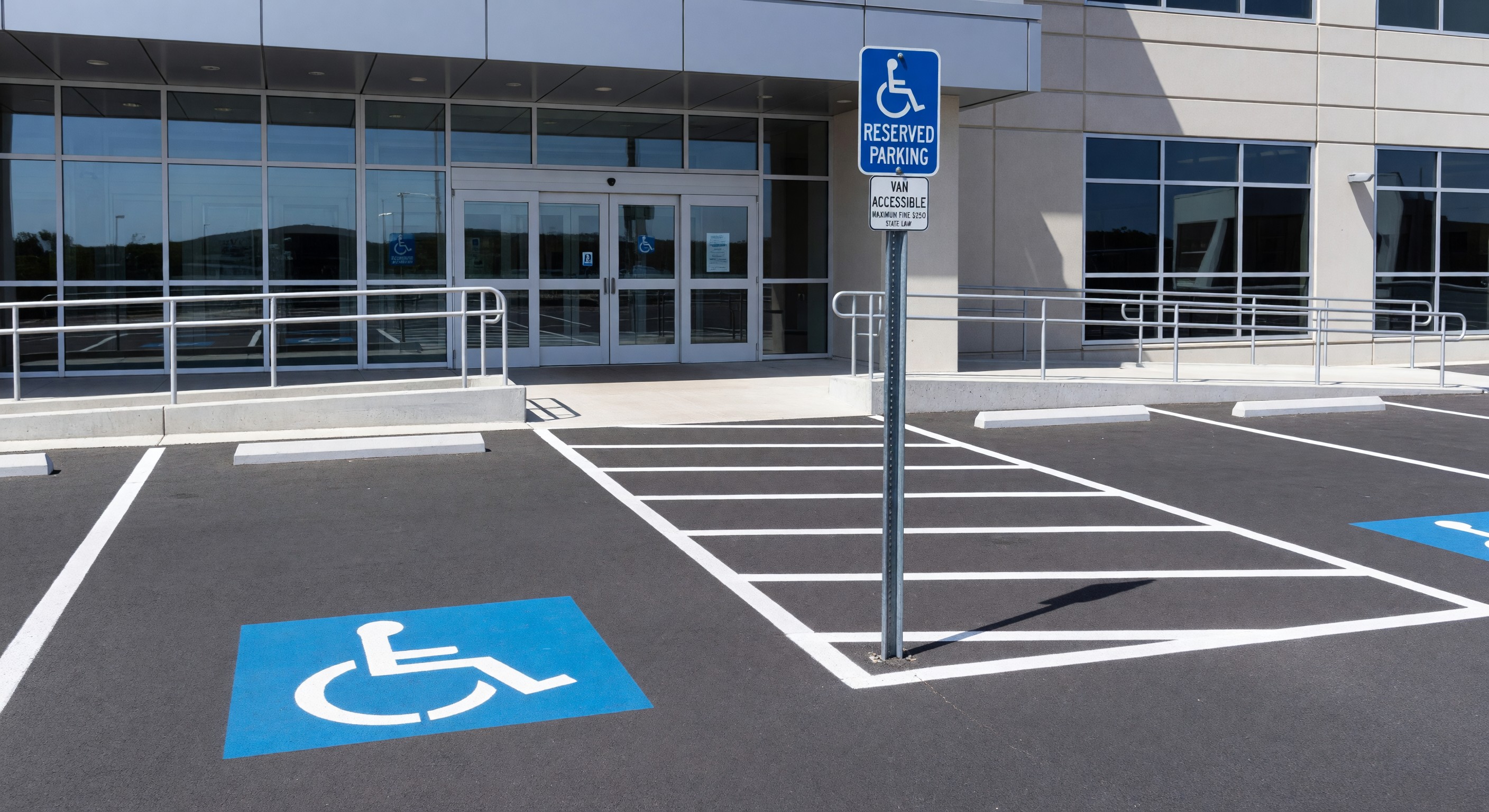
No area of hospital parking generates more compliance risk or patient relations challenges than accessible parking. The Americans with Disabilities Act Standards for Accessible Design establish clear requirements for the number, location, design, and signage of accessible parking spaces—but healthcare facilities face additional practical obligations beyond the ADA minimum that reflect the population they serve.
For facility directors managing hospital parking, accessible parking compliance is not a static box to check. It requires ongoing monitoring, periodic reassessment as facility footprints change, and a patient-centered approach to enforcement and accommodation.
ADA Accessible Parking Space Requirements
The ADA Standards for Accessible Design (2010 ADA Standards, Section 208) establish parking space requirements based on total lot capacity:
| Total Spaces in Lot | Required Accessible Spaces |
|---|---|
| 1–25 | 1 |
| 26–50 | 2 |
| 51–75 | 3 |
| 76–100 | 4 |
| 101–150 | 5 |
| 151–200 | 6 |
| 201–300 | 7 |
| 301–400 | 8 |
| 401–500 | 9 |
| 501–1,000 | 2% of total |
| Over 1,000 | 20 spaces plus 1 per 100 spaces over 1,000 |
Van-Accessible Spaces For every six required accessible spaces (or fraction thereof), at least one must be van-accessible. Van-accessible spaces require either:
- An 8-foot wide parking space plus an 8-foot wide adjacent access aisle (16 feet total width), or
- A 16-foot wide parking space with a 5-foot access aisle on the passenger side
Van-accessible spaces must be identified with signage that includes the “van accessible” designation in addition to the standard accessible space symbol.
Healthcare-Specific Accessibility Considerations
Healthcare facilities serving patients with diverse mobility limitations face practical accessibility demands that exceed ADA minimums.
Outpatient and Specialty Clinic Entrances Cancer centers, orthopedics clinics, cardiac rehabilitation facilities, and outpatient surgery centers serve patient populations with high rates of mobility impairment. The ADA requires accessible spaces on the most direct route to the accessible entrance, but facilities serving these populations should consider exceeding minimum counts near high-demand clinical entrances.
Emergency Department Parking Emergency department drop-off areas require careful design to accommodate patients arriving by personal vehicle in crisis conditions. Accessible drop-off zones adjacent to the ED entrance, clearly separated from ambulance bays, must meet ADA access aisle requirements and provide a continuous accessible route to the ED entrance.
Parking Structures Multi-level parking structures must provide accessible spaces at each level served by an accessible route, typically adjacent to elevators. The path from accessible spaces to the elevator must be free of level changes greater than 1/2 inch, with adequate turning radius for wheelchairs and mobility scooters.
Accessible Routes The ADA requires a continuous accessible route connecting accessible parking spaces to the accessible building entrance. Accessible routes must:
- Have a running slope no greater than 1:20 (5%)
- Have a cross slope no greater than 1:48 (2%)
- Be at least 36 inches wide (60 inches minimum when two wheelchairs must pass)
- Be free of protruding objects and surface discontinuities
- Not cross vehicular traffic lanes without a marked and signaled crossing
Curb ramps at all crossings within the accessible route are required. Healthcare campus grounds maintenance programs must include accessible route inspection to ensure that cracked pavement, heaved curb ramps, and drainage grates with gaps exceeding 1/2 inch are repaired promptly.
Payment System Accessibility
All parking payment systems—kiosks, pay-by-phone, validation machines—must be accessible to individuals with disabilities.
Kiosk ADA Requirements Pay stations must provide an accessible reach range: the operating controls must be between 15 and 48 inches above the ground for forward reach, or 15 and 46 inches for side reach. Accessible kiosks must be located on an accessible route adjacent to accessible parking spaces.
Audio output capability is required for visually impaired users. Healthcare parking payment systems should provide audible transaction prompts and confirmation.
Pay-by-Phone Alternatives Pay-by-phone systems are not an acceptable substitute for accessible kiosk access—they are a supplemental option. Healthcare facilities must maintain accessible physical kiosks regardless of mobile payment adoption levels.
Signage Requirements
ADA accessible parking signage must include:
- The International Symbol of Accessibility (ISA)
- “Van Accessible” designation on van-accessible spaces
- Signs mounted at least 60 inches above the ground (to the bottom of the sign) to remain visible when a vehicle is parked in the space
- Reserved parking designation language where applicable under state law
Many states impose additional signage requirements beyond federal ADA standards, including state fine amounts for unauthorized use. Healthcare facility parking teams should verify compliance with state-specific accessible parking signage requirements.
Enforcement of Accessible Parking Compliance
Unauthorized use of accessible parking spaces is a significant and persistent problem on hospital campuses. Healthcare facilities have both legal authority and ethical obligation to enforce accessible parking requirements.
Verification Standards State-issued accessible parking placards or license plates are the legal credential for accessible parking use. Enforcement staff should be trained to visually verify credential display—placard must be visible from outside the vehicle.
Reporting to Authorities In most states, accessible parking violations on private property (including hospital campuses) can be cited by law enforcement. Healthcare facilities should establish protocols for requesting law enforcement assistance for accessible parking enforcement, particularly for repeat violators.
Internal Citation Programs Hospital parking operations can also issue internal citations for accessible parking violations, typically with fine amounts that reflect the seriousness of the offense. These internal citations should be clearly documented and consistent in application.
Documentation and Self-Assessment
Healthcare facility parking teams should conduct periodic self-assessments of accessible parking compliance:
- Count and verify accessible space totals by lot against ADA requirements
- Walk accessible routes from parking to all major building entrances, noting any barriers
- Verify accessible route maintenance condition
- Test all payment kiosks for ADA reach range and audio accessibility compliance
- Photograph accessible space signage to document compliance
Documentation of self-assessments creates a compliance record that demonstrates good faith effort in the event of a complaint investigation or DOJ inquiry.
Responding to Accessibility Complaints
Healthcare organizations that receive accessible parking complaints—whether through the ADA complaint process, patient relations, or direct contact—should respond promptly and document their response. Key elements of an effective complaint response:
- Acknowledge receipt within 5 business days
- Assign a responsible contact for the complaint
- Conduct a site inspection to verify the reported condition
- Implement corrective action if a violation is confirmed
- Communicate the corrective action to the complainant
- Document the resolution
The DOJ and state ADA enforcement agencies look favorably on organizations with documented complaint response processes and demonstrated history of corrective action.
Frequently Asked Questions
Do ADA accessible parking requirements apply to leased parking facilities off-campus? Yes. When a healthcare organization provides parking for its patients and employees in a leased facility, ADA accessible parking requirements apply to the spaces available for that use. The obligation to provide accessible parking follows the healthcare organization’s control over the parking, not property ownership.
What’s the process for requesting a variance or alternative compliance approach for accessible parking? The ADA does not provide a formal variance process. However, the Department of Justice acknowledges that existing facilities may face architectural barriers that are not readily achievable to remove. Healthcare organizations facing genuine access barrier removal challenges should document the barrier, document the feasibility and cost analysis, and implement alternative accessible routes where removal is not readily achievable.
How often should healthcare facilities conduct ADA parking compliance audits? Annual audits are a best practice minimum. Facilities should also conduct interim audits after any construction or renovation project that modifies parking areas or accessible routes, and after any changes in parking lot configuration.
Are there additional accessible parking requirements under the Rehabilitation Act for hospitals receiving federal funding? Yes. Section 504 of the Rehabilitation Act applies to entities receiving federal financial assistance, which includes hospitals participating in Medicare and Medicaid. Section 504 requirements are generally parallel to ADA requirements, but the enforcement process differs—Section 504 complaints are directed to the relevant federal funding agency (HHS for hospitals), which can initiate compliance reviews and, ultimately, suspend federal funding for non-compliant organizations.