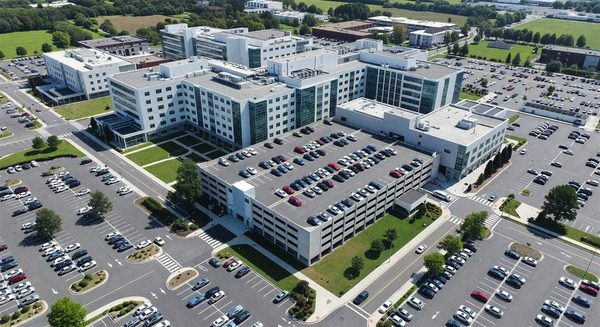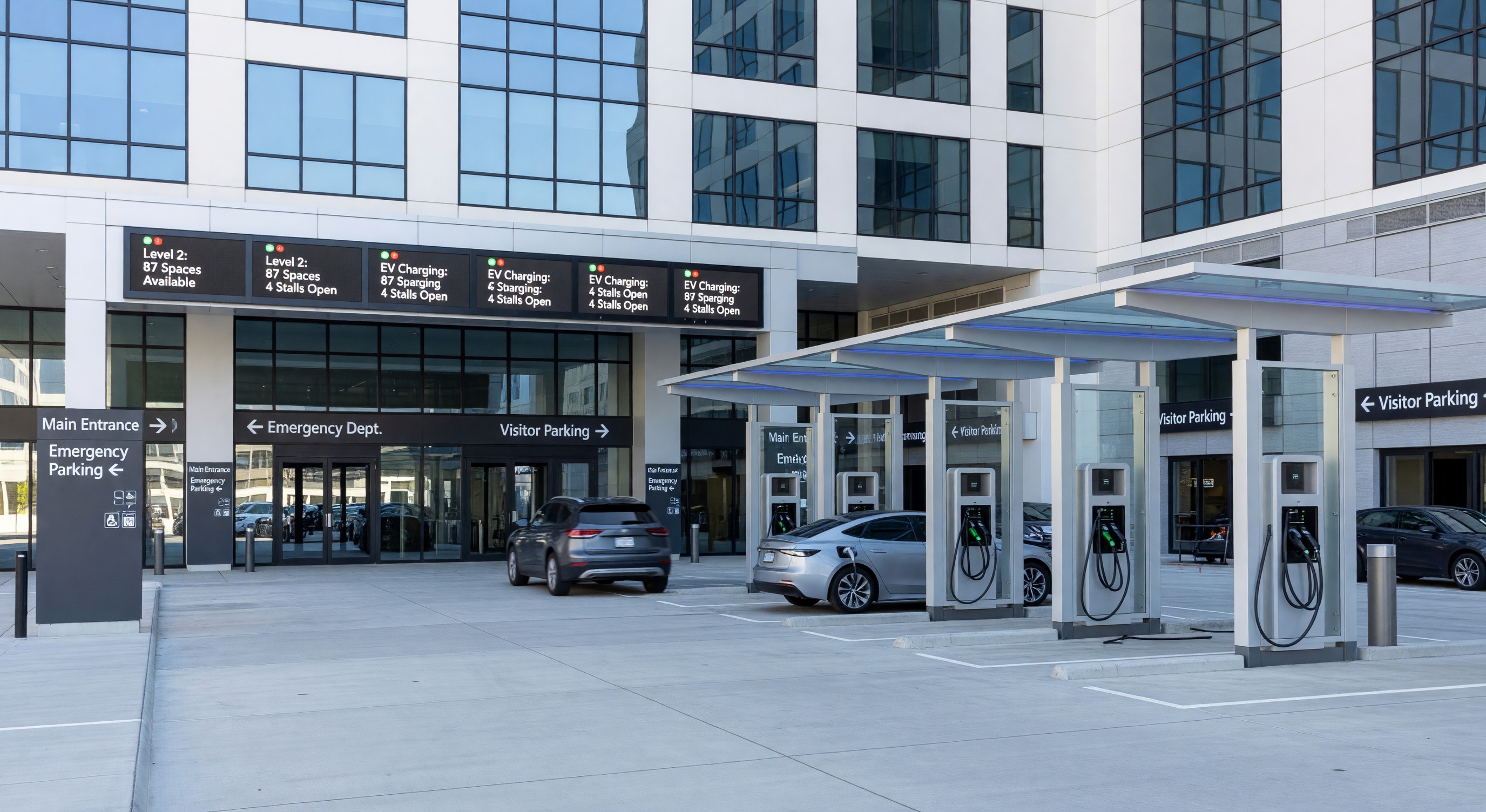
Hospital parking strategy in 2026 sits at an inflection point. The technology that was emerging three years ago—frictionless LPR entry, AI demand forecasting, mobile-first payment—has matured into deployable, proven systems. Meanwhile, new pressures are arriving: state EV charging mandates expanding beyond California, federal workplace violence prevention regulations affecting campus security design, and healthcare system consolidation creating multi-campus parking integration challenges that single-facility systems can’t address.
For facility directors planning capital budgets and operational strategies through fiscal year 2026 and beyond, several developments deserve specific planning attention.
EV Charging Infrastructure: From Optional to Mandatory
The regulatory landscape for EV charging in commercial parking has shifted decisively. States implementing EV charging requirements for new construction and major renovations now include California, Washington, Oregon, Colorado, New Jersey, Maryland, and Massachusetts, with additional states advancing legislation.
For healthcare organizations, this means:
New Construction Projects Must Budget for EV from the Start Any parking structure or major surface lot project breaking ground in 2026 in regulated states must include EV-ready conduit and circuit capacity at minimum, with a percentage of spaces requiring operational charging equipment. The specific requirements vary by state, but the direction of travel is consistent: EV readiness is no longer optional for new parking construction.
Retrofitting Existing Structures Is Becoming Urgent Healthcare systems that deferred EV charging decisions are now facing higher retrofit costs as electrical utility capacity upgrades become necessary. Organizations that acted earlier—installing conduit infrastructure during less disruptive periods—are finding retrofit much simpler and less expensive than those starting from scratch.
Managed Charging Is Essential at Scale As hospital campus EV charging scales to hundreds of ports across multiple structures, unmanaged charging creates utility demand charge problems. Managed charging platforms that control charge rates based on grid demand, time of day, and charging station priority allow facilities to support larger EV fleets without upgrading electrical service to the theoretical maximum draw of all stations running simultaneously.
Federal Workplace Violence Rule and Parking Security
OSHA’s workplace violence prevention final rule for healthcare settings, effective in phases through 2026, has implications that extend into parking and campus security design. The rule requires healthcare employers to develop and implement workplace violence prevention plans that address physical environment risk factors—including areas where employees may be at risk, which includes parking structures and surface lots.
Specific parking-related implications include:
Lighting Standards Parking areas serving employee lots must meet illumination standards that reduce assault risk during night and early morning shifts. Healthcare facilities should assess current parking lighting against IES RP-20 standards for healthcare facility parking and schedule upgrades where deficiencies exist.
Emergency Communication Coverage Emergency call stations in parking structures are not new, but the workplace violence rule’s focus on physical environment risk factors has renewed attention to whether call station density, functionality, and coverage actually meet the standard of providing “prompt emergency response” required by the rule.
Surveillance Coverage Camera coverage of parking areas—particularly employee parking structures and lots used during night shifts—is increasingly documented as part of workplace violence prevention plans. Healthcare organizations should audit current camera coverage and identify gaps before OSHA inspections begin under the new rule.
Multi-Campus Parking Integration
Healthcare system consolidation has accelerated dramatically, and many facility directors are now managing parking operations across multiple campuses with different legacy systems, different technology generations, and different operational cultures.
The parking management platform challenge in this environment is significant: how do you provide consistent patient and employee experience across campuses with different PARCS vendors, different gate systems, and different payment infrastructure?
The leading response in 2026 is centralized parking management platforms that can integrate across multiple technology environments through API-based connections. Rather than replacing all campus systems simultaneously—prohibitively expensive—these platforms create a unified management layer above existing infrastructure, providing:
- Centralized permit management across all campuses
- Unified analytics and reporting across the system
- System-wide LPR enforcement database
- Consistent patient-facing mobile payment experience regardless of which campus they visit
For healthcare systems navigating multi-campus integration, this represents a more achievable path than full system replacement while providing meaningful operational consistency.
Revenue Optimization in a Capital-Constrained Environment
Healthcare operating margins remain under pressure in 2026, and parking—often managed as an afterthought to clinical operations—is receiving new scrutiny as a revenue optimization opportunity.
Healthcare organization CFOs are increasingly asking facility directors to document parking revenue per space, compare it to industry benchmarks, and identify specific improvement opportunities. The most common findings from these analyses:
Validation Program Leakage Most hospital validation programs were designed generously—multiple departments with authority to issue full-day validations, limited oversight of validation usage patterns. Analytics applied to validation data typically reveals significant opportunities to tighten validation to clinically appropriate uses without affecting patient access.
Dynamic Pricing Underutilization Time-of-day and demand-based pricing has been proven effective at optimizing revenue across healthcare parking systems. Organizations still charging flat daily rates are leaving revenue on the table during peak demand periods while providing no incentive for visitors to use lower-demand lots.
Permit Pricing Below Market Employee permit pricing at many healthcare organizations hasn’t been updated to reflect current commuting costs or competitor parking rates. Annual permit pricing reviews—benchmarked against comparable local parking options—identify opportunities to adjust rates without creating employee relations problems.
Patient Experience Standards Are Raising the Bar
HCAHPS score linkage to reimbursement continues to create pressure on every patient touchpoint, including parking. Facilities where parking consistently generates complaints in patient satisfaction surveys are facing specific pressure to address the operational gaps driving those complaints.
In 2026, the patient experience bar for hospital parking includes:
- Real-time parking availability visible to patients before they arrive
- Clear wayfinding from arrival at campus to the specific entrance for their appointment
- No kiosk interaction required for standard patient parking (pay-by-phone or integrated billing)
- Accessible parking availability that reliably meets patient demand at peak periods
- Consistent enforcement that keeps patient spaces available for patients
Facilities meeting this standard are seeing parking-related patient satisfaction complaints drop to near zero. Facilities that haven’t invested in these capabilities continue to generate complaints that affect overall satisfaction scores.
Leading parking equipment manufacturers offer healthcare-grade access control solutions designed for hospital traffic volumes and the operational demands of healthcare campuses.
Frequently Asked Questions
What’s the most cost-effective starting point for hospital parking modernization in 2026? LPR infrastructure combined with a modern cloud-based PARCS management platform provides the highest return across multiple use cases simultaneously: LPR enables frictionless entry, automated enforcement, and the data foundation for analytics. Starting with LPR and platform modernization—rather than individual point solutions—creates an infrastructure foundation for subsequent improvements.
How should healthcare organizations approach the EV charging planning conversation with their electric utility? Early engagement with the utility is essential. A hospital planning significant EV charging expansion should contact their utility’s commercial accounts team 12–18 months before planned installation to understand service capacity, available rate structures, demand response program options, and utility incentive programs for EV infrastructure. Utilities in most service territories have specific commercial EV programs worth understanding before finalizing infrastructure designs.
Are there grant or funding programs available for hospital parking modernization in 2026? Federal funding for parking specifically is limited. However, EV charging infrastructure is supported through multiple programs including the IRA Alternative Fuel Vehicle Infrastructure tax credit (30% of installation cost, up to $100,000 per location) and state-level EV infrastructure grant programs in most states with EV mandates. Workplace violence prevention improvements may qualify for OSHA compliance assistance grants in some states.
What should healthcare facility directors communicate to their boards about parking capital investment? Board presentations on parking capital investment should frame parking in terms of patient experience (satisfaction score impact), revenue contribution (net revenue per space versus benchmark), regulatory compliance (OSHA workplace violence rule, ADA, state EV mandates), and deferred maintenance risk (structural repair costs that increase with deferral). This framing positions parking investment as strategic operational capital rather than a facilities maintenance expense.