Parking demand at healthcare facilities rarely decreases. Growing outpatient volumes, expanded service lines, increasing staff headcount, and the gradual shift toward car-dependent suburban campuses keep parking demand on a persistent upward trajectory. When existing capacity reaches its limits, facility directors face one of the most capital-intensive decisions in healthcare infrastructure: parking expansion.
Getting this decision right requires understanding not just how many spaces are needed, but which options are feasible on the specific campus, what the true demand picture looks like, and what alternatives to physical expansion might relieve pressure before committing to a multi-million-dollar structure.
Establishing the True Demand Baseline
Before any expansion planning begins, facility teams need an accurate picture of current demand—not estimates or guesses, but actual occupancy data across the full range of operating conditions.
A proper demand assessment covers:
- Peak occupancy by lot and time of day across a minimum 90-day period
- Seasonal variation (many hospitals see 15–20% higher parking demand during fall and winter)
- Occupancy distribution across shifts (night shift parking is frequently underutilized in lots designated for day operations)
- Permit allocation versus actual usage (phantom permits artificially inflate perceived need)
- Visitor versus employee mix by lot and time window
Many hospitals that commission this analysis discover that their stated “parking shortage” is actually a distribution problem—overall supply is adequate, but demand is concentrated in specific lots or time windows while other areas go underutilized. In these cases, demand management interventions (incentivized remote parking, time-of-day pricing, shift stagger) can defer or eliminate the need for physical expansion.
Expansion Options for Constrained Campuses
When physical expansion is genuinely needed, campus constraints typically shape which options are viable.
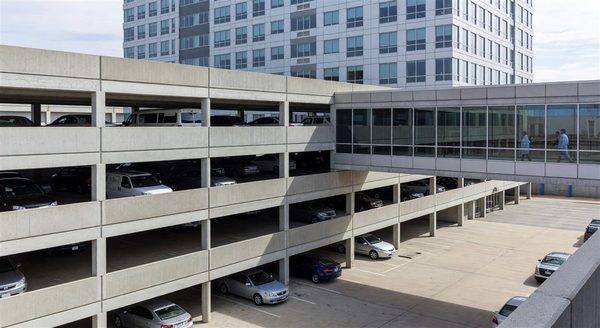
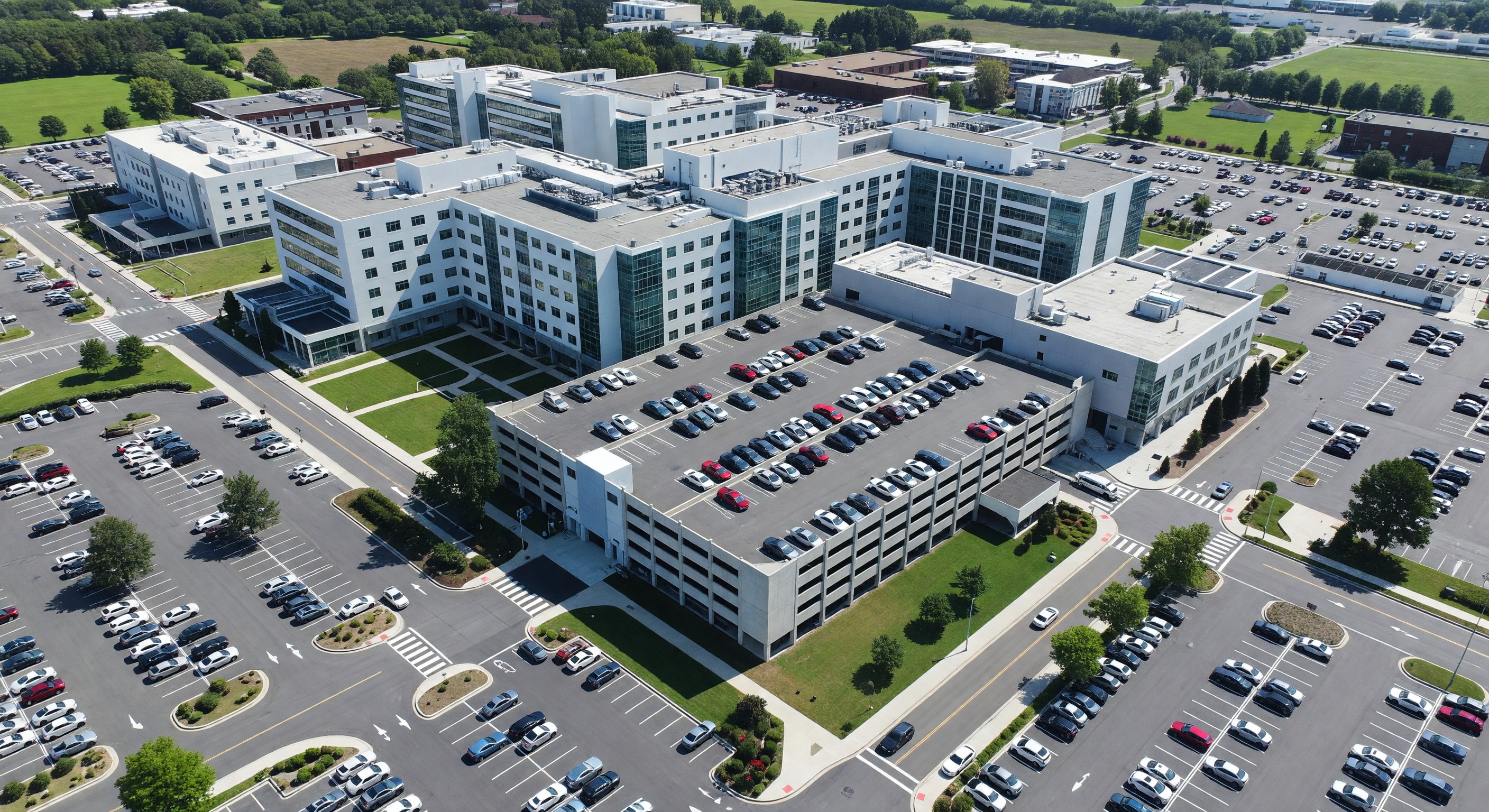
Structured Parking Garages New-build parking garages offer the highest space yield per land area—typically 350–400 spaces per floor—at a capital cost of $20,000–$35,000 per space depending on location, construction type, and site conditions. For healthcare campuses, structured parking must meet specific design requirements: clear height minimums for ambulance clearance if the structure connects to the hospital, accessible route integration per ADA, emergency generator connection for lighting and gate systems, and security infrastructure including cameras and emergency call stations.
Structured parking also carries significant ongoing maintenance obligations. Concrete parking structures in northern climates require joint sealing, deck waterproofing, and deicing management programs to prevent the accelerated deterioration that chloride-laden water causes in reinforced concrete. The lifecycle cost of a parking structure extends 40–60 years and includes multiple major restoration cycles.
Surface Lot Expansion Where land is available—through adjacent property acquisition, rezoning of underutilized parcels, or demolition of non-essential structures—surface lot expansion offers the lowest per-space capital cost, typically $3,000–$8,000 per space including grading, pavement, striping, lighting, and access control. Surface lots offer operational simplicity but generate the lowest revenue per space and have significant stormwater management implications under current EPA and state environmental regulations.
Remote Parking with Shuttle Service Remote parking facilities on off-campus land connected by shuttle service offer a cost-effective alternative to on-campus construction when land costs and construction costs for on-campus expansion are prohibitive. Capital costs for remote surface lots are significantly lower than structured on-campus parking, and shuttle operating costs can be offset by lower land and construction investment.
The operational challenge of remote parking is patient acceptance. Healthcare organizations implementing remote parking must invest in shuttle reliability, real-time tracking visibility through apps, comfortable waiting areas at both ends, and clear communication about how the system works. Remote parking programs that are poorly communicated or unreliable generate patient experience complaints that outweigh the cost savings.
Mechanical Parking Systems Automated mechanical parking systems—stacker systems, robotic parking garages, and puzzle lifters—can significantly increase space yield in constrained footprints. These systems are most appropriate for employee parking where predictable batch retrieval is possible, and less suitable for visitor-heavy patient parking where random access and retrieval time are critical.
Capital costs for mechanical systems are high ($40,000–$80,000 per space) and maintenance complexity is greater than conventional structures. Healthcare campuses that have deployed mechanical parking typically do so in employee-specific structures where demand patterns are predictable.
The ADA Compliance Dimension
Any parking expansion project must address ADA accessible space requirements. The ADA Standards for Accessible Design require a specific ratio of accessible spaces to total capacity, with van-accessible spaces comprising a subset of accessible spaces.
For expansion projects, ADA compliance implications include:
- New lots and structures must include the required number of accessible spaces from opening day
- Accessible spaces must be located on the most direct accessible route to each building entrance served by the lot
- Van-accessible spaces require an 8-foot wide parking space plus an 8-foot wide access aisle, or a 16-foot wide combined space
In practice, many hospital expansion projects add accessible spaces beyond the ADA minimum to address observed demand at entrances serving outpatient and emergency facilities, where patient mobility limitations are most prevalent.
Stormwater and Environmental Permitting
Parking expansion that adds impervious surface typically triggers stormwater management permitting requirements under state environmental programs implementing the EPA’s National Pollutant Discharge Elimination System (NPDES). The requirements vary by state and project scale but commonly include:
- Stormwater pollution prevention plans (SWPPP) for construction phase
- Post-construction stormwater management structures (detention basins, bioswales, permeable paving)
- Impervious area mitigation requirements in some jurisdictions
Healthcare campuses in states with aggressive stormwater reduction requirements may find that the cost of stormwater mitigation significantly increases the effective per-space cost of surface lot expansion, changing the economics of structured versus surface options.
Financing Healthcare Parking Expansion
Parking expansions are typically financed through one of several mechanisms:
Revenue Bonds Healthcare systems with strong bond ratings can finance parking structures through tax-exempt revenue bonds backed by parking revenue pledges. This approach is common for major academic medical centers with predictable, growing parking revenue streams.
Parking Management Agreements Some healthcare organizations enter long-term management agreements with professional parking operators who finance and construct parking infrastructure in exchange for operating rights and revenue sharing over a 20–40 year concession period. This approach shifts capital requirements off the healthcare organization’s balance sheet but requires careful contract structuring to protect patient experience standards and operational control.
Operational Reserves For smaller expansion projects—surface lot additions, modest structured parking additions—many health systems fund expansion from operating reserves, particularly when the expansion generates sufficient new revenue to justify the investment.
Frequently Asked Questions
How long does it take to plan and build a new hospital parking structure? From initial feasibility assessment to first day of operation, a new parking structure typically requires 3–5 years. Feasibility and planning take 6–12 months, design and permitting add another 12–18 months, and construction of a mid-size structure (500–800 spaces) typically runs 18–24 months. Healthcare campuses with complex utility and traffic constraints often see longer timelines.
What’s the minimum occupancy rate needed to justify a new parking structure financially? Most parking consultants use a threshold of 85–90% peak occupancy in existing lots as the trigger for evaluating new structured parking. Below that threshold, demand management and operational improvements typically offer better ROI than new construction.
How should accessible parking spaces be distributed in a new structure serving multiple hospital buildings? Accessible spaces should be located closest to the elevator or entrance serving each building, distributed based on which buildings generate the highest volume of mobility-impaired visitors. Outpatient clinics, cancer centers, and emergency departments typically justify higher concentrations of accessible spaces near their primary entrances.
What security infrastructure is required in a new hospital parking structure? At minimum, new structures should include emergency call stations at regular intervals (no more than 300 feet apart per most security standards), full camera coverage of all levels and stairwells, adequate lighting to meet IES standards for parking facility illumination, and access-controlled pedestrian entries. Most healthcare security standards also recommend clear sightlines through open structural design, eliminating blind corners and enclosed stairwells where possible.