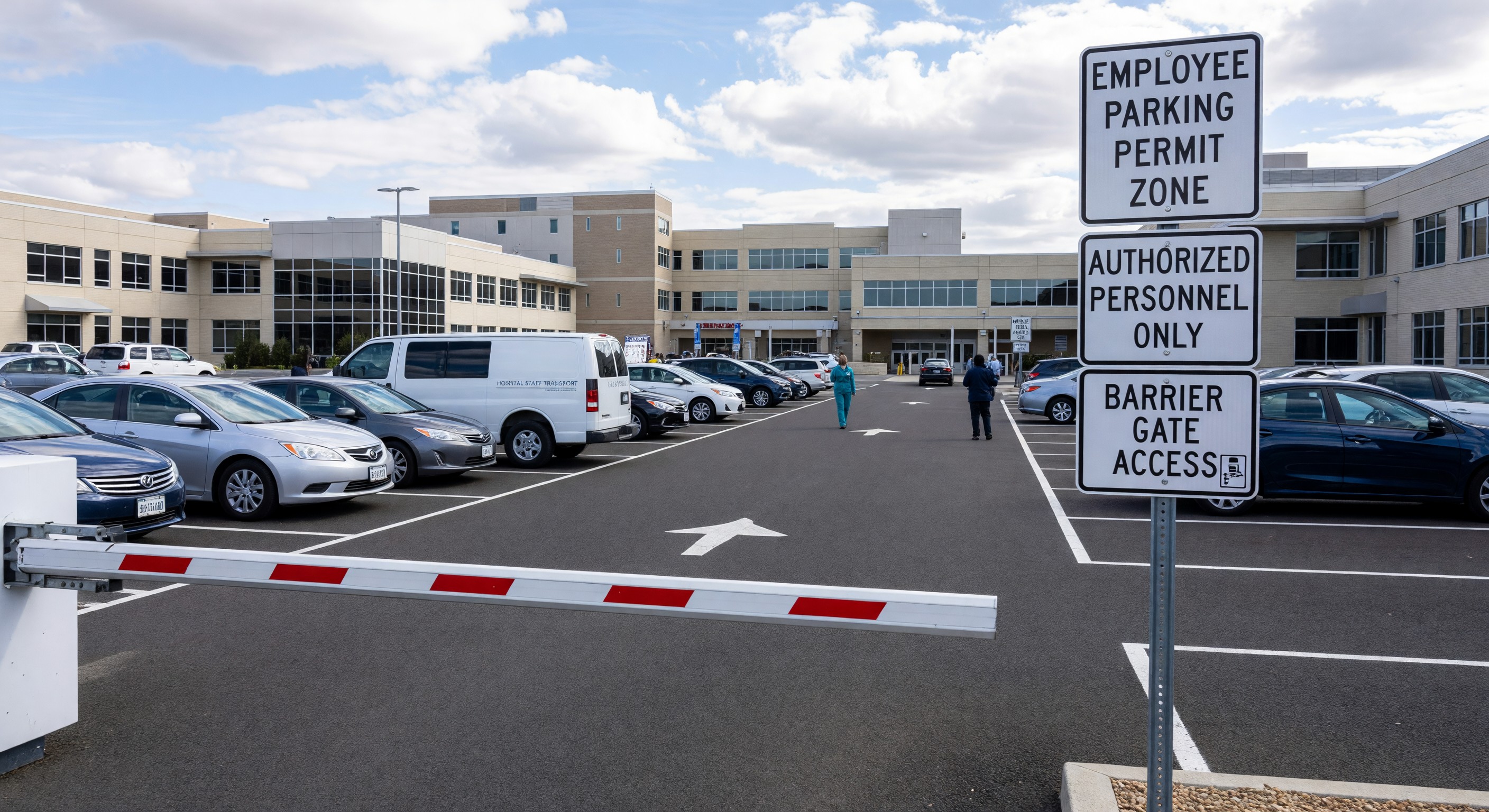
Employee parking is a benefits question as much as it is a facilities question. In a labor market where healthcare organizations compete intensely for nurses, technicians, and support staff, the quality and cost of the commute experience matters. Parking is a daily friction point — and daily friction accumulates into turnover risk.
Hospital facility directors who treat employee parking as merely an allocation problem miss the larger organizational opportunity. A well-designed employee parking program signals that the institution values its workforce’s time and experience from the moment they arrive on campus.
The Fundamentals of Hospital Employee Parking Structure
Most healthcare campuses stratify employee parking across two or three tiers:
Tier 1 — Physicians and senior medical staff. Typically assigned spaces in covered or gated structures closest to clinical buildings. 24/7 access via proximity card or vehicle sticker. Some facilities maintain dedicated physician entrances with monitored barrier gates.
Tier 2 — Nursing and clinical staff. Often the largest population and the most operationally sensitive. Shift-change volumes create peak pressure on entry and exit lanes. These employees need reliable, predictable parking within reasonable walking distance. Many facilities are moving nursing staff into nearby structures with shuttle service rather than distant surface lots.
Tier 3 — Support, administrative, and contract staff. Remote lots, surface parking, or shared arrangements with adjacent properties. Monthly permits are standard. Some organizations offer a subsidized transit option as an alternative.
Permit Systems: What Works at Scale
Paper permits have given way almost entirely to digital and RFID-based systems at larger campuses. Modern permit management software allows HR and facilities departments to:
- Issue and revoke credentials without physical interaction
- Link permits to employee ID for automatic deactivation upon termination
- Track utilization by zone and time to identify underused supply
- Run waitlists for premium zones and auto-notify when a space opens
License plate recognition (LPR) has replaced stickers at many facilities, eliminating the need to re-issue permits when an employee changes vehicles. The employee registers plate numbers in a portal; the system reads the plate at the barrier and allows entry. This reduces tailgating and lost permit issues significantly.
Addressing the COVID-19 Staffing Surge (2020)
When COVID-19 struck, many hospitals saw massive shifts in staff parking demand. Visitor restrictions freed up patient parking supply, which could be temporarily reallocated to staff — but doing so without access control reconfiguration created confusion and enforcement problems.
Facilities that had flexible PARCS (Parking Access and Revenue Control Systems) were able to reroute credentials and open access zones within hours. Those relying on static paper permit systems had to manually redirect enforcement staff.
The pandemic also surfaced an equity issue: employees who could not afford to own vehicles (common among certain support staff demographics in urban areas) faced reduced transit service during the same period. Forward-thinking facilities enhanced their transit subsidy programs to compensate.
Shift-Change Traffic and Gate Throughput
Nursing shift changes — typically at 7 AM, 3 PM, and 11 PM — create the highest-volume entry and exit events of the hospital day. A facility with 600 nursing staff and a 15-minute overlap window needs to process potentially 400+ transactions in that period.
Gate throughput is a genuine engineering problem. Each lane on a barrier gate system can process approximately 200–350 vehicles per hour under ideal conditions. If your facility handles 400 vehicles in 15 minutes, you need at least 2–3 staffed or high-speed automatic lanes dedicated to the employee entry point.
Stagger start times where clinically possible. Even a 10-minute offset across departments reduces peak queue formation by 30–40%. Some facilities have moved to 4-hour overlapping shifts to reduce concentrated ingress.
Costs, Subsidies, and Equity Considerations
Employee parking cost-sharing is a policy decision with equity implications. Charging employees for parking recovers operating costs but creates disparate burden — a $40/month parking fee represents a different percentage of income for a food service worker versus a department director.
Common approaches include:
- Free parking for all staff — Eliminates administrative overhead but forgoes revenue. Common in suburban facilities with abundant supply.
- Tiered pricing by compensation band — More equitable but complex to administer. Requires HR integration.
- Pretax payroll deduction — Under IRS Section 132, employees can pay up to $315/month in parking costs with pretax dollars (2024 limit). This effectively reduces the employee’s out-of-pocket cost by their marginal tax rate.
- Transit alternatives — Subsidizing bus passes or vanpool programs reduces parking demand and can be positioned as a sustainability initiative.
Enforcement Without Alienating Staff
Parking enforcement in a hospital setting requires a calibrated approach. Overly aggressive ticketing of clinical staff — especially during high-stress periods — generates significant internal friction. Under-enforcement means permit holders lose the value of their assigned zones.
Best practices:
- Clear, written parking policies distributed at onboarding
- Grace periods for new employees while they learn the system
- Easy online appeals process for contested citations
- Focus enforcement on patient-reserved zones and fire lanes — the highest-risk violations
- Regular communication reminding staff of overflow options before enforcement action
Planning for Future Needs
As healthcare campuses expand, employee parking needs grow non-linearly. Adding a new patient tower adds not just patient parking demand but physician, nursing, and support staff demand simultaneously.
Facility directors should include parking demand modeling in every major capital project environmental assessment. Building above or below grade parking into new construction costs significantly less than adding structured parking after the fact.
Electric vehicle charging is now an employee expectation rather than a perk. New employee parking structures should plan for EV-ready infrastructure — conduit and electrical capacity even before chargers are installed — to avoid expensive retrofits.
Frequently Asked Questions
How do we handle employees who park in patient zones? Consistent enforcement with clear consequence escalation. Issue a warning for first offense, a fine for the second, and a permit suspension review for the third. Document the policy in writing. Many facilities find that signage improvements (clearly differentiating patient from staff zones visually) reduce violations more than enforcement action alone.
Should we charge physicians for parking? This is a political and financial question as much as an operational one. Many hospitals treat physician parking as a provided benefit given the revenue physicians generate. If your medical staff bylaws or employment agreements include parking as a benefit, changing the policy requires careful legal review and physician leadership engagement.
What is a reasonable walking distance from employee parking to entrance? OSHA and general ergonomic guidelines are silent on this, but facility practice suggests a maximum of 1,000–1,200 feet (about a 5-minute walk) for unassisted staff. Night shift employees in particular should have well-lit, covered or sheltered walking paths. Shuttle service becomes necessary beyond 1,500 feet, especially in extreme weather regions.
How do we manage parking for travelers and agency staff? Assign agency and travel staff to overflow or visitor parking and issue temporary credentials valid for their contract period. HR should trigger credential provisioning and deactivation as part of the onboarding and offboarding workflow — not leave it to the facilities team to track manually.