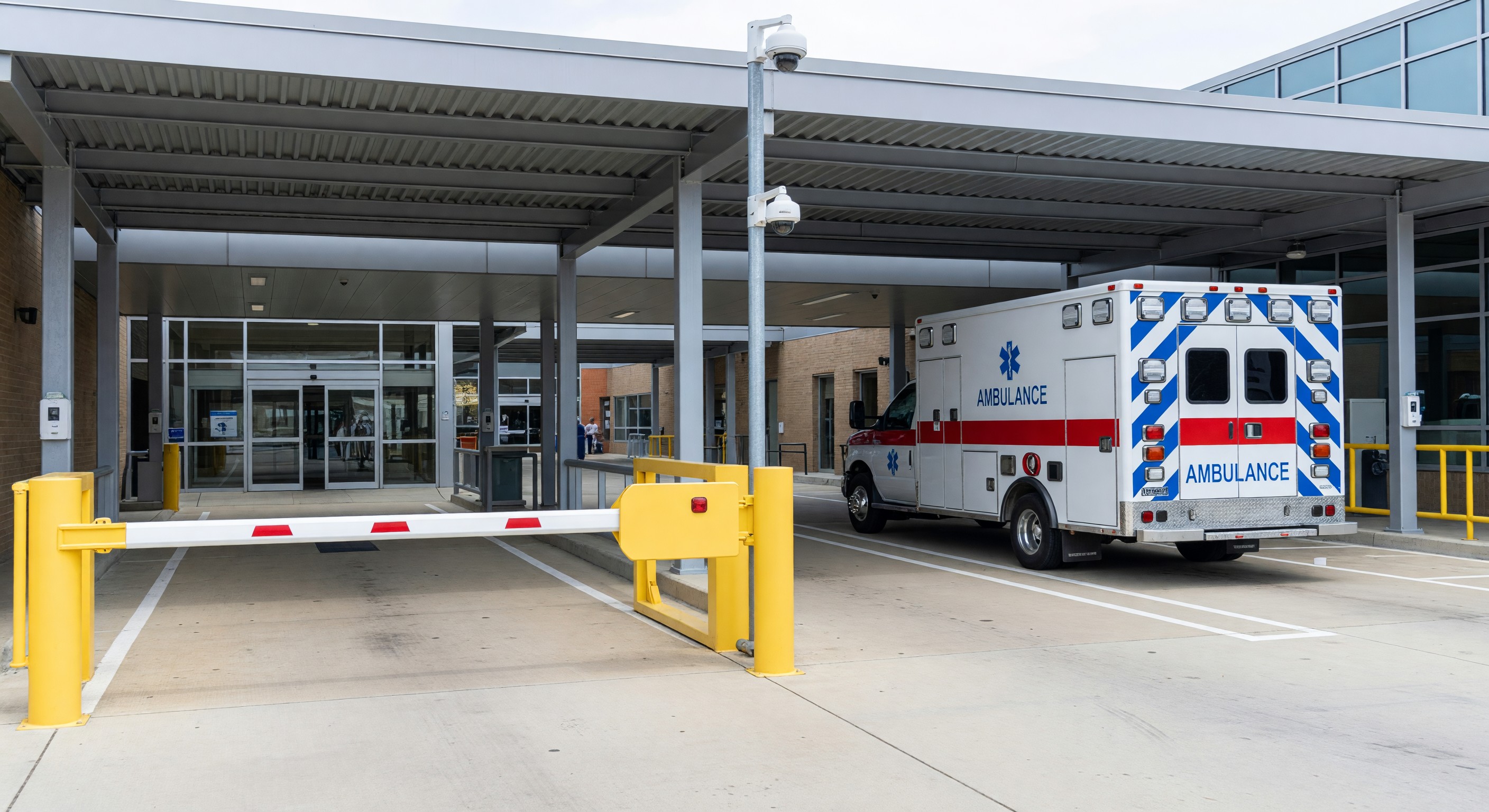
The ambulance bay is where the outside world meets the hospital at its most critical moments. Patients in cardiac arrest, trauma victims, obstetric emergencies, and pediatric codes all arrive through this single point of entry. Access control in the ambulance bay must balance an absolute requirement for rapid, unrestricted EMS access with the security needs of the emergency department — a unit that experiences some of the highest rates of workplace violence in healthcare.
Operational Access Requirements
Ambulance bays must accommodate emergency medical services vehicles reliably, at any hour, under any weather conditions. Requirements:
EMS access hours — Ambulance bay access is 24/7 with no exceptions. Any barrier or access control mechanism must default to open during power failures or system malfunctions. Fail-safe design is non-negotiable.
Vehicle sizing — Ambulance bays must accommodate standard ambulances, bariatric ambulances (wider, longer), and mutual aid vehicles from neighboring agencies whose specifications may vary. Plan for 12-foot width minimum and 13.5-foot overhead clearance minimum.
Patient transfer path — From the ambulance bay to the emergency department treatment area, the path must be continuous, unobstructed, and wide enough for stretchers plus EMS crew and receiving clinical staff simultaneously.
Weather protection — Covered ambulance bays protect both patients during transfer and EMS personnel who must prepare for patient handoff in outdoor conditions. Heated bays in cold climates are a significant quality-of-care consideration.
Staging capacity — During mass casualty events, the ambulance bay may need to accommodate multiple vehicles simultaneously. Some facilities include forward staging areas (secondary ambulance positions) separate from the primary patient unloading position.
Security Without Sacrificing Emergency Access
Emergency departments have a dual requirement that creates genuine design tension: they must be instantly accessible to EMS while maintaining security against the violence risk associated with ED populations.
Approaches that resolve this tension:
EMS-specific access with fast gate systems — Ambulance bay access gates tied to a vehicle recognition system (license plate recognition of registered EMS vehicles, or a transponder-based system where EMS vehicles carry a credential that activates the gate from 50+ feet away) provide rapid automatic opening without requiring EMS personnel to interact with a keypad or call box.
Pedestrian separation — The ambulance bay’s EMS vehicle access should not be the public pedestrian path to the emergency department. Patients and visitors walking to the ED use a separate, access-controlled pedestrian entrance. This separation maintains security while allowing unrestricted EMS vehicle access.
Security monitoring of the bay — Cameras with security center live monitoring provide visibility of all ambulance bay activity. A suspicious vehicle or unusual situation can be assessed and responded to without impeding actual EMS operations.
Callbox for non-credentialed EMS agencies — During mutual aid events, unfamiliar EMS agencies may arrive without transponders or registered plates. An intercom with video at the bay access point allows security to visually verify the arriving vehicle and remotely open the gate.
Integration with Emergency Department Operations
Ambulance bay access management extends into the emergency department operations:
Diversion notification — When a hospital goes on diversion (no capacity to accept additional EMS patients), the communication protocol with EMS dispatch is a clinical operations function, but the bay must remain open for life-threatening emergencies that cannot be diverted regardless of capacity.
EMS communication — Many EDs have integrated radio communication systems that allow EMS crews to report patient information while still en route, allowing the receiving team to prepare. This communication infrastructure should be planned as part of the ambulance bay design.
Contamination protocols — Ambulance bays must have protocols for receiving contaminated patients (HAZMAT exposures, radioactive contamination) that prevent contamination from entering the main ED. Decontamination station design, drainage, and environmental controls require early planning in any ED renovation or new construction.
Helicopter landing zone — Hospitals with rooftop or ground-level helicopter landing zones must ensure that the access path from the landing zone to the ED treatment area is equally optimized for rapid patient transfer. Elevator sizing, path width, and air transport team access are design factors.
Delineating Parking from Emergency Access
Emergency bay areas adjacent to general parking create confusion about the intended use of the space. Common problems:
- Staff or visitor vehicles blocking ambulance bay access lanes
- Patient drop-off vehicles using ambulance bay space as a convenient stopping point
- Ride-share pickups and drop-offs clustering near visible hospital entrances including ambulance bays
Physical barriers (curb cuts, medians, signage, and sometimes automatic barriers) clearly delineate the ambulance bay from general traffic. The access lane from the street to the ambulance bay should not be shared with general parking access routes if at all possible.
No-parking enforcement in ambulance bay zones must be immediate and consistent. A vehicle blocking an ambulance bay approach lane is a life-safety issue, not a parking citation situation.
Frequently Asked Questions
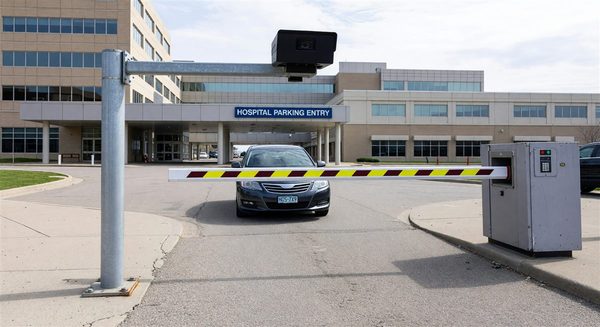
Should we install barriers at the ambulance bay entrance to prevent unauthorized vehicle access? Security barriers appropriate for the specific risk profile — ranging from signage and camera monitoring at lower-risk facilities to retractable bollards or access-controlled gates at higher-risk facilities — are appropriate. The key requirement is that any barrier can be instantly opened (retracted, deactivated) for legitimate emergency access, including power-fail-open mode. Bollards that require active human intervention to lower are generally not appropriate for primary ambulance bay access.
How do we handle private vehicle patient transports arriving at the ambulance bay? Private vehicles transporting patients should be redirected to the patient drop-off area adjacent to the main ED pedestrian entrance. This is a training and signage issue: EMS crews and the public must understand that the ambulance bay is reserved for emergency vehicles. Aggressive enforcement of this boundary may be counterproductive if the arriving family has a patient in genuine distress — clinical judgment by security on case-by-case circumstances is appropriate.
What are the lighting requirements for ambulance bays? Ambulance bays should be illuminated to a minimum of 10 footcandles at the patient unloading area to support safe patient transfer in nighttime conditions. Camera coverage requires adequate illumination for facial and vehicle recognition purposes. Weather-tight, impact-resistant fixtures appropriate for vehicle exhaust environments should be specified.
How do we plan for ambulance bay capacity during a mass casualty event? Develop a mass casualty parking plan that designates temporary ambulance staging areas on the campus (often a portion of adjacent parking lot converted to ambulance staging) during MCI events, with defined access lanes that do not compete with patient parking. Practice this plan during emergency exercises. Include ambulance bay and traffic flow in your annual emergency management tabletop exercises.