Hospital facility directors have spent the past two years watching OSHA’s proposed federal heat standard move through rulemaking, and the natural assumption was that a clear compliance deadline would eventually arrive to force the issue. That is not how 2026 has played out. The proposed rule has stalled — but the enforcement program that has driven most heat-related inspections since 2022 was just renewed and expanded for another five years, and the legal basis for a citation never depended on the rule in the first place. It would be easy to read a stalled standard as a reason to deprioritize heat planning — and it would be a mistake. The exposure on a hospital campus has not changed, the legal basis for a citation has not gone away, and the workers most at risk are precisely the non-clinical staff a facility director is responsible for.
Where the Federal Heat Rule Actually Stands
On August 30, 2024, OSHA published a Notice of Proposed Rulemaking for Heat Injury and Illness Prevention in Outdoor and Indoor Work Settings — the agency’s first attempt at a comprehensive federal heat standard covering general industry, construction, maritime, and agriculture. The informal public hearing concluded on July 2, 2025, and the post-hearing comment period closed later that year. Since then the rule has not advanced toward finalization and carries no target completion date; as of 2026 it is not a current administration priority.
The proposed framework, even if it never becomes a final rule as written, is worth understanding because it has become the de facto benchmark that regulators, insurers, and plaintiffs’ experts reference for what a reasonable heat program looks like. The NPRM sets two trigger points based on the heat index (or a wet-bulb globe temperature equivalent):
- An initial heat trigger at a heat index of 80°F, at which employers would provide drinking water, break areas with cooling, an acclimatization protocol for new and returning workers, and hazard training.
- A high heat trigger at a heat index of 90°F, at which employers would add mandatory paid rest breaks, physiological or symptom monitoring, and a documented emergency response procedure for heat illness.
Underlying both triggers is a written Heat Injury and Illness Prevention Plan, site-specific and reviewed by a designated coordinator — the kind of document a facility director is already accustomed to maintaining for other Environment of Care programs.
Enforcement Did Not Pause — It Expanded
OSHA’s Heat National Emphasis Program launched on April 8, 2022, and was extended for one year in January 2025. Rather than lapsing, it was renewed on April 10, 2026 — this time set to run for five years and expanded to target 55 high-hazard industries, up from 33. The NEP has been the engine behind a dramatic rise in enforcement: OSHA conducted roughly 7,000 heat-related inspections between April 2022 and December 2024, compared with only about 200 per year in the 2015–2020 period, issuing 60 General Duty Clause citations and more than 1,300 hazard alert letters.
The important point for facility directors is that OSHA’s authority to cite a heat hazard was never confined to the NEP. That authority comes from Section 5(a)(1) of the Occupational Safety and Health Act — the General Duty Clause — which requires employers to furnish a workplace “free from recognized hazards that are causing or are likely to cause death or serious physical harm.” Heat is unambiguously a recognized hazard, and OSHA has cited employers for heat fatalities under the General Duty Clause for years, entirely independent of the NEP or any specific standard. A stalled rule does not narrow that legal exposure after a worker collapses on a hospital roof in August — and with the emphasis program now renewed and broadened, programmed heat inspections are continuing, not winding down.
State-plan states add another layer that a stalled federal rule does not touch. Several OSHA-approved State Plans already enforce their own heat standards independent of federal rulemaking — California enforces both an outdoor heat standard and, since 2024, an indoor heat standard, and Oregon, Washington, Minnesota, Colorado, Maryland, and Nevada have adopted or moved to adopt heat rules of their own. A facility director operating in one of these jurisdictions may already be subject to an enforceable heat requirement today, and should confirm the specific obligations of the state plan covering their campus rather than waiting on the federal timeline.
The Highest-Exposure Workers Are Yours, Not the Clinical Team’s
Heat coverage in the healthcare press understandably focuses on patients and on emergency-department surge during heat waves. But the workers at greatest occupational heat risk on a hospital campus are almost entirely under facility management, not clinical leadership:
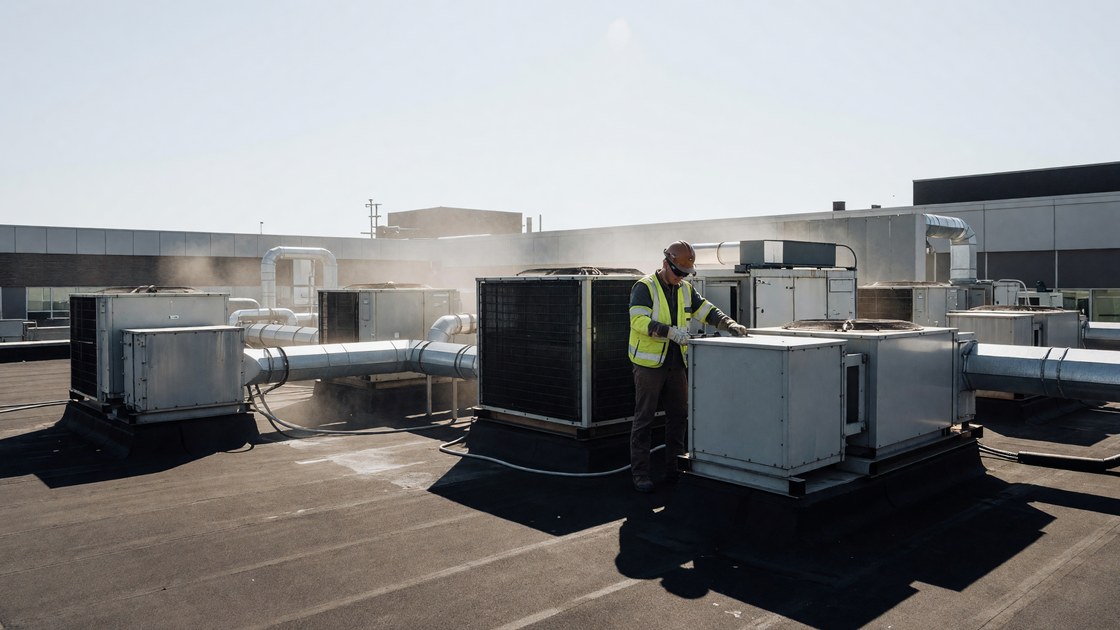
- Rooftop HVAC and mechanical technicians. Summer is peak season for cooling-system work, and a hospital roof is one of the hottest work environments on the entire campus — dark membrane surfaces, radiant heat off equipment, and no shade. These technicians are often working alone or in pairs, far from the building’s occupied, conditioned spaces.
- Loading dock and materials-handling personnel. Docks combine outdoor ambient heat with radiant load off pavement and trucks, physical exertion, and frequently poor natural ventilation. Staff here move continuously between the heat of the dock and cooler interior spaces, which complicates acclimatization.
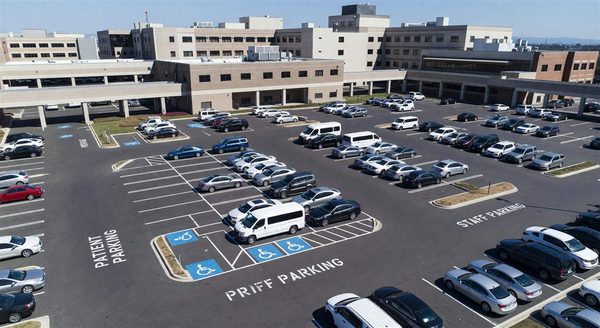
- Parking structure attendants and grounds staff. Open-deck and rooftop parking levels trap and radiate heat, and attendants, valet staff, and grounds crews can spend most of a shift in that environment. Structure equipment failures also climb in extreme heat, pulling maintenance staff into the hottest parts of the deck at the worst time.
- Central plant and utility workers. Boiler rooms, chiller plants, and mechanical spaces can run well above ambient temperature even when the outdoor heat index is moderate — a reminder that the “indoor” half of the proposed rule’s title is not an afterthought for hospitals.
None of these roles fits the clinical staffing conversation. All of them fall squarely within a facility director’s span of control, which is exactly why heat planning belongs on the facility-management agenda regardless of what happens to the federal rule.
Building a Defensible Heat Program Now
The practical move for 2026 is not to wait for a deadline but to stand up a program that would satisfy both a General Duty Clause inspection and the proposed standard’s framework, because building to the higher bar costs little more than building to the lower one:
- Write a site-specific heat plan and name a coordinator. A short, documented plan that identifies your high-exposure roles, sets your trigger temperatures, and defines the response is the single most valuable artifact if OSHA ever knocks — and it slots naturally into your existing Environment of Care committee structure.
- Set trigger points and monitor conditions. Adopt the proposed 80°F and 90°F heat-index triggers as your program’s thresholds and monitor local heat index (not just air temperature) for outdoor work, plus measured temperature in hot indoor spaces like the central plant and mechanical rooms.
- Formalize acclimatization. New hires and workers returning from more than a week away are disproportionately represented in serious heat cases. A graduated first-week exposure schedule is one of the cheapest and most protective controls available.
- Provide water, cooling, and rest as policy, not favor. Accessible cool drinking water, a shaded or air-conditioned break location near rooftop and dock work areas, and permission to take rest breaks without seeking approval each time.
- Train supervisors on recognition and response. Front-line supervisors of loading dock and rooftop crews need to recognize early heat-illness symptoms and know the emergency response steps before a worker is in trouble, not after.
- Coordinate with your broader OSHA compliance posture. Heat planning should live alongside — not separate from — the rest of your OSHA compliance program and your facility’s thermal-environment obligations, so that documentation, training records, and incident reporting flow through one system.
A facility director who can produce a written plan, temperature logs, acclimatization records, and supervisor training documentation is in a fundamentally different position than one relying on informal practice — whether the standard is ever finalized or not.
Frequently Asked Questions
Does OSHA have an enforceable heat standard for hospitals in 2026?
There is no final federal heat-specific standard. The proposed rule published in August 2024 has stalled with no completion date. OSHA renewed its Heat National Emphasis Program in April 2026, and it can also cite heat hazards under the General Duty Clause, Section 5(a)(1), which applies to hospital employers year-round.
Which hospital workers are covered by heat illness concerns?
The highest-exposure roles are non-clinical facility staff: rooftop and mechanical HVAC technicians, loading dock and materials-handling personnel, parking structure attendants, grounds crews, and central plant workers in hot mechanical spaces. These roles fall under facility management rather than clinical leadership, which is why heat planning belongs on the facilities agenda.
What temperature triggers a heat illness prevention response?
OSHA’s proposed rule uses two heat-index thresholds. An initial trigger at 80°F would require water, cooling break areas, acclimatization, and training; a high-heat trigger at 90°F would add mandatory paid rest breaks, monitoring, and a documented emergency response. Adopting these thresholds now aligns a facility with the emerging benchmark.
Should we build a heat program if the federal rule is stalled?
Yes. The legal exposure under the General Duty Clause exists regardless of the proposed rule’s status, and a documented heat plan, temperature logs, acclimatization records, and supervisor training are the evidence that distinguishes a defensible program from informal practice after any heat-related incident on campus.
Further Reading
- OSHA — Heat Injury and Illness Prevention in Outdoor and Indoor Work Settings Rulemaking
- OSHA — Heat overview and prevention resources
- American Society for Health Care Engineering (ASHE) — ashe.org