NFPA 101, the Life Safety Code, forms the foundational regulatory framework for fire and life safety in healthcare facilities. Its requirements—for means of egress, construction type, compartmentalization, fire detection and suppression, and emergency lighting—define the physical environment within which every US hospital must operate. The Joint Commission and CMS both reference specific editions of NFPA 101 in their conditions for accreditation and participation, making Life Safety Code compliance a direct regulatory compliance requirement rather than simply a best practice.
For facility directors responsible for maintaining compliance in aging hospital buildings while managing active construction and ongoing clinical operations, NFPA 101 presents a continuous management challenge. The standard is detailed, the application to existing buildings differs significantly from new construction requirements, and the interaction between NFPA 101 and construction, renovation, and operational changes creates compliance considerations at every turn.
Healthcare Occupancy Classification
NFPA 101 applies different requirements to different occupancy classifications. Healthcare facilities fall into three primary classifications:
Health Care Occupancy The most stringent classification, applying to facilities where 4 or more inpatients are housed overnight. Acute care hospitals are the primary health care occupancy. These facilities must comply with the full suite of health care occupancy requirements including automatic sprinkler systems throughout, smoke compartmentalization, non-lockout egress, and specific fire alarm requirements.
Ambulatory Health Care Occupancy Facilities providing outpatient services to 4 or more patients simultaneously who are incapable of self-preservation during emergencies. Surgical centers, dialysis centers, and similar facilities are ambulatory health care occupancies with requirements less stringent than full health care occupancy but more demanding than business occupancy.
Business Occupancy Administrative and medical office buildings on healthcare campuses that don’t provide patient care services are classified as business occupancies, with significantly less stringent NFPA 101 requirements.
Mixed-use campus buildings with portions used for multiple occupancy types (clinic space on the first floor, administrative offices above) require careful analysis to determine which classification applies to which portions of the building.
Key Life Safety Code Requirements for Healthcare
Means of Egress Healthcare facilities must provide adequate means of egress for occupants who cannot self-evacuate in an emergency. NFPA 101’s corridor width requirements (minimum 8 feet for new construction in health care occupancies), horizontal exit provisions (that allow patients to be moved to adjacent smoke compartments rather than evacuating the building), and door opening requirements reflect the reality that patients in beds, on gurneys, and in wheelchairs cannot evacuate through typical commercial egress paths.
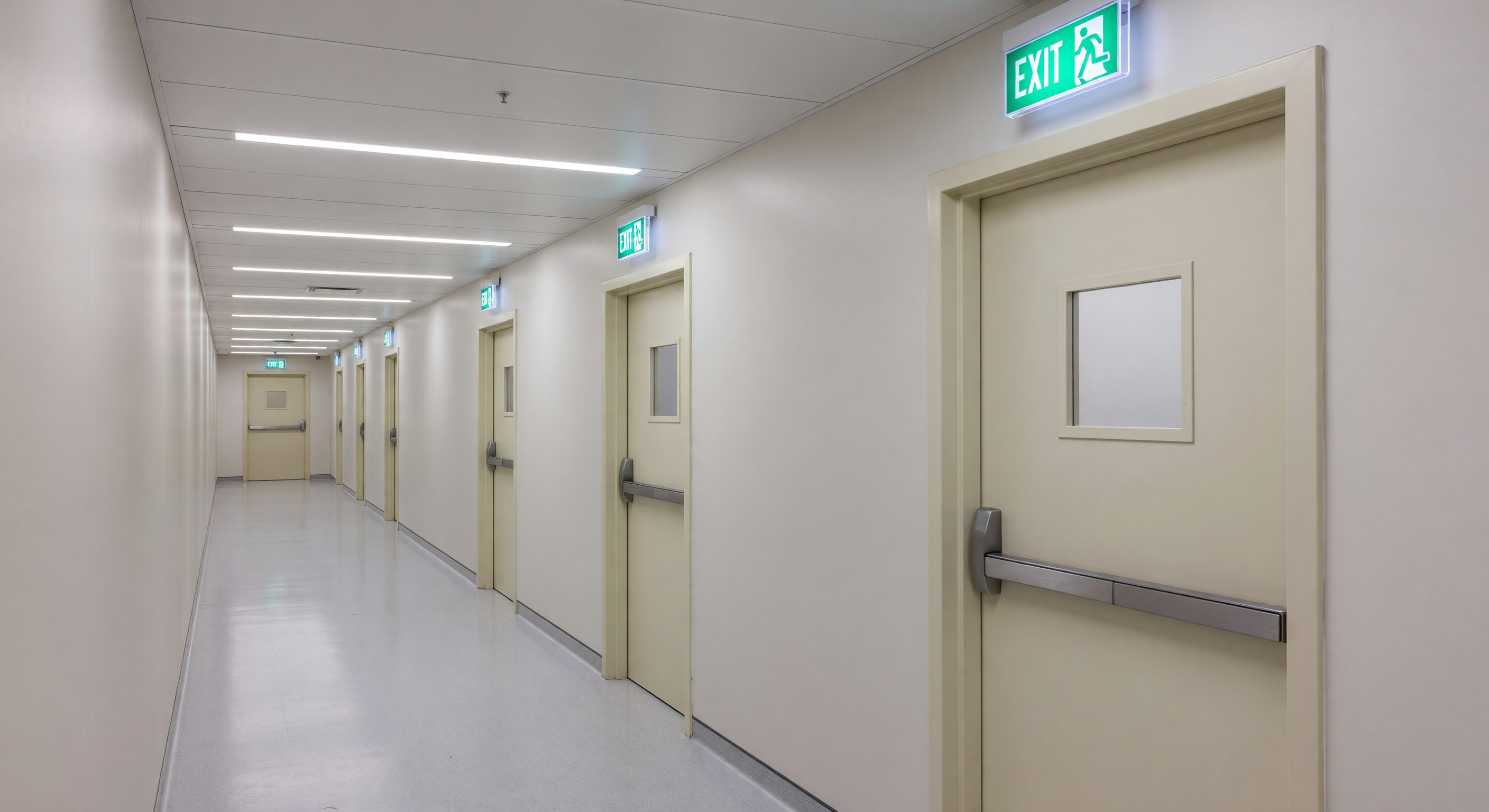
Corridor Doors and Smoke Compartmentalization Smoke compartmentalization—dividing healthcare buildings into zones that can be isolated from smoke spread by smoke barriers—is a foundational life safety strategy for facilities that cannot rapidly evacuate non-ambulatory patients. NFPA 101 specifies smoke compartment size limits (22,500 square feet maximum), smoke barrier construction requirements, and door specifications including automatic closing and positive latching requirements.
Smoke compartment corridor doors are among the most frequently cited Life Safety Code deficiencies in healthcare facilities. Common issues include: doors that don’t close and latch when released from the open position, gaps around the door that exceed 1/8 inch, vision panels that don’t meet the fire-rated glass requirement, and hardware modifications that have compromised the door’s fire-resistive function.
Fire Alarm Systems NFPA 101 requires automatic fire detection and alarm systems in health care occupancies, governed by NFPA 72 (National Fire Alarm and Signaling Code). Healthcare-specific requirements include smoke detection in corridors, certain mechanical spaces, and attic spaces, and addressable alarm systems that provide specific location information for every detector activation.
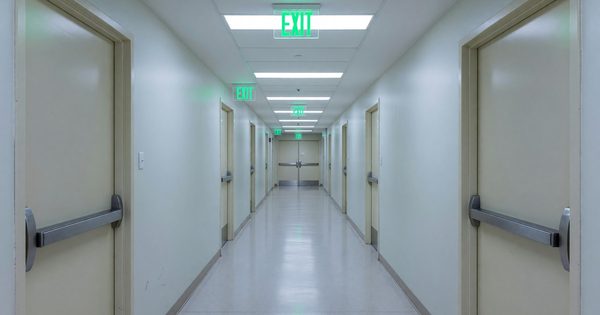
Emergency Lighting Exit signs and emergency lighting must remain operational during power outages, with emergency lighting providing a minimum of 1 footcandle average along means of egress. These systems must be tested per NFPA 101 schedules: 30-second functional tests monthly, 90-minute full-duration tests annually.
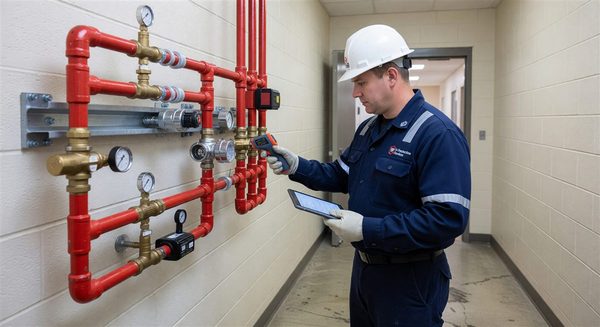
Sprinkler Systems New health care occupancies must be fully sprinklered. Existing health care occupancies that lack sprinklers face ongoing pressure from CMS and state licensing bodies toward full sprinkler installation. NFPA 101 provides a limited window of exceptions for specific existing conditions, but these exceptions are narrowing with each code edition.
Existing vs. New Construction Standards
NFPA 101 applies different standards to new construction versus existing buildings. This distinction is essential for healthcare facility directors managing aging building stock.
New Construction Requirements The most stringent NFPA 101 requirements apply to new construction. These include corridor width minimums, construction type requirements, compartment size limits, and other specifications that reflect current fire safety engineering knowledge.
Existing Building Provisions Existing health care occupancies—buildings constructed under older code editions—are generally permitted to comply with the existing health care occupancy requirements of the current NFPA 101 edition, which in many respects are less stringent than new construction requirements. This acknowledges the practical reality that retroactively applying all new construction requirements to existing buildings would be economically infeasible.
Triggered Upgrades When healthcare facilities undergo significant renovation or construction, portions of the building may be required to meet current new construction standards. Understanding when renovation work triggers code upgrade requirements—and planning renovation projects accordingly—is a key compliance skill for facility directors.
The Equivalency and Waiver Process
When existing building conditions cannot comply with NFPA 101 requirements, healthcare facilities have two primary paths to compliance relief:
Equivalency NFPA 101 permits the Authority Having Jurisdiction (AHJ—typically the state health department for CMS purposes, and The Joint Commission for accreditation purposes) to accept alternative means of compliance that provide equivalent life safety protection. An equivalency must be proposed through a formal process and approved by the AHJ. Successfully granted equivalencies allow facilities to maintain conditions that don’t literally comply with the standard while providing demonstrably equivalent protection.
CMS Categorical Waiver CMS has issued categorical waivers for certain NFPA 101 provisions, allowing all healthcare facilities to deviate from specific requirements under defined conditions without submitting individual applications. Current categorical waivers address specific existing building conditions—facility directors should verify current waiver status through CMS State Operations Manual updates.
Individual CMS Waiver Facilities with conditions that don’t qualify for categorical waivers can apply for individual CMS waivers, demonstrating that the alternative provides equivalent life safety protection. Individual waiver applications require detailed documentation and can take 6–18 months for CMS review and decision.
Common Life Safety Code Deficiencies in Healthcare
Based on Joint Commission survey findings data and CMS inspection reports, the most frequently cited NFPA 101 deficiencies in healthcare facilities include:
- Corridor door deficiencies (non-closing, non-latching, improper hardware, gaps)
- Penetrations in smoke/fire-rated barriers (unsealed conduit, pipe, or duct penetrations)
- Sprinkler system maintenance deficiencies (obstructions, painted heads, missing escutcheons)
- Emergency lighting testing documentation gaps
- Storage in egress corridors or within 18 inches of sprinkler heads
- Exit sign deficiencies (non-illuminated, missing, incorrectly located)
- Hazardous material storage violations (flammable materials in non-compliant quantities or locations)
A quarterly internal Life Safety Code walk-through that specifically inspects for these common deficiency categories is the most effective proactive approach to survey readiness.
Frequently Asked Questions
Which edition of NFPA 101 is currently enforced by CMS? CMS enforces a specific edition of NFPA 101 referenced in the State Operations Manual—and this edition does not automatically update when NFPA publishes a new edition. As of 2024, CMS references the 2012 edition of NFPA 101 for existing facilities and the 2012 edition for new construction. Facility directors should verify the current CMS-referenced edition through the State Operations Manual, as this may change as CMS updates its references.
How should healthcare facilities handle corridor door modifications made for clinical workflow reasons? Corridor door modifications that affect fire or smoke protection function—replacing hollow metal doors with glass doors, adding windows, modifying hardware—require review against NFPA 101 requirements before implementation. Many clinically motivated modifications (adding automatic door openers, widening openings for equipment) can be done compliantly with appropriate door hardware and rated glass. Modifications that cannot be made compliantly without unacceptable clinical impact may qualify for equivalency consideration.
What training should healthcare facilities teams have on NFPA 101 requirements? Facilities staff responsible for construction, renovation, maintenance, and compliance should have working knowledge of NFPA 101 healthcare occupancy requirements. Formal training options include ASHE’s Life Safety Code courses, NFPA 101 healthcare occupancy seminars, and manufacturer training on specific code-compliant products. The Joint Commission also offers education resources on Environment of Care compliance.
How do CMS and The Joint Commission coordinate on NFPA 101 enforcement? The Joint Commission has Deemed Status from CMS for hospital accreditation, meaning Joint Commission-accredited hospitals are deemed compliant with CMS Conditions of Participation. However, CMS retains the right to conduct independent surveys and has found significant compliance gaps even in Joint Commission-accredited facilities. Organizations should not assume that Joint Commission accreditation provides complete protection from CMS enforcement actions related to life safety.