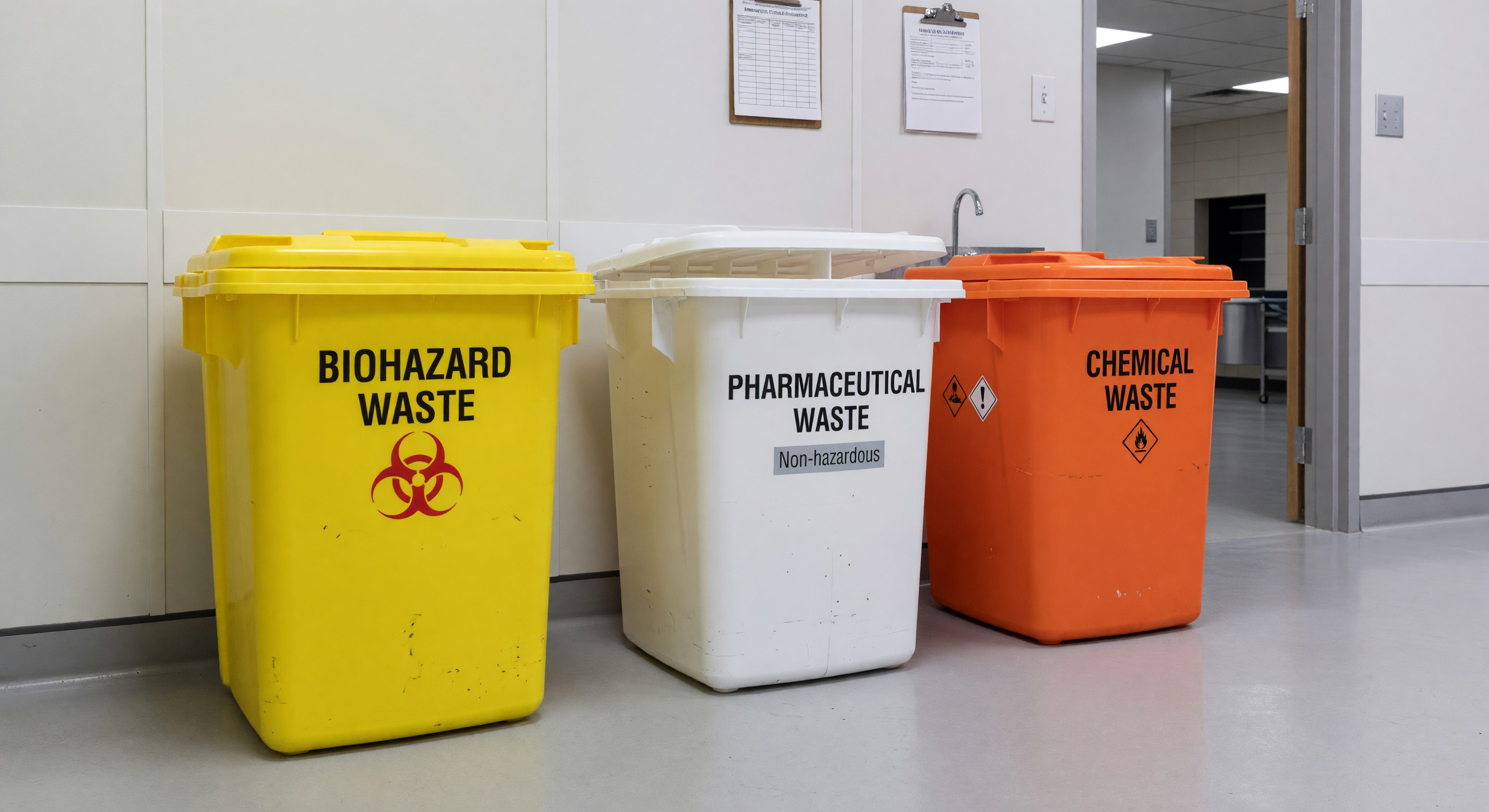
Healthcare facilities generate a broad spectrum of regulated waste streams — regulated medical waste, pharmaceutical waste, chemotherapy waste, chemical waste, radioactive waste, and universal waste. Each stream has its own regulatory framework, handling requirements, storage limits, and disposal requirements. For facility directors and environmental health and safety managers, maintaining compliance across all these streams simultaneously requires a comprehensive, systematically managed program.
Regulated Medical Waste
Regulated medical waste (RMW) — also called biohazardous waste or infectious waste — includes:
- Cultures and stocks of infectious agents
- Human blood and blood products
- Pathological waste (human tissue, anatomical parts)
- Sharps waste (needles, lancets, scalpel blades, broken glass from patient care areas)
- Other items contaminated with blood or body fluids that could pose infectious hazard
Regulatory authority — RMW is primarily regulated by state health departments and environmental agencies. There is no single federal RMW standard, though the Medical Waste Tracking Act of 1988 established a federal framework and several states have adopted regulations based on it. Confirm the applicable regulations for your state, as requirements for segregation, packaging, labeling, storage, and treatment vary.
Treatment and disposal — Most RMW is treated by autoclave (steam sterilization) or incineration to render it non-infectious before disposal as ordinary solid waste. Many hospitals contract with regulated medical waste treatment companies that transport and treat RMW off-site.
Sharps management — Sharps containers must be properly filled (no more than 3/4 full), closed, labeled with the biohazard symbol, and either treated on-site or transported by a licensed hazardous waste hauler. Sharps containers must be accessible at the point of use; staff should never have to carry uncontained sharps to a disposal location.
Pharmaceutical Waste
Pharmaceutical waste is increasingly regulated under EPA’s Resource Conservation and Recovery Act (RCRA) hazardous waste framework, as well as state pharmaceutical waste regulations. The EPA’s 2019 Management Standards for Hazardous Waste Pharmaceuticals (40 CFR Part 266 Subpart P) established specific management standards for healthcare pharmaceutical hazardous waste.
RCRA hazardous pharmaceutical waste — Certain pharmaceuticals are RCRA P- or U-listed hazardous wastes (e.g., warfarin above specified concentrations, nicotine patches) or exhibit hazardous characteristics. These require hazardous waste management as defined in 40 CFR 266.
Non-hazardous pharmaceutical waste — Most drugs that are not RCRA-listed may be managed as solid waste or, in some cases, through reverse distribution programs that return unused medications to manufacturers or wholesalers. The DEA has specific requirements for controlled substance disposal.
Controlled substance waste — DEA-registered healthcare facilities must dispose of controlled substance waste through DEA-authorized disposal methods: authorized collectors (pharmacies, hospitals registered as collector sites), authorized mail-back programs, or official take-back events.
Best management practices — Pharmaceutical waste should be segregated at the point of generation: hazardous pharmaceutical waste into hazardous pharmaceutical waste containers; non-hazardous pharmaceutical waste into trace chemotherapy or pharmaceutical waste containers; controlled substance waste into DEA-compliant disposal protocols.
Chemotherapy (Antineoplastic) Waste
Chemotherapy and antineoplastic drug waste is regulated by NIOSH (for occupational hazard) and EPA (for environmental disposal) and requires specialized management:
Trace contaminated waste — Items contaminated with small amounts of chemotherapy drugs (empty IV bags, tubing, gloves from drug administration) are managed as “trace chemotherapy waste” in yellow containers.
Bulk chemotherapy waste — Unused or partially used chemotherapy drugs are RCRA hazardous pharmaceutical waste and must be managed accordingly.
Personal protective equipment — Staff handling chemotherapy waste must use appropriate PPE: chemotherapy-rated gowns, gloves, and eye protection.
Spill kits — Chemotherapy spill kits must be available in all areas where chemotherapy is prepared or administered. Spill response training is required for all staff in these areas.
Chemical Waste
Laboratories, pathology, radiology, and building maintenance operations generate chemical waste subject to RCRA and state hazardous waste regulations:
- Laboratory solvents and reagents
- Formalin and formaldehyde from pathology
- Silver and photographic chemicals from radiology (film processing)
- Mercury from gauges, thermometers, and fluorescent lamps
- Acids and bases from laboratory operations
- Cleaning chemicals with hazardous characteristics
Generator status — RCRA generator status (very small quantity generator, small quantity generator, or large quantity generator) is determined by the total quantity of hazardous waste generated per month. Generator status determines storage limits, emergency planning requirements, and training requirements. Confirm your generator status annually.
Radioactive Waste
Nuclear medicine departments, PET suites, and radiation oncology generate radioactive waste regulated by the Nuclear Regulatory Commission (NRC) and Agreement States:
Short-lived isotopes — Many nuclear medicine isotopes (Tc-99m, I-131 in diagnostic quantities) decay to levels below regulatory concern within days to weeks. These can be managed through “decay-in-storage” — holding the waste in secured storage until radioactivity decays to background levels, then disposing as regular waste.
Longer-lived isotopes — Some therapeutic and research isotopes require licensed radioactive waste disposal. The medical facility’s NRC license specifies acceptable disposal methods.
Storage requirements — Radioactive waste storage areas must be posted with required radiation warning signs, secured against unauthorized access, and monitored for radiation levels.
Frequently Asked Questions
Are there federal regulations specifically for regulated medical waste? Unlike hazardous chemical waste (governed by federal RCRA), there is no comprehensive federal regulatory framework specifically for regulated medical waste. The Medical Waste Tracking Act of 1988 resulted in a 2-year pilot program in several states but was not extended. Most RMW regulation is at the state level, with significant variation between states. Confirm the specific requirements in your state.
Can we use our RCRA hazardous waste contractor for all our healthcare waste streams? A qualified RCRA hazardous waste contractor can handle pharmaceutical hazardous waste and chemical waste. However, regulated medical waste requires a state-licensed medical waste transporter and treatment facility, which is a different licensing regime than RCRA hazardous waste. Controlled substance waste requires DEA authorization. You may need separate contractors for each stream unless your contractor holds all applicable licenses.
How do we manage pharmaceutical waste in patient rooms at discharge? Medications left in patient rooms at discharge should be collected and returned to pharmacy for proper disposal (rather than discarded in room trash). Nursing staff training should include proper medication waste collection procedures. The appropriate disposal stream (reverse distribution, RCRA hazardous waste, or non-hazardous pharmaceutical waste) is determined by the specific medication.
What training is required for staff who handle hazardous waste? OSHA Hazard Communication training for all staff who may encounter hazardous materials. Specific training for staff handling regulated medical waste (sharps, biohazardous waste), pharmaceutical waste, and chemotherapy waste as applicable to their role. DOT Hazardous Materials training (HM-181) for staff involved in preparing or shipping hazardous materials. Annual refresher training is required for DOT training; frequency for other training is risk-based.