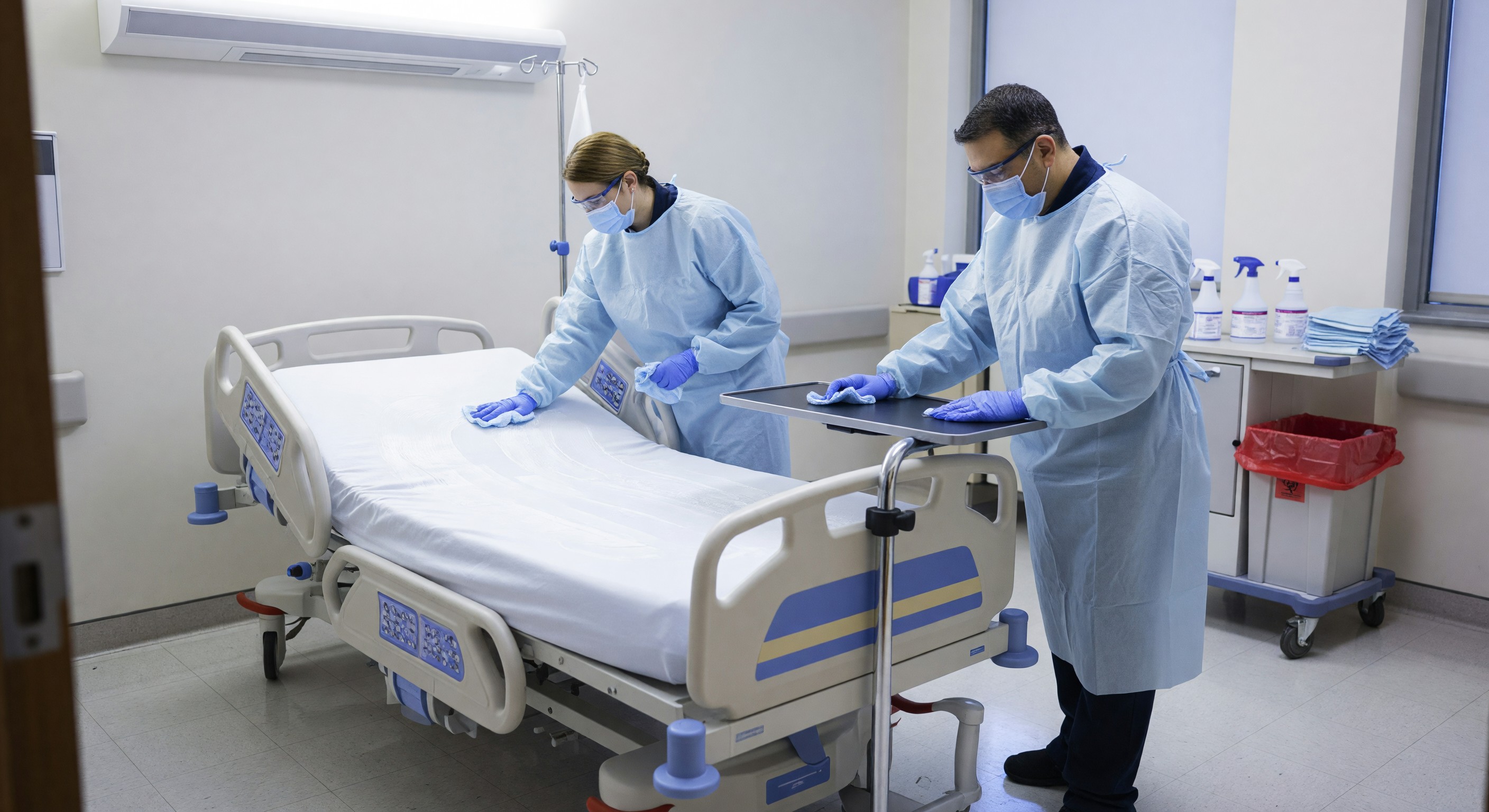
Environmental services (EVS) in healthcare facilities operates within a dense regulatory framework that spans federal, state, and accreditation requirements. The cleaning, disinfection, and waste management practices of EVS departments directly affect infection rates, regulatory standing, and staff safety—making compliance a patient safety imperative rather than merely a paperwork obligation.
For healthcare facility directors overseeing EVS operations, understanding the regulatory landscape—what’s required by whom, at what frequency, and with what documentation—is foundational to managing an effective compliance program.
Joint Commission Standards Affecting EVS
The Joint Commission’s Environment of Care standards most directly affecting EVS operations include:
EC.02.06.01 (Maintaining a Clean and Sanitary Environment) This standard requires healthcare organizations to maintain a clean and sanitary environment throughout the facility. Surveyors specifically inspect for visible cleanliness deficiencies—soil in patient rooms, blood or body fluids on environmental surfaces, dust accumulation in clinical areas, and improper storage of cleaning chemicals or soiled items.
IC.02.02.01 (Reducing Infection Risk from Cleaning and Disinfection) Infection Control standards require that healthcare organizations reduce infection risks from the cleaning and disinfection of medical equipment, devices, and the environment. EVS cleaning and disinfection protocols must be based on evidence (CDC Guidelines for Environmental Infection Control in Health Care Facilities) and consistently implemented.
LS Standards for Hazardous Materials Storage EVS cleaning chemicals are regulated under Life Safety standards that govern hazardous material storage quantities, ventilation requirements for chemical storage areas, and compatibility of stored chemicals. Flammable cleaning agents require specific storage conditions; bulk chemical storage quantities may be limited in occupied buildings.
EPA Regulatory Requirements
Medical Waste Management The EPA regulates generators of medical (regulated) waste under the Resource Conservation and Recovery Act (RCRA) framework, though specific requirements are implemented primarily through state environmental programs. Healthcare EVS programs must manage regulated medical waste (sharps, cultures, blood-soaked materials) through licensed medical waste disposal contractors, with proper container labeling, storage requirements, and manifest documentation.
Disinfectant Product Registration Healthcare disinfectants used for surface disinfection must be EPA-registered under the Federal Insecticide, Fungicide, and Rodenticide Act (FIFRA). Products used for specific claims (tuberculocidal, sporicidal, virucidal) must carry EPA-registered claims for those pathogen categories. Healthcare organizations should verify that disinfectants used for clinical surface disinfection are EPA-registered and carry the specific claims relevant to their use.
Hazardous Waste Disposal Cleaning chemicals that are hazardous when discarded (certain disinfectants, solvents) may require hazardous waste disposal rather than sanitary sewer disposal. Healthcare organizations should evaluate their cleaning chemical inventory against EPA hazardous waste generator requirements.
OSHA Requirements for EVS Staff
EVS staff face specific occupational hazards that OSHA standards address:
Bloodborne Pathogen Standard (29 CFR 1910.1030) EVS staff who encounter blood and other potentially infectious materials in the course of their work are covered by OSHA’s Bloodborne Pathogen Standard. Requirements include: exposure control plan documenting tasks with potential exposure; provision of personal protective equipment appropriate for exposure risk; hepatitis B vaccination offered at employer expense; post-exposure evaluation and follow-up; and annual training for covered staff.
Hazard Communication Standard (29 CFR 1910.1200) EVS staff who use hazardous cleaning chemicals must have access to Safety Data Sheets (SDS) for all chemicals they use, receive training on chemical hazards and safe handling, and have chemical containers properly labeled. A written hazard communication program is required.
Personal Protective Equipment Standard OSHA requires that employers assess EVS staff exposure to hazards—including chemical exposure from cleaning products, biological exposure from patient care areas, and physical hazards—and provide appropriate PPE. PPE selection for EVS in clinical areas must address both chemical and biological protection.
State Health Department Requirements
State health departments impose EVS-specific requirements through health facility licensing standards. Common state requirements include:
Terminal Cleaning Documentation Many state licensing programs require documentation that patient rooms receive terminal cleaning between each patient occupancy. EVS programs must maintain records demonstrating compliance with room turnover cleaning requirements.
Textile and Linen Standards State standards often specify requirements for healthcare linen processing—water temperature minimums for hot-water washing of patient linen, separation of soiled and clean linen transport and storage, and inspection requirements for linen leaving the laundry.
Cleaning Protocol Documentation State inspectors may request written cleaning protocols for specific area types—operating rooms, isolation rooms, high-touch surface lists. EVS programs should maintain documented cleaning protocols that specify products, contact times, and frequencies for all healthcare space categories.
Infection Prevention Integration
The most operationally significant compliance relationship for EVS is with infection prevention. EVS and infection prevention must be aligned on:
- Product selection (EVS uses the products IP validates as appropriate for the pathogens of concern)
- Protocol development (IP develops and validates cleaning protocols; EVS implements them)
- Outbreak response (IP directs enhanced cleaning protocols during C. diff outbreaks, MRSA clusters, or other HAI events)
- Environmental rounds (IP and EVS jointly conduct environmental rounds to assess cleaning quality)
Joint Commission EC and IC standards together require demonstrated coordination between EVS and infection prevention. Survey tracer methodology that follows the patient care environment will specifically assess whether this coordination is functioning.
Frequently Asked Questions
What’s required for UV disinfection devices used in healthcare EVS programs? UV disinfection robots (UV-C devices) are medical devices subject to FDA oversight if marketed with disease prevention claims. Healthcare organizations deploying UV devices should verify the device’s regulatory status, ensure use protocols are developed with infection prevention input, and document UV device use as a supplement (not replacement) to manual terminal cleaning.
How should healthcare EVS programs handle cleaning of patients under contact precautions? Contact precaution rooms require more frequent cleaning and disinfection during occupancy, use of products effective against the specific pathogen of concern, and terminal cleaning protocols appropriate for the precaution type. EVS staff cleaning contact precaution rooms must use appropriate PPE (gloves, gown for direct contact precautions) and receive specific training on the additional requirements.
What records should healthcare EVS programs maintain for regulatory compliance? Core records: Completed cleaning checklists or electronic tracking for terminal cleans and routine clinical cleaning; safety data sheets for all chemical products in use; staff training records (BBP training, chemical hazard training); medical waste manifest records (retained per state requirements, typically 3 years); PPE provision and assessment documentation; and any state licensing inspection records.
What are the quality monitoring requirements for EVS cleaning in healthcare? Joint Commission and CMS surveys assess cleaning quality during facility tours. Healthcare organizations should implement systematic EVS quality monitoring that includes: supervisor observation rounds, adenosine triphosphate (ATP) bioluminescence testing of high-touch surfaces, UV fluorescent marker audits, and patient satisfaction data on environmental cleanliness. Document quality monitoring results and corrective actions as evidence of systematic program management.