Emergency power reliability in healthcare is a patient safety imperative. When primary utility power fails, life-support equipment, operating rooms, intensive care units, emergency departments, and lighting in patient care areas must receive backup power within 10 seconds. NFPA 99, the Health Care Facilities Code, establishes the comprehensive regulatory framework for healthcare emergency power systems—from generator specifications and fuel storage requirements to testing protocols and documentation obligations.
For facility directors managing healthcare emergency power infrastructure, NFPA 99 compliance is not optional. CMS surveys specifically assess emergency power compliance, and findings can have immediate regulatory consequences. The Joint Commission EC.02.05.07 standard requires comprehensive emergency power system testing and maintenance programs. States implement NFPA 99 through their health facility licensing programs, and AHJs conduct inspections that verify ongoing compliance.
NFPA 99 Healthcare Facility Categories
NFPA 99 classifies healthcare facilities and spaces into categories based on the degree of risk from power failure:
Category 1 (Highest Risk) Spaces where failure of equipment or a system is likely to cause major injury or death of patients, staff, or visitors. Operating rooms, intensive care units, cardiac catheterization labs, emergency departments, labor and delivery, and newborn intensive care units are Category 1 spaces. Category 1 electrical systems must meet the most stringent NFPA 99 requirements.
Category 2 Spaces where failure is likely to cause minor injury to patients, staff, or visitors. Most patient care rooms, examination rooms, and clinical support areas fall in this category.
Category 3 Spaces where failure is unlikely to cause injury to patients, staff, or visitors. Administrative offices, mechanical rooms, and non-patient areas.
Category 4 Spaces where the environment of care is not expected to affect patient treatment. General warehouse, non-clinical support spaces.
Essential Electrical System Architecture
NFPA 99 establishes the Essential Electrical System (EES) architecture for healthcare facilities—the structured approach to providing emergency power to critical loads during utility outages.
Life Safety Branch The Life Safety Branch receives power within 10 seconds of normal power failure and serves loads required for safe egress and evacuation: emergency lighting in egress paths, exit signs, alarms, automatic fire detection, elevator cab lighting, and communications systems. This is the smallest and most immediate-response component of the EES.
Critical Branch The Critical Branch also restores power within 10 seconds and serves patient care areas: task lighting in operating rooms, medication preparation areas, nurses’ stations, patient care corridors, and critical care unit lighting. Medical equipment outlets at patient beds and at operating room positions are Critical Branch loads. Blood bank refrigerators, laboratory equipment for patient blood gas analysis, and communications throughout the hospital are also Critical Branch loads.
Equipment System The Equipment System may restore power in phases over a longer period (up to 10 seconds for the first automatic connection, with additional loads connected in deliberate stages). It serves large motor loads—heating and ventilation for operating rooms, supply, return, and exhaust ventilation for intensive care and isolation rooms, elevator power, and other major equipment loads.
Separating loads into these branches allows phased connection to the emergency generator, preventing the simultaneous motor starting current that would occur if all loads connected simultaneously and potentially overwhelming the generator during the critical first moments of an outage.
Generator Requirements Under NFPA 99
Generator Specifications NFPA 99 requires that emergency generators for Category 1 facilities be designed, installed, and maintained to provide reliable power under all facility load conditions. Key specifications:
- Generator rating must accommodate the connected load (full connected load of all EES branches simultaneously, with appropriate demand factor)
- Fuel systems must provide at least 96 hours of runtime at peak load (increased from 72 hours in earlier editions)
- Transfer switches must connect EES loads within 10 seconds of normal power failure
Fuel Storage and Supply The 96-hour fuel requirement means most hospitals maintain substantial on-site diesel fuel storage. Fuel quality management—fuel polishing, biocide treatment, regular tank inspection—is a maintenance obligation that affects generator reliability in extended outages.
Generator Testing NFPA 99 specifies a generator testing program that healthcare facilities must implement and document:
Monthly testing: 30-minute load test under load (connecting the EES loads to the generator) to verify operational capability. The test must be performed under load—a no-load test that simply runs the generator does not meet the NFPA 99 requirement.
Annual testing: 4-hour load test that demonstrates the generator can sustain connected facility loads for an extended period. Many facilities satisfy this requirement through actual utility outages rather than planned tests—if outages provide adequate duration and load.
Inspection and maintenance: NFPA 110 (Emergency and Standby Power Systems) provides additional inspection, testing, and maintenance requirements for generator systems.
Transfer Switch Requirements
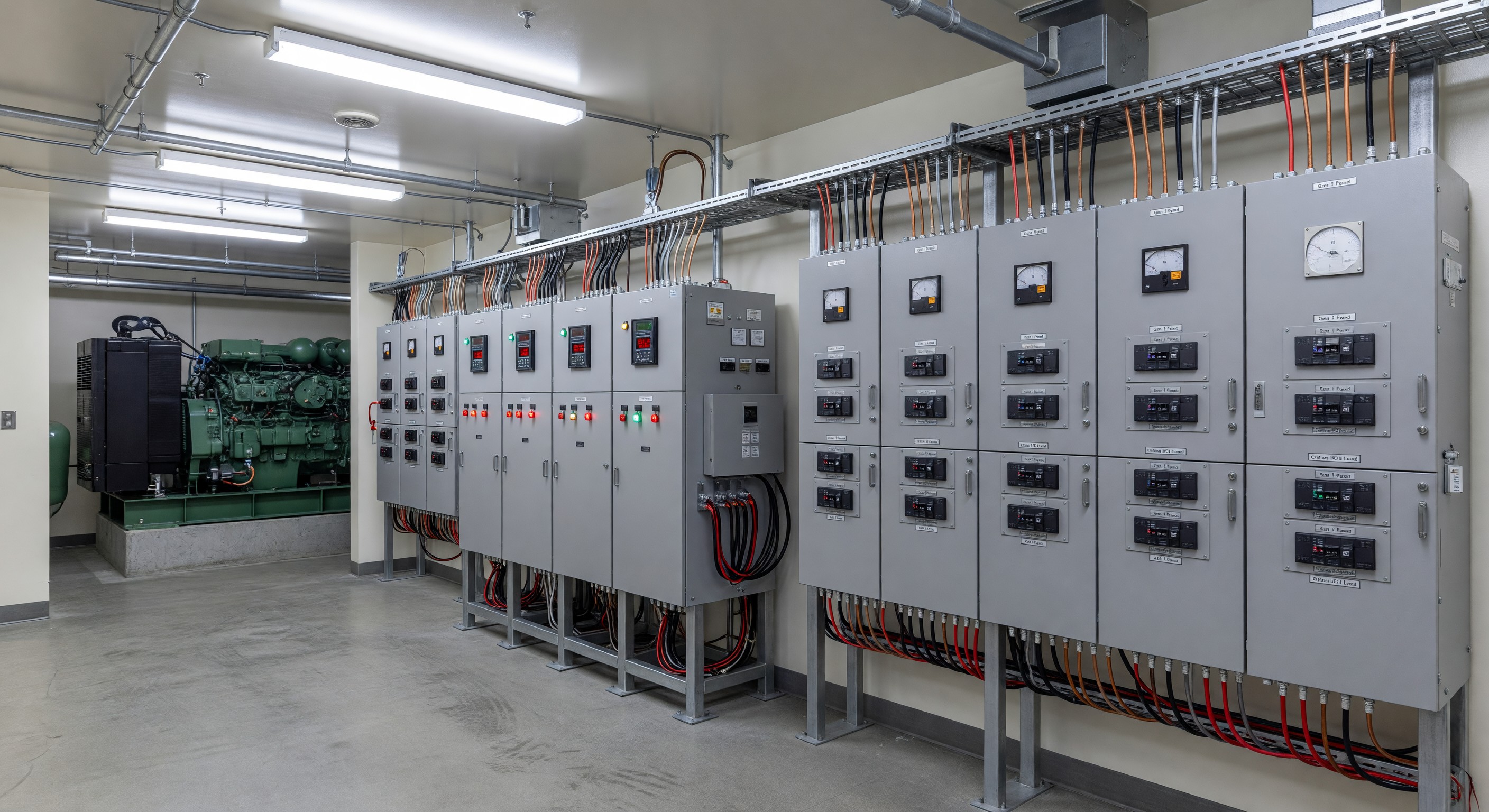
Automatic transfer switches (ATS) that disconnect utility power and connect EES loads to emergency generators must meet NFPA 99 requirements for response time, testing, and maintenance.
Critical Requirements
- ATS must transfer within 10 seconds of sensing utility power failure
- Manual transfer capability required for testing and maintenance
- Transfer switches serving Life Safety Branch and Critical Branch loads must be listed (UL 1008 or equivalent)
- Bypass isolation capability required by NFPA 99 for serviceability without power interruption
Testing and Maintenance Transfer switches must be exercised (transferred and retransferred) during generator tests to verify operation. Preventive maintenance that includes contact inspection, lubrication, torque verification, and operational testing is required annually or per manufacturer specifications.
Battery Energy Storage in Healthcare Emergency Power
The potential of battery energy storage systems (BESS) to replace or supplement diesel generators in healthcare emergency power has received significant attention as battery technology costs decline and sustainability commitments drive interest in fossil fuel alternatives.
As of 2024-2025, NFPA 99 and AHJ acceptance of BESS as an alternative to generator systems for Category 1 spaces remains limited. The primary constraints:
Duration Requirement NFPA 99 requires 96 hours of fuel/energy supply for Category 1 facilities. Current BESS technology at practical cost points cannot provide 96 hours of full-facility emergency power. Hybrid approaches—BESS for immediate response during the first minutes while generators start, combined with generators for extended outage duration—are the most viable current architecture.
Reliability Standards Healthcare-grade generator systems have decades of documented reliability data. BESS reliability in healthcare emergency power applications is less established, and AHJs are appropriately cautious about accepting unproven alternatives for life-safety applications.
Code Development NFPA is actively developing code provisions for energy storage in healthcare emergency power applications. Facility directors should monitor NFPA 99 revision activity and engage with their AHJ about evolving acceptance criteria for BESS in healthcare contexts.
Documentation for Regulatory Compliance
Healthcare emergency power compliance is a documentation-intensive program. Key documentation elements:
- Generator installation documentation (specifications, commissioning reports)
- Monthly and annual test records (date, duration, load conditions, any failures or anomalies)
- Transfer switch test records
- Fuel level and quality records
- Preventive maintenance records (generator, transfer switches, all EES distribution components)
- Battery backup system records (UPS, equipment systems)
- AHJ inspection reports and correspondence
- Corrective action documentation for any test failures
This documentation should be organized for rapid retrieval during Joint Commission surveys and CMS inspections. Surveyors specifically review emergency power records and will ask for documentation of recent tests and any failures identified.
Frequently Asked Questions
What happens when a monthly generator test reveals a problem—does it need to be reported immediately? Generator test failures should trigger immediate investigation and corrective action. If the failure indicates that the generator cannot reliably serve EES loads, the facility should assess whether compensatory measures (utility arrangements, portable generator backup, contingency planning) are needed while repairs are made. The Joint Commission requires that EPS (emergency power supply) test failures be documented, investigated, and corrected. Significant failures affecting life safety function should be reported to the safety officer and hospital leadership immediately.
Are there exemptions from the 4-hour annual generator test requirement? NFPA 99 allows the annual 4-hour test requirement to be satisfied by actual utility outages of sufficient duration, under load, rather than planned tests. This provision is practical for facilities in areas with frequent utility disruptions. Documentation of actual outage duration and load conditions must be maintained to use outages to satisfy the annual test requirement.
How does a healthcare facility handle generator fuel management during extended outages? Emergency planning should include fuel delivery contracts with vendors who can provide priority delivery during declared emergencies. Healthcare facilities should negotiate emergency fuel delivery agreements before outages occur—during extended regional emergencies (hurricanes, ice storms), fuel delivery capacity is limited and prioritized for organizations with pre-existing contracts. Many state emergency management plans include healthcare facilities in priority fuel allocation categories.
What’s the facility director’s role in hospital emergency operations plan development related to utility failures? Healthcare facility directors are essential participants in Hospital Incident Command System (HICS) planning for utility failure events. They should provide technical input on generator capacity, fuel duration, and load shedding options that would allow extended operation on emergency power if needed. Facility directors are typically the subject matter experts for the Facilities Unit within the HICS structure during declared emergencies.