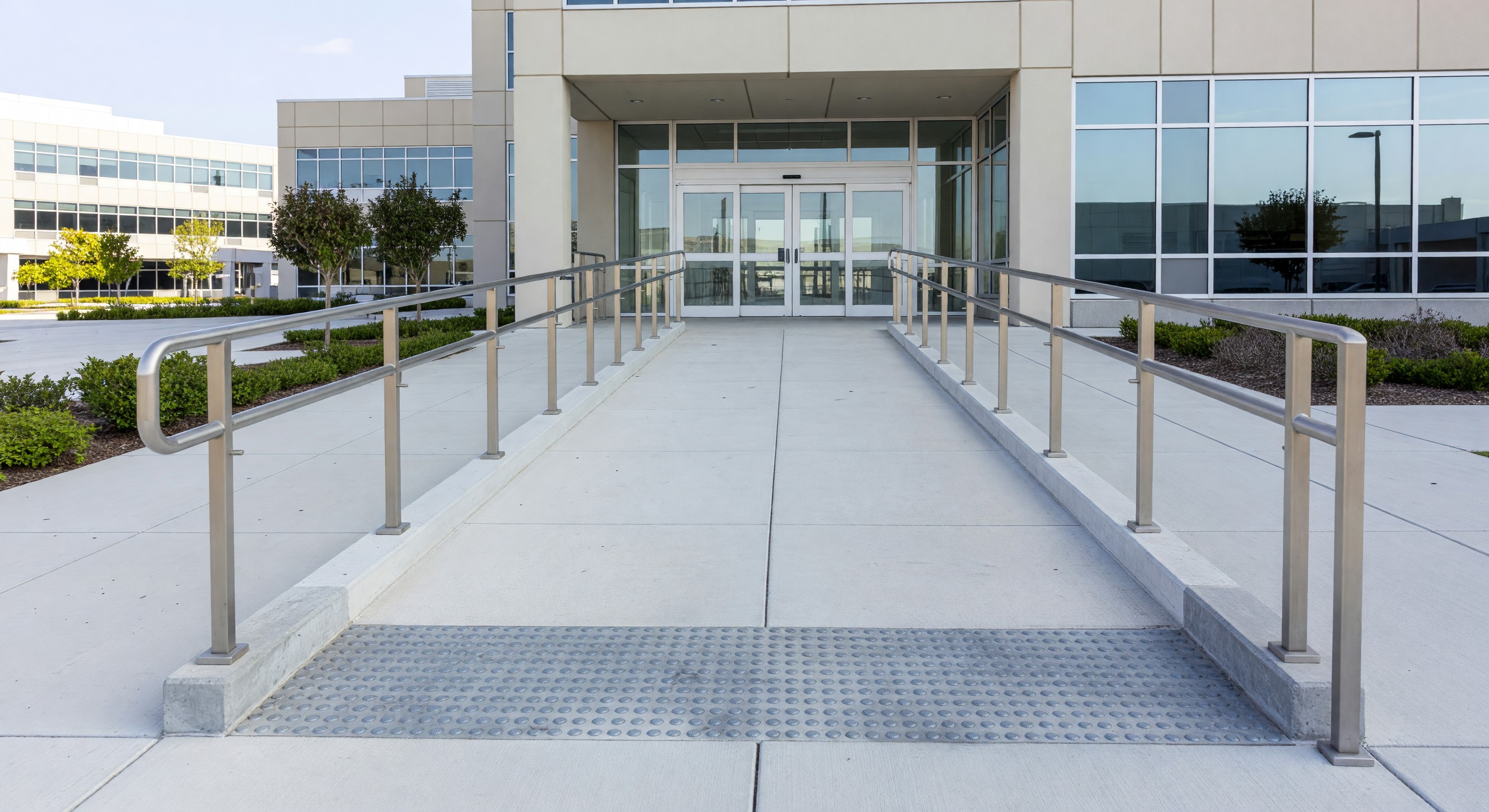
The Americans with Disabilities Act (ADA) and its implementing standards — the 2010 ADA Standards for Accessible Design — apply comprehensively to healthcare facilities. Hospitals and medical campuses are among the most frequently used facilities by people with disabilities, making accessibility not merely a legal obligation but a fundamental service quality issue.
For healthcare facility directors, ADA compliance spans physical infrastructure, communications, equipment, and policies. A single accessibility barrier in a care delivery environment can result in delayed or foregone care — a genuine health equity outcome, not just a compliance gap.
The Legal Framework
The ADA applies to healthcare facilities through two primary titles:
Title II governs state and local government entities, including public hospitals, county health departments, and facilities operated by government health authorities.
Title III governs places of public accommodation, which includes virtually all privately operated healthcare facilities. Title III requires that places of public accommodation be accessible to individuals with disabilities.
The 2010 ADA Standards for Accessible Design (based on ANSI A117.1) provide the technical requirements for building accessibility. Facilities built or significantly altered after March 15, 2012, must meet the 2010 standards. Existing facilities built before that date must comply with the older 1991 standards unless a major renovation triggers current-standard compliance.
Section 504 of the Rehabilitation Act applies to any entity receiving federal financial assistance — which includes virtually all hospitals through Medicare and Medicaid reimbursements.
Accessible Routes and Entrances
The accessible route — the continuous, unobstructed path from parking, public transportation, and site arrival points to the building entrance and within the building — is the foundation of ADA compliance.
Requirements for accessible routes include:
- Minimum 44-inch clear width in corridors (60 inches where passing is required)
- Maximum 1:20 running slope (5%)
- Maximum 1:48 cross slope (2%)
- Firm, stable, slip-resistant surface
- No protruding objects extending more than 4 inches into the path at heights between 27 and 80 inches
At least 60% of building entrances must be accessible. In healthcare settings with multiple entrance points (main lobby, ED, specialty clinic, pharmacy), each primary entrance must be accessible.
Automatic door openers are not required by ADA but are strongly recommended in healthcare settings where patients may be using wheelchairs, crutches, walkers, or IV poles. A non-powered heavy door is technically compliant but practically inaccessible for many patients.
Patient Care Areas
The 2010 ADA Standards include requirements specific to healthcare facilities:
Exam and treatment rooms must have accessible routes, turning radius space (60-inch turning circle minimum), and accessible features on exam tables and equipment.
Accessible medical equipment is addressed in a separate guidance document from the U.S. Access Board (Technical Assistance Document on Medical Diagnostic Equipment). While not yet codified in ADA standards, the Access Board guidance addresses:
- Exam tables with adjustable heights (17–25 inches from floor)
- Imaging equipment (MRI, CT) with accessible transfer surfaces
- Mammography machines with accessible positioning
- Weight scales with accessible platforms and supports
Waiting areas must include accessible seating (space for wheelchairs alongside fixed seating, not just in isolated locations), accessible check-in counters (at least one section at 36 inches maximum height), and accessible signage.
Accessible Parking Requirements
2010 ADA Standards require:
- 1 accessible space per 25 spaces (1–25 total spaces), scaling up for larger facilities
- 1 van-accessible space with 11-foot width and 5-foot access aisle for every 6 accessible spaces
- Accessible spaces must be located on the shortest accessible route to the accessible entrance
- Access aisles must connect to accessible routes without crossing traffic lanes
- Signage per required specifications
In healthcare settings, the minimum ratios are frequently inadequate given the patient population. Many facility directors apply a planning standard of 2–4% accessible spaces (rather than the roughly 4% minimum required) and locate them specifically near specialty clinic entrances serving high-density disabled patient populations such as oncology and neurology.
Van-accessible spaces require overhead clearance of at least 98 inches for the access aisle and adjacent area — critical in parking structures with low overhead clearance.
Accessible Signage
Signage in healthcare facilities must meet ADA character height, contrast, finish, and placement requirements:
- Room designation signage must include Grade 2 Braille
- Characters must be raised (1/32 inch minimum)
- Matte or non-glare finish required
- Mounted between 48 and 60 inches to the centerline of the sign
- Mounted on the latch side of the door
Overhead directional signs (suspended or wall-mounted above reach range) are exempt from Braille and tactile character requirements but must meet legibility standards including minimum character size and contrast ratio.
Wayfinding systems in healthcare facilities should include auditory components (audio navigation apps or human assistance) for patients with visual impairments.
Communication Accessibility
Title III requires that healthcare facilities provide effective communication to people who are deaf, hard of hearing, or have speech disabilities. Requirements include:
- TTY or equivalent relay service access for telephone communication
- Video Remote Interpreting (VRI) or in-person sign language interpreters for significant clinical communications
- Captioned televisions in patient rooms and waiting areas
- Written communication as an alternative when other means are unavailable
The facility cannot charge patients for accessibility accommodations.
Self-Assessment and Transition Plans
Public entities (Title II) are required to complete a self-evaluation of accessibility barriers and develop a transition plan for addressing identified barriers. Private entities (Title III) are not required to maintain a formal transition plan but are advised to do so as a litigation risk management strategy.
An accessibility self-assessment should cover:
- Site arrival and parking
- Accessible routes to all entrances
- All primary public and patient-facing areas
- Patient restrooms
- Exam and treatment rooms
- Communication systems
- Signage
Prioritize barrier removal based on the frequency of use and the severity of the barrier. A missing accessible route element at the most-used patient entrance should be addressed before a minor issue in a rarely used corridor.
Frequently Asked Questions
Do ADA requirements apply to temporary construction barriers? Yes. When construction creates a temporary accessible route disruption, an alternative accessible route must be provided and clearly signed. Temporary inaccessibility without an alternative route is an ADA violation. Include accessible route maintenance in your Interim Life Safety Measure planning during any construction project.
What is the difference between ADA compliance and universal design? ADA compliance meets the minimum legal threshold. Universal design is the practice of designing spaces to be usable by the broadest possible range of people without adaptation. Universal design exceeds ADA requirements in many areas — wider corridors, lower counter heights, better lighting, clearer signage. In healthcare, universal design reduces barriers for aging patients and those with temporary disabilities as well as permanent disabilities.
How do we handle a patient complaint about physical accessibility? Investigate promptly and document the barrier, the complaint, and your response. Correct any legitimate accessibility barrier without delay. Inform the patient of the corrective action taken. If the barrier is a systemic issue requiring capital investment, develop a timeline and interim accommodation plan. Defensible responses combine good faith remediation with clear documentation.
Is our obligation limited to the building itself, or does it extend to our website and digital tools? The DOJ has increasingly taken the position that Title III applies to websites and digital tools of covered entities. Healthcare patient portals, online scheduling, telehealth platforms, and digital forms must be accessible (WCAG 2.1 AA is the widely recognized standard). This is an area of active litigation and regulatory development.