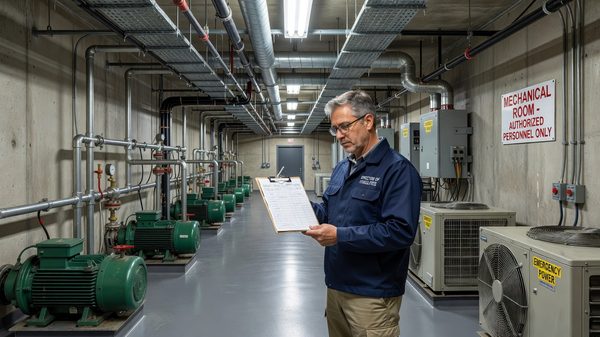
On January 1, 2026, the Joint Commission retired the separate Environment of Care (EC) and Life Safety (LS) chapters for hospitals and critical access hospitals and replaced them with a single Physical Environment (PE) chapter, part of its Accreditation 360 overhaul. Ten months in, the public record is thin on hard survey statistics, but the structure is clear, the guidance from the organization itself is specific on several points, and enough practical lessons have surfaced to separate what changed from what only looks like it did.
What actually changed
The Joint Commission’s own published materials describe the new chapter as modeled on the structure of the CMS Conditions of Participation. Standards and elements of performance that go beyond CMS requirements were moved into a separate National Performance Goals (NPG) chapter. Infection Control and Emergency Management remain standalone chapters, though some emergency management content also moved to NPG. Each standard lists the elements of performance and the Conditions of Participation they derive from, so a surveyor and a facility manager are now reading the same cross-reference.
Health Facilities Management magazine reported that the revision removed 714 requirements from the hospital program and 649 from the critical access hospital program, and that it added no new standards and removed no CMS requirements. A consultant analysis from Environmental Health & Engineering, written in 2025 before the effective date, counted 63 elements of performance in the combined PE and NPG material tied to former EC and LS standards, against 195 EC and 269 LS elements previously. Those figures come from secondary sources and counting conventions differ, so treat them as order-of-magnitude indicators rather than exact tallies. Vendor pages circulating other totals do not reconcile with each other and are best ignored.
The codes did not change. Both sources point out that the underlying requirements, including the 2012 editions of NFPA 101 and NFPA 99 that CMS enforces, are the same. A hospital that was meeting the old standards and doing the same work is, in substance, still meeting the new ones.
Lesson one: written management plans no longer carry the survey
The most consequential operational change is the treatment of management plans. According to the January 2026 Environment of Care News, as relayed by consultant Matthew Daniel in Health Facilities Management, hospitals (other than ambulatory care organizations) no longer need a separate written management plan for each of safety, security, hazardous materials and waste, utilities, and medical equipment. That requirement had come from the old planning standard, EC.01.01.01. Surveyors will review only three plans: the fire response plan, the water management plan, and the emergency operations plan.
This is a documentation relief that invites a mistake. The plans were never only paperwork. They recorded committee structure, ownership, monitoring and rounding processes, and staff education. A facility that discards them to save effort will lose the written record that explains how its programs run, and a surveyor tracing an issue will ask how the organization knows its program works. The practical middle path is to keep a short program description for each former plan area, update it annually, and stop maintaining the long narrative versions nobody reads.
Lesson two: the numbering moved, the findings did not
Many standard numbers changed, and deficiencies are now cited under broader categories. Joint Commission-related guidance indicated a grace period for organizations whose policies still cite old numbering, provided the underlying requirement is met. That grace should not be read as permission to leave binders unrevised. Crosswalk tables and compare reports are available publicly, and a one-time update of policy references (EC and LS numbers to PE numbers) is a manageable task. Examples reported by consultants include PE.03.01.01 for Life Safety Code compliance, PE.03.02.01 for interim life safety measures, and PE.04.01.05 for water management. Verify any specific number against the current manual before printing it in a policy.
A second consequence of consolidation, flagged by the EH&E analysis as its own prediction rather than a Joint Commission rule, is that grouping several issues under fewer elements of performance could push findings further across the scoring matrix. If that holds, a cluster of minor fire door or penetration issues would be more visible than before.
Lesson three: what surveyors keep finding
The Joint Commission’s June 2026 JC News, as summarized by secondary reporting, lists frequent physical environment improvement opportunities including electrical panels with inaccurate or missing breaker legends and environmental risk mitigation plans that are vague or absent. The January 2026 Joint Commission Perspectives similarly describes recurring findings around expired supplies and equipment, stained or damaged ceiling tiles, peeling paint, damaged walls, unclean surfaces in care areas, and temperature and humidity out of range in operating rooms and sterile areas, sometimes with missing documentation or no evident corrective action.
None of these requires a capital project. Panel legends are a half-day task per electrical room if the one-line diagram is current. Temperature and humidity logs for sterile areas need an alarm limit, a named reviewer, and a corrective action field that is filled in. Ceiling tile and paint conditions depend on a rounding process that reports and closes work orders quickly. They are management findings, not engineering ones, and they track closely with the discipline described in our Physical Environment chapter overview.
Lesson four: the survey itself changed in smaller ways
A Joint Commission-affiliated speaker at a 2026 conference characterized the survey process as largely unchanged apart from the new standards, with additional time spent at business occupancies listed on the hospital’s certificate or Statement of Conditions. The EH&E analysis notes that since July 1, 2025, Life Safety surveyors must visit offsite business occupancy locations, which can add surveyor days, and that reports are now ordered by placement on the SAFER Matrix so the highest-priority findings appear first. Teams with offsite clinics, administrative buildings, or leased space should confirm that those buildings have current inspection, testing, and maintenance records, not only the main campus.
Where facility teams are still exposed
The same pattern appears across the sources. Teams relaxed about the chapter merger and then discovered that the work underneath was the same, with less room for a vague answer. The areas most worth a second look this fall:
- Inspection, testing, and maintenance evidence. Fire door, damper, sprinkler, and emergency power records must tie to the code editions CMS enforces. Our NFPA 110 testing guide covers the generator side.
- Offsite and leased locations. Include them in rounding and records reviews.
- Risk mitigation documentation. If a hazard is accepted temporarily, the plan should say what it is, who owns it, and when it closes.
- Policy references. Replace EC and LS citations with PE or NPG equivalents, and check each against the current manual.
A practical read at ten months
Accreditation 360 changed the map more than the territory. For a facility director, the change is that the survey conversation is more likely to start with how the organization knows its building is safe and less likely to start with whether a binder exists. Keep the evidence current, close the small findings fast, and treat the merged chapter as a reason to retire duplicated paperwork rather than the underlying rounds.