Pressure differentials between critical spaces and adjacent corridors are one of the least visible and most consequential building-systems requirements a hospital facility team manages. A positive-pressure operating room and a negative-pressure airborne-infection isolation (AII) room both depend on a consistent, measurable pressure relationship holding steady around the clock — and summer cooling load is one of the most common conditions that quietly erodes that margin, often without an obvious alarm until a surveyor’s pressure-differential reading or a device malfunction reveals the gap.
Why Summer Is the Season Pressure Differentials Actually Fail
Pressure relationships in surgical suites and AII rooms are maintained by a balance between supply and exhaust airflow rates, and that balance is more fragile than it appears on a design drawing. As outdoor temperatures rise and central chiller plants run closer to capacity, several things happen simultaneously that stress the pressure-control system:
- Variable air volume (VAV) boxes work harder and drift further from calibration as they modulate more aggressively to meet cooling demand, and a VAV box that has drifted out of calibration is one of the most common root causes of a degraded pressure relationship.
- Chiller plant capacity constraints during extended heat events can force load-shedding decisions that affect air handling unit output across a facility, and a reduction in overall supply air capacity can ripple into pressure-critical zones if load-shedding isn’t planned with those zones protected as a priority.
- Filter loading accelerates as air handlers run longer hours at higher volumes during peak cooling season, and a heavily loaded filter changes the actual airflow delivered even when the unit’s control sequence assumes design conditions.
- Building envelope and stack effects change with outdoor-to-indoor temperature differential, and a larger differential during a heat wave can alter infiltration and exfiltration patterns in ways that interact with a room’s designed pressure relationship.
None of these are dramatic failures on their own — they’re gradual drifts that compound. A room that was in compliance during a spring commissioning check can be measurably out of tolerance by mid-summer without any single obvious cause.
What the Guidelines Actually Require
The 2022 Facility Guidelines Institute (FGI) Guidelines, which ASHE references as the design-standard baseline for healthcare facilities, specify pressure-differential tolerances for AII and protective-environment (PE) rooms, along with monitoring and alarm requirements. The specifics vary by room type and are detailed in the current FGI edition and the ASHRAE 170 ventilation standard it references, so facility teams should confirm current numeric tolerances against those primary documents rather than relying on secondary summaries — tolerances and monitoring requirements have been refined across FGI editions and getting the exact figure wrong in a compliance document is a real risk.
What’s consistent across editions is the underlying intent: AII rooms must maintain negative pressure relative to the corridor to prevent airborne pathogens from migrating into adjacent spaces, PE rooms must maintain positive pressure to protect immunocompromised patients from external contaminants, and surgical suites generally require positive pressure relative to adjacent spaces to protect the sterile field. Continuous monitoring with visual or audible alarm on pressure excursion is the standard expectation for these room types, not periodic spot-checking alone.
Where Surveyors and Infection Preventionists Actually Look
Both CDC infection-control guidance and Joint Commission surveyors have flagged pressure-differential failures as a recurring deficiency during warm-weather survey seasons, and the pattern of what gets found is consistent:
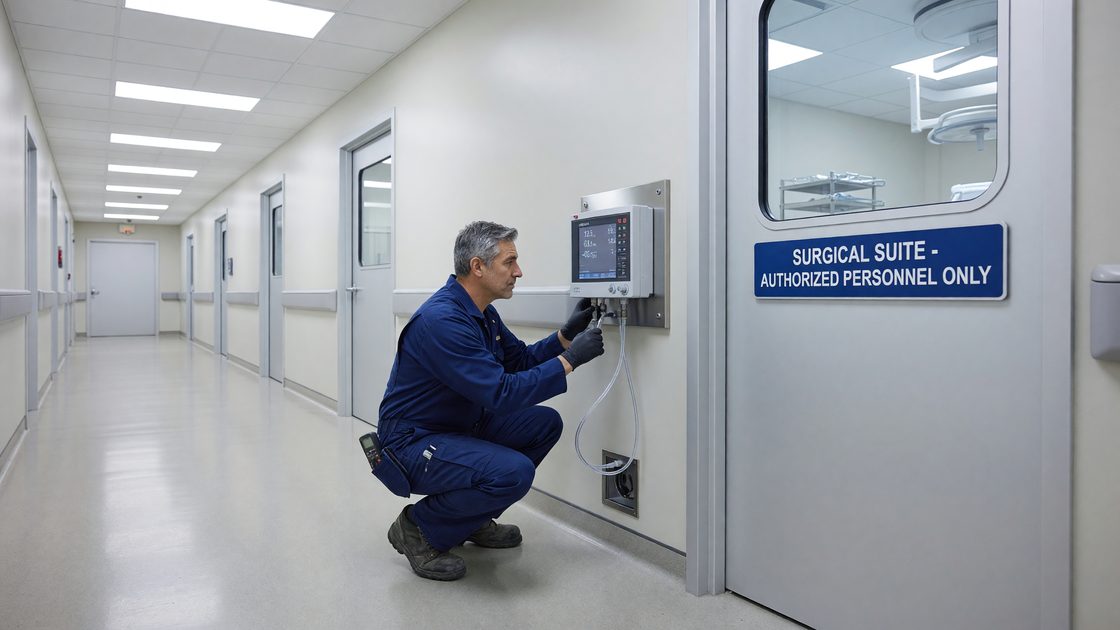
- A pressure monitor reading in range but not actually reflecting current airflow conditions, because the monitor itself has drifted out of calibration or the sensor location no longer represents the room’s actual pressure relationship after a renovation or door replacement.
- Documented monitoring logs with gaps or implausibly uniform readings, which read to a surveyor as a manual entry process rather than a genuinely monitored system.
- AII or PE room doors that don’t seal properly, undermining the pressure relationship regardless of what the HVAC system is doing — door sweep condition and self-closing mechanism function are frequently checked alongside the pressure reading itself.
- Rooms converted for a different clinical use without re-verifying the pressure relationship, particularly during a busy summer census period when a room originally designed as an AII room gets pressed into different service temporarily.
A Peak-Season Verification Sequence
Facility teams can reduce the risk of a summer compliance gap by treating peak cooling season as a distinct verification window rather than relying solely on the standard commissioning schedule:
- Re-verify pressure-monitor calibration ahead of the season, not just on the standard annual interval, since the monitors most likely to drift are the ones under continuous load during the highest-demand months.
- Cross-check monitor readings against an independent handheld measurement periodically rather than trusting the fixed monitor’s own reading exclusively — a monitor reading in range that doesn’t match an independent spot-check is a calibration failure waiting to be discovered by a surveyor instead of by your own team.
- Coordinate with the chiller plant and BAS team on any planned load-shedding sequence, and explicitly flag pressure-critical rooms as protected zones that should not have their supply air reduced during a capacity-constrained period, even if that means shedding load elsewhere first.
- Increase filter-change frequency proactively during peak season rather than waiting for a differential-pressure alarm across the filter bank, since accelerated loading during high-runtime months can outpace a standard seasonal filter-change schedule.
- Include pressure-critical rooms in any construction or renovation infection-control risk assessment, confirming that adjacent work doesn’t compromise door seals, ductwork, or the room’s pressure boundary even temporarily.
Coordinating Across Facilities, Infection Prevention, and Clinical Teams
A summer pressure-differential program rarely fails for lack of a single technical fix — it fails at the seams between departments. The facility engineering team owns the HVAC system and the monitors, infection prevention owns the clinical-risk interpretation of a pressure excursion, and clinical unit staff are the ones who actually notice when an isolation room door isn’t sealing or an alarm has been silenced. A verification sequence that lives only in the engineering department, without a defined handoff to those other groups, tends to catch the mechanical drift but miss the operational one.
Practical coordination steps that strengthen the program during peak season include agreeing in advance on who is notified when a pressure alarm trips and what the expected response is, so an excursion in an occupied AII room isn’t quietly acknowledged and reset without a clinical assessment of whether a patient was exposed. It also helps to give unit charge nurses a simple, non-technical way to report a suspected pressure or door-seal problem without having to diagnose it themselves, since frontline staff frequently notice a symptom — a door that won’t stay shut, a room that feels stuffy — before it registers as a formal alarm. Documenting these communication pathways, alongside the technical verification steps, is part of what distinguishes a genuinely monitored program from one that only looks monitored on paper.
Building This Into Standing Practice
The facilities that avoid a mid-summer pressure-differential finding treat the peak cooling season as a known-risk window with its own verification cadence, rather than assuming a spring commissioning check holds steady through the hottest months of the year. Documenting the peak-season verification sequence itself — not just the individual readings — gives a facility director a defensible record showing the program actively accounts for seasonal load, which is a meaningfully stronger survey posture than static annual documentation that doesn’t reflect the actual operating conditions a room experiences across the year.
Frequently Asked Questions
Why do pressure differentials fail more often in summer than other seasons? Central chiller plants running near capacity, VAV boxes working harder and drifting from calibration, accelerated filter loading, and larger indoor-outdoor temperature differentials all compound during peak cooling season, gradually eroding the pressure margin in ways that aren’t always obvious until a reading or survey catches the drift.
What’s the difference between AII room and protective-environment room pressure requirements? AII (airborne infection isolation) rooms require negative pressure relative to the corridor to contain airborne pathogens, while protective-environment (PE) rooms require positive pressure to protect immunocompromised patients from external contaminants — the two room types have opposite pressure relationships and shouldn’t be confused during commissioning or verification.
Should facility teams rely on fixed pressure monitors alone, or verify with handheld instruments too? Periodic independent verification with a handheld instrument is a valuable check against fixed-monitor calibration drift — a monitor reading in range that doesn’t match an independent spot-check indicates the monitor itself needs recalibration, and finding that internally is far better than a surveyor finding it first.
Can a room’s pressure relationship change if it’s temporarily used for a different clinical purpose? Yes — converting a room to a different use, even temporarily during a high-census period, can affect the pressure relationship if door seals, airflow paths, or occupancy patterns change. Re-verify the pressure relationship rather than assuming the original commissioning still applies after a use change.
What documentation should facility teams keep to demonstrate genuine (not just periodic) pressure monitoring? Continuous monitoring logs that reflect actual, varying real-world conditions rather than implausibly uniform readings, calibration records for the monitors themselves, and evidence of a peak-season verification sequence beyond the standard annual commissioning check all strengthen a facility’s documented compliance posture.
Further Reading from Authoritative Sources
- ASHE — American Society for Health Care Engineering — facility design and ventilation guidance referencing the FGI Guidelines and ASHRAE 170 standard.
- CDC — Environmental Infection Control Guidelines — infection-control guidance covering ventilation and pressure-differential requirements in healthcare settings.