The Sterile Processing Department (SPD) — also called Central Sterile Supply, Sterile Processing and Distribution, or Decontamination and Sterilization — is one of the most infrastructure-intensive departments in a hospital. It operates with strict environmental, utility, and workflow requirements that directly affect surgical site infection rates and patient safety.
For healthcare facility directors, SPD represents a department where physical plant failures have immediate clinical consequences. Understanding the facility requirements that AAMI, ASHRAE, and The Joint Commission define for SPD — and ensuring those requirements are met continuously — is essential.
Functional Zone Design
An SPD operates across three functionally and physically separated zones:
Decontamination Zone — The soiled zone. Contaminated instruments and equipment arrive here from clinical departments. Technicians wearing appropriate PPE (fluid-resistant gowns, face shields, gloves) manually clean and mechanically wash instruments. This zone operates under negative pressure relative to adjacent spaces.
Preparation and Assembly Zone — The clean zone. Decontaminated instruments are inspected, assembled into sets, and packaged for sterilization. This zone must maintain positive pressure relative to the decontamination zone.
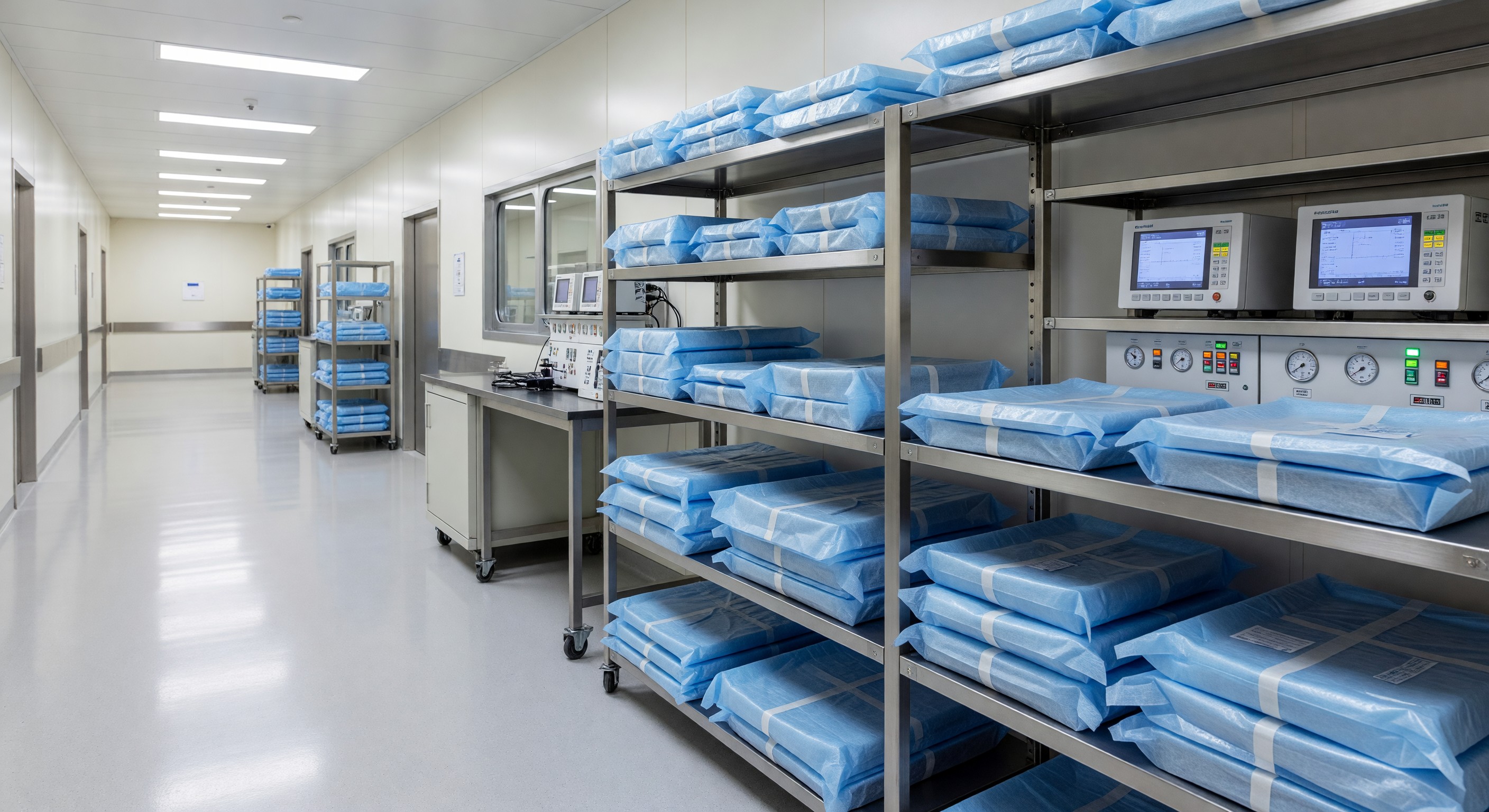
Sterile Storage Zone — Sterilized items are stored here prior to distribution to clinical departments. Positive pressure, controlled temperature, and humidity maintain sterility of wrapped and sealed items.
Physical separation between zones is critical. The workflow must be unidirectional — contaminated items enter decontamination, flow through preparation and assembly, and exit as sterile items. Any pathway that allows contaminated items to re-enter clean zones represents a design failure.
ASHRAE 170 Requirements for SPD
ASHRAE 170-2021 provides specific environmental requirements for SPD spaces:
| Space | ACH (Total) | ACH (Outdoor) | Pressure | Temp °F | Humidity %RH |
|---|---|---|---|---|---|
| Decontamination | 6 | 2 | Negative | 60–65 | 30–60 |
| Prep and Assembly | 4 | 2 | Positive | 68–73 | 30–60 |
| Sterile Storage | 4 | 2 | Positive | 75 or cooler | 30–60 |
The negative pressure in decontamination is critical for infection control — it prevents aerosols and biocontaminants from decontamination activities (particularly when using high-pressure washer jets) from migrating to clean zones. Pressure differential must be monitored continuously.
Temperature requirements reflect both worker comfort (decontamination is physically demanding PPE-intensive work in a warm zone) and product integrity (sterile storage cool temperatures extend sterilization indicator performance and packaging integrity).
Utility Requirements
SPD is a utility-intensive department:
Steam — Autoclave sterilizers require clean steam meeting AAMI TIR34 quality standards. Steam quality monitoring is required — chemical contamination from boiler treatment compounds in patient contact areas is a clinical concern. Steam pressure must be adequate for the sterilizer’s design and maintained without significant fluctuation.
Water — Sterilizers, washers, and ultrasonic cleaners require water of specific quality. Final rinse in washer-disinfectors should use water that meets purified water standards (resistivity, total dissolved solids, bacterial limits per AAMI ST79). RO or DI water systems may be required depending on the equipment specifications and local water quality.
Electrical — Sterilizers, washers, washer-disinfectors, pass-through units, and ETO sterilizers (where used) have substantial electrical demands. Single-phase and three-phase requirements vary by equipment. Emergency power provisions must be defined — which SPD equipment is on the critical branch, and what happens during a power failure.
Compressed air — Some sterilizers use compressed air in drying cycles and control systems. Compressed air must meet the pressure and quality specifications for the equipment.
Exhaust — ETO sterilizer exhaust must be managed per OSHA and EPA requirements. Washer exhaust (steam and water vapor) must be adequately ventilated to prevent condensation issues in the department.
AAMI Standards for SPD
The Association for the Advancement of Medical Instrumentation (AAMI) publishes the primary technical standards for sterilization processes used in SPD:
AAMI ST79 — Comprehensive guide to steam sterilization and sterility assurance in health care facilities. The most broadly used AAMI standard for SPD operations, covering biological indicators, chemical indicators, sterilizer testing, and documentation requirements.
AAMI ST41 — EO sterilization in health care facilities.
AAMI TIR30 — Decontamination of reusable medical devices.
AAMI ST91 — Flexible and semi-rigid endoscope processing.
Joint Commission surveyors and SPD-focused accreditation reviewers from SGNA and others expect facilities to demonstrate compliance with applicable AAMI standards, particularly ST79 for steam sterilization.
Sterilizer Testing and Documentation
AAMI ST79 requires specific testing protocols for sterilizers:
Daily — Bowie-Dick test (for prevacuum sterilizers) or equivalent air removal test. Biological indicator run with the first load of the day. Chemical indicator with every load.
Weekly — Biological indicator challenge with test load.
Per load — Chemical indicator included in every sterilized load. Load record including sterilizer ID, cycle parameters, cycle date/time, and operator identification.
All test results must be documented and retained. Positive biological indicator results trigger a recall protocol for loads sterilized in the same sterilizer since the last negative result.
Joint Commission surveyors routinely review sterilizer logs during surveys. Missing documentation, gaps in testing, or poor record organization are common findings.
SPD Facility Management Issues
From a facility director’s perspective, SPD presents several recurring management challenges:
Steam quality maintenance — Boiler maintenance, steam trap performance, and steam quality testing must be coordinated between facilities and SPD to ensure consistent steam quality. A maintenance change to the boiler chemical treatment program must be reviewed for impact on steam quality.
Pressure differential monitoring — HVAC maintenance affecting SPD airflow — filter changes, damper adjustments, AHU work — can disrupt the critical pressure relationships between decontamination and clean zones. Any HVAC work affecting SPD should be coordinated with SPD leadership and verified by measurement after completion.
Construction adjacency — SPD near a construction zone is a high-infection-control-risk situation. Construction dust, vibration, and pressure changes can affect sterility conditions. Notify infection control and SPD management before any construction in or adjacent to SPD.
Frequently Asked Questions
What happens if SPD loses water quality (e.g., during a water system issue)? SPD should stop sterilization processing if water quality drops below the specifications in AAMI TIR34. Loads produced during the period of inadequate water quality must be quarantined pending quality review. SPD leadership should notify infection prevention and may need to recall items already distributed. Surgery scheduling may need to pause if sterile instrument supply is interrupted.
How do we manage SPD during a major HVAC repair that affects ventilation? If the repair affects decontamination pressure or clean zone positive pressure, SPD processing must pause during the impairment. A temporary pressure differential monitoring plan, using portable monitoring equipment, may allow limited operation if the differential can be verified during the repair period. Notify infection control and Joint Commission (for accreditation-sensitive impairments) and document the ILSM.
What are the space requirements per AAMI for a properly designed SPD? AAMI provides planning guidelines for SPD sizing based on surgical case volume. As a general benchmark, approximately 1.2–1.5 square feet of total SPD space per OR is a planning starting point for comprehensive surgical programs, though this varies significantly by service mix and workflow design. SPD renovations should be designed by architects and engineers with specific SPD experience, not general healthcare facility designers.
How do we evaluate whether our SPD meets current facility standards without a major renovation? Commission a gap assessment by a healthcare facility engineer and infection control expert with SPD experience. They will compare your current physical plant against current AAMI, ASHRAE 170, and applicable Joint Commission standards and produce a prioritized deficiency list. Many SPD improvements can be made through HVAC modifications, procedural changes, or targeted renovation rather than complete reconstruction.