Hospitals generate a complex mix of waste streams that require specialized infrastructure, strict handling protocols, and regulatory compliance spanning multiple agencies. Facility directors must understand not only how to collect and dispose of regulated medical waste, but how the physical infrastructure of waste management — storage rooms, transport routes, compactors, and treatment systems — integrates with the broader hospital environment.
Mismanagement of hospital waste creates risks for patients, staff, and the surrounding community, and can result in significant regulatory penalties from OSHA, EPA, and state environmental agencies.
Hospital Waste Stream Categories
Understanding the distinct waste categories is the foundation of compliant waste management infrastructure:
Regulated Medical Waste (RMW): Includes blood and body fluids, pathological waste, microbiological waste, sharps, and isolation waste from patients with communicable diseases. RMW is governed by state environmental agencies and OSHA’s Bloodborne Pathogen Standard (29 CFR 1910.1030).
Pharmaceutical Waste: Unused or expired medications require segregation and disposal through licensed pharmaceutical waste vendors. EPA’s Resource Conservation and Recovery Act (RCRA) categorizes pharmaceutical waste as hazardous (P-list or U-list) or non-hazardous, with different disposal requirements for each. The EPA’s 2019 Management Standards for Hazardous Waste Pharmaceuticals rule revised disposal requirements for healthcare facilities.
Chemotherapy Waste (Trace Hazardous Waste): Chemotherapy agents, residue, and contaminated materials require disposal as hazardous waste. NIOSH and the Oncology Nursing Society have established handling and disposal guidelines.
Radioactive Waste: Nuclear medicine departments generate low-level radioactive waste governed by the Nuclear Regulatory Commission (NRC). Storage for decay-in-storage is the most common management approach for short-lived isotopes.
General Solid Waste: Non-regulated solid waste — packaging, food service waste, administrative paper — follows standard municipal solid waste disposal pathways.
Universal Waste: Batteries, fluorescent lamps, and certain electronics follow EPA Universal Waste regulations with simplified requirements for accumulation and disposal.
Physical Infrastructure Requirements
Waste Accumulation and Staging Areas
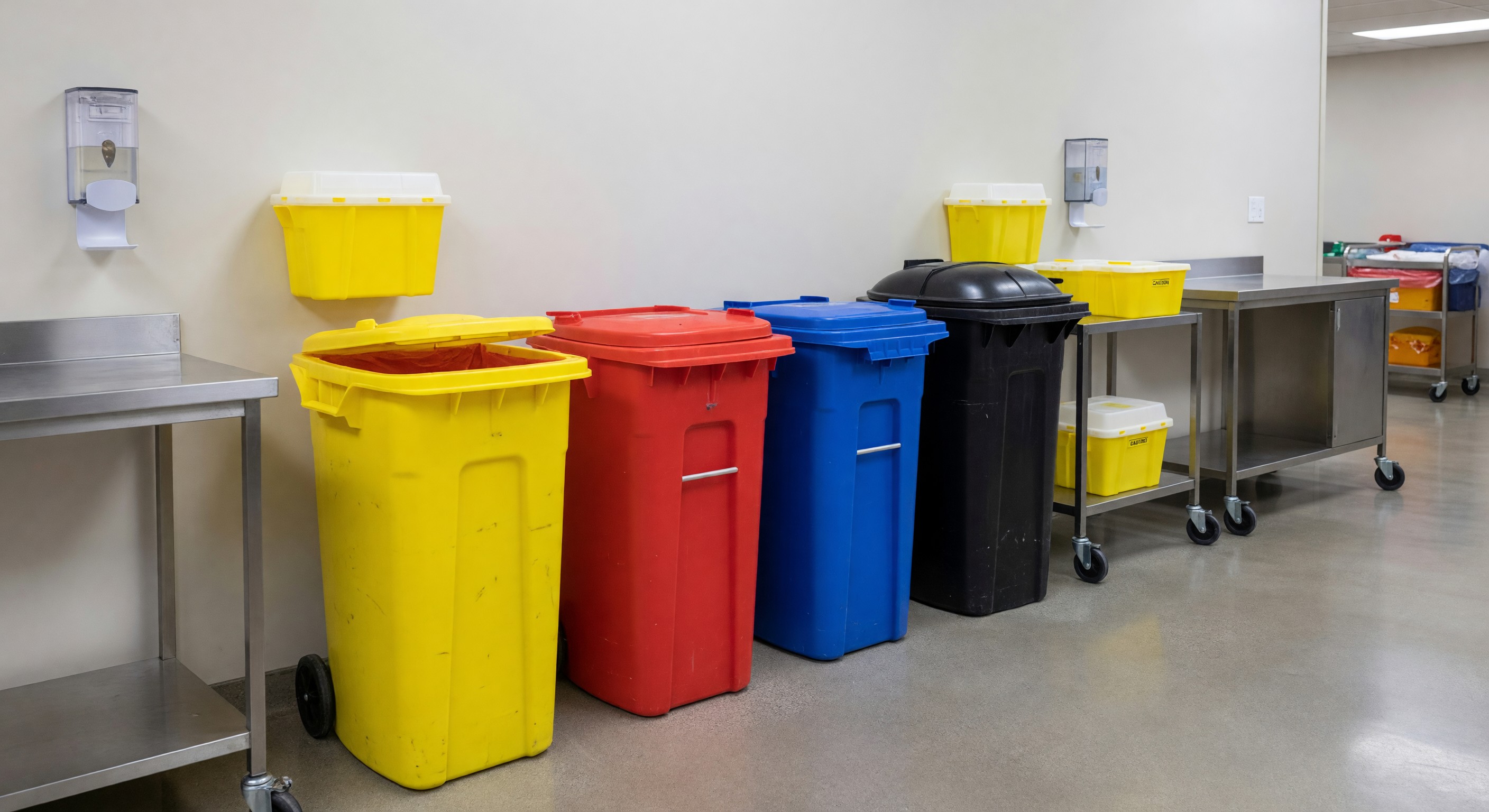
OSHA’s Bloodborne Pathogen Standard requires that RMW containers be closable, puncture-resistant, leak-proof, and color-coded (red or biohazard-labeled for RMW; yellow for chemotherapy waste). Storage areas must:
- Be secured against unauthorized access
- Have impervious, cleanable floors and walls
- Provide adequate ventilation to control odors and prevent pathogen aerosol buildup
- Be labeled with appropriate regulatory signage
- Maintain temperature control — RMW storage rooms should be cooled if waste will be held more than 24-48 hours to control odor and bacterial growth
Satellite accumulation points at point-of-care (sharps containers in patient rooms, RMW bags in clinical areas) must be managed to prevent overfilling and transported to central accumulation areas on a defined schedule.
Transport Routes and Equipment
Waste transport within the hospital must be designed to minimize patient and visitor contact. Best practices include:
- Dedicated service elevators for waste transport, separate from patient and visitor elevators
- Wheeled carts or pneumatic tube systems for sharps transport in high-volume facilities
- Enclosed transport containers to prevent leaks and contain any packaging failures during transport
- Defined transport routes documented in the waste management plan, reviewed for infection control risk
On-Site Treatment Options
Some large hospitals operate on-site medical waste treatment systems to reduce the volume of off-site transport:
Autoclaving (steam sterilization): The most common on-site RMW treatment method. Steam at 121°C for defined cycle times renders most biological waste non-infectious. Autoclaved waste can typically be disposed of as solid waste after treatment.
Microwave treatment systems: Use microwave energy with steam to achieve sterilization. More compact than autoclaves; appropriate for mid-volume facilities.
Compaction: General solid waste compactors reduce volume for disposal but should never be used for unsterilized RMW or sharps.
On-site treatment systems require operating permits from state environmental agencies and regular equipment maintenance documentation.
Sharps Safety and Infrastructure
Sharps injuries remain a significant occupational hazard in healthcare despite advances in safety-engineered devices. OSHA’s Bloodborne Pathogen Standard requires:
- Evaluation and use of safety-engineered sharps devices (needleless systems, retractable needles)
- Puncture-resistant sharps containers at point of use
- Containers positioned to allow one-handed disposal without reaching over the needle
- Container replacement before the fill line — never overfilled
Sharps container selection: Wall-mounted, bedside, and floor-standing containers serve different clinical settings. Reusable sharps container programs using on-site sterilization can reduce waste volume and disposal costs compared to single-use containers.
Pharmaceutical Waste Compliance
The EPA’s 2019 Pharmaceutical Waste rule significantly changed management requirements for healthcare facilities. Key changes:
- Hospitals are classified as “healthcare facilities” under RCRA, with specific standards different from general industry
- Reverse distribution is eliminated as a compliant option for hazardous pharmaceutical waste disposal
- Sewering of hazardous pharmaceuticals (including many controlled substances) is prohibited
- Nicotine replacement products were added to hazardous waste lists
Facility directors should coordinate with pharmacy leadership and the environmental health and safety team to ensure waste segregation programs are aligned with current EPA requirements. Regular staff training on pharmaceutical waste segregation at point of care is essential — improper disposal that places hazardous pharmaceuticals in the municipal sewer is both a regulatory violation and an environmental harm.
Documentation and Recordkeeping
Regulatory compliance requires comprehensive waste management documentation:
- Waste manifests for all RMW shipped off-site (copies maintained for minimum 3 years)
- Hazardous waste manifests for RCRA-regulated pharmaceutical waste (maintained minimum 3 years)
- Training records for all staff who handle regulated waste
- Incident records for spills, exposures, or container failures
- Annual regulatory reports as required by state agencies and EPA (for large quantity generators)
Joint Commission Environment of Care standards (EC.02.02.01) require hospitals to manage hazardous materials and waste, with documented annual evaluations of the hazardous materials and waste management program.
Frequently Asked Questions
What is the difference between RMW and hazardous waste in a hospital context? Regulated medical waste (RMW) is defined by state environmental regulations and primarily concerns biological/infectious waste. Hazardous waste is defined by EPA/RCRA and primarily concerns chemical hazards including pharmaceuticals and chemotherapy agents. Some waste streams (e.g., chemotherapy waste) may be regulated under both frameworks simultaneously.
Does OSHA inspect hospital waste management? Yes. OSHA inspects healthcare facilities for compliance with the Bloodborne Pathogen Standard, which includes sharps disposal and RMW handling. Inspections may be triggered by complaints, after reported exposure incidents, or through programmed inspections in high-risk industries.
Can hospitals flush unused medications down the drain? EPA regulations generally prohibit flushing hazardous pharmaceuticals. A limited list of high-risk controlled substances (like fentanyl patches) may be authorized for flushing under FDA guidance to prevent diversion. All other pharmaceutical waste should be collected and disposed through licensed vendors. Facilities should review their current pharmaceutical waste policy against current EPA requirements.
How often should waste management training be conducted? OSHA’s Bloodborne Pathogen Standard requires training at hire and annually thereafter for all workers with occupational exposure. Additional training is required when new tasks or procedures create new exposure risks. Training documentation must be maintained for at least three years.