Modern hospital operations depend on continuous, reliable telecommunications. Clinical systems — electronic health records, nurse call, patient monitoring, RTLS, and voice communications — all ride on the same physical infrastructure. A cable failure in the wrong location can disrupt care delivery and trigger regulatory scrutiny.
Facility directors bear responsibility for the physical telecommunications plant: structured cabling, network closets, wireless access point placement, and the physical security of telecommunications rooms. Understanding the standards and best practices that govern this infrastructure is essential for long-term reliability.
Structured Cabling Standards
Hospital telecommunications infrastructure is governed by ANSI/TIA-568 (structured cabling systems) and ANSI/TIA-569 (telecommunications pathways and spaces). These standards define:
- Horizontal cabling: from the telecommunications room (TR) to workstation outlets
- Backbone cabling: between distribution frames, main cross-connects, and telecommunications rooms
- Work area components: patch cords and equipment connections at the endpoint
Category 6A cabling is the current minimum recommendation for new healthcare construction. Cat 6A supports 10 Gigabit Ethernet at full 100-meter distances — critical as clinical systems demand increasing bandwidth. Cat 5e, while still functional, should be replaced during renovation cycles.
Fiber optic backbone: Multimode or single-mode fiber between telecommunications rooms provides high-bandwidth, interference-resistant backbone connectivity. Healthcare environments with heavy imaging workloads (PACS, fluoroscopy, ultrasound) particularly benefit from fiber backbone.
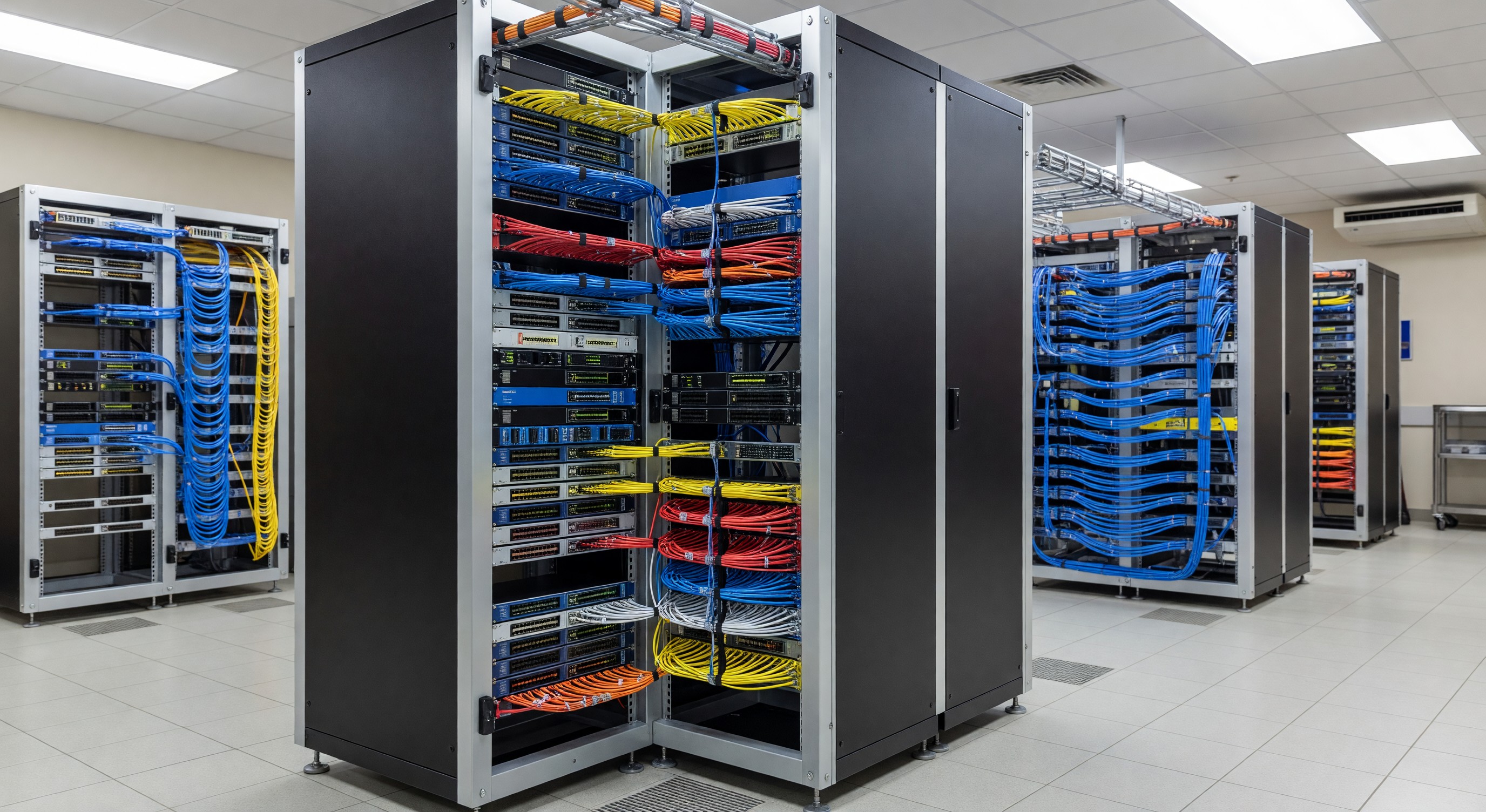
Cable management: Proper cable management in telecommunications rooms is not cosmetic — it enables faster troubleshooting, reduces heat buildup around active equipment, and prevents accidental disconnection. TIA-569 specifies minimum bend radius, fill ratios in conduit, and labeling requirements.
Telecommunications Room (TR) Design
Each floor or zone of a hospital requires at least one telecommunications room. Design standards per TIA-569 include:
- Minimum room size: 10 square meters for standard rooms; larger for high-density zones
- Dedicated electrical circuits with UPS backup for active network equipment
- Cooling: telecommunications rooms generate significant heat from active equipment; independent HVAC or precision cooling units prevent equipment thermal shutdown
- Physical security: TR door access should be controlled by badge credential, not master key, to create an audit trail of access events
- No water lines: telecommunications rooms should be free of plumbing to prevent water intrusion damage
Main data centers and network operations centers have additional requirements including raised flooring, N+1 cooling redundancy, and fire suppression systems appropriate for electronic equipment.
Wireless Infrastructure
Hospital wireless networks must support clinical mobility — nurses carrying tablets, physicians rounding with mobile devices, and wireless patient monitoring equipment. Key design considerations:
RF site survey: Before access point placement, a professional RF site survey identifies coverage gaps, channel interference, and wall material attenuation. Healthcare facilities present challenges including lead-lined radiology rooms, thick concrete walls, and high-density patient care units.
Access point density: Clinical settings require high AP density compared to commercial office environments. Patient care units with multiple wireless devices per room need APs spaced closer together to maintain adequate signal strength and minimize co-channel interference.
Frequency bands: Dual-band (2.4 GHz and 5 GHz) and tri-band (adding 6 GHz Wi-Fi 6E) infrastructure supports legacy devices on 2.4 GHz while delivering performance to modern clinical systems on 5 GHz and 6 GHz.
Clinical-grade wireless: Some clinical systems — wireless infusion pumps, patient monitoring — require Quality of Service (QoS) configurations that prioritize clinical traffic over general data. Network design should include VLAN segmentation and QoS policies coordinated with clinical engineering.
Redundancy and Reliability
Hospital telecommunications infrastructure must meet the reliability expectations of a life-critical environment:
Dual-path cabling: Critical systems — nurse call, code response, security — should have redundant cabling paths through separate conduit routes to eliminate single points of failure.
Generator-backed UPS: All telecommunications rooms should receive utility power on the essential electrical system (EES) per NFPA 99, with local UPS providing bridge power during generator transfer. Network equipment shutdown during a power event can disrupt clinical systems even when clinical devices themselves are generator-backed.
Redundant internet connectivity: Hospital internet connections should use diverse carriers with automatic failover. Telemedicine services, cloud-based EHR platforms, and remote monitoring all depend on continuous internet availability.
Fiber ring topology: Campus-scale hospitals often deploy fiber in ring topology, so a single cable cut does not isolate any segment of the network.
Telecommunications Infrastructure and Joint Commission
The Joint Commission does not audit cabling standards directly, but telecommunications infrastructure failures that affect clinical operations trigger EC.02.05.01 findings related to maintaining utility systems. Preventive maintenance documentation for active network equipment and UPS systems should be maintained as part of the utility management program.
Significant outages — including those caused by telecommunications failures — may qualify as sentinel events if patient harm results and must be addressed through root cause analysis per Joint Commission requirements.
Planning for Infrastructure Upgrades
Telecommunications technology evolves faster than most other hospital infrastructure. Planning for upgrades requires:
Technology refresh cycles: Active network equipment (switches, wireless controllers, access points) typically has a 5-7 year lifecycle. Capital planning should include telecom equipment alongside mechanical and electrical systems.
Capacity headroom: New construction should install conduit and pathways with 40% spare capacity per TIA-569 to accommodate future cabling runs without major construction disruption.
Coordination with clinical engineering: Any wireless infrastructure change must be validated with clinical engineering to confirm that wireless clinical devices continue to meet performance requirements after the change.
Frequently Asked Questions
What cabling category should new hospital construction use? Category 6A is the current recommended minimum for new healthcare construction, supporting 10GbE at 100 meters. For very high-density clinical areas or when a longer lifecycle is desired, some facilities are deploying Cat 8 in targeted applications, though Cat 6A remains the standard baseline.
Who owns hospital telecommunications infrastructure — IT or facilities? Physical infrastructure (cabling, conduit, telecommunications rooms, and physical security of those spaces) is typically owned by the facilities department. Active equipment (switches, wireless controllers) is owned by IT. This distinction matters for maintenance responsibility, capital budgeting, and Joint Commission documentation.
How often should a hospital conduct a wireless RF site survey? An initial design survey should occur before construction or major renovation. A validation survey should follow installation. Ongoing surveys are recommended every 3-5 years or whenever significant physical changes occur (new walls, equipment placement) or clinical wireless performance complaints arise.
What are the fire suppression requirements for telecommunications rooms? Telecommunications rooms containing active electronic equipment should use clean agent fire suppression systems (e.g., FM-200, Novec 1230) rather than wet-pipe sprinklers. NFPA 75 governs fire protection for IT equipment. The suppression system type must be coordinated with the local authority having jurisdiction (AHJ).