Structural systems — the concrete, steel, and masonry that form a hospital’s skeleton — rarely receive the same operational attention as mechanical, electrical, and plumbing systems. Yet structural integrity is foundational to everything else: patient safety, regulatory occupancy, and continuity of care. A structural failure in an acute care hospital is catastrophic in ways that mechanical failures are not.
Facility directors need a working understanding of structural system maintenance requirements, inspection protocols, and the seismic considerations that affect hospitals in earthquake-prone regions.
Why Hospital Structural Systems Deserve Active Management
Unlike commercial office buildings, hospitals carry life-safety designation under building codes — meaning they must remain operational during and after natural disasters to serve their community function. This essential facility status imposes higher design and maintenance standards than comparable occupancies.
Contributing factors that make hospital structural management distinct:
- Continuous heavy live loads: Medical equipment, patient beds, imaging systems (CT, MRI), and concentrations of people in specific areas create live loading patterns that differ from design assumptions as the facility evolves
- Seismic importance factor: In ASCE 7 (Minimum Design Loads for Buildings), essential facilities like hospitals carry a seismic importance factor of 1.5, meaning they must be designed to resist stronger seismic events than ordinary structures
- Renovation-induced modifications: Cutting structural members for new penetrations, adding loads from new equipment, and removing walls that contribute to lateral bracing are common renovation risks that must be engineered, not improvised
- Moisture and corrosion: Water intrusion through the envelope, condensation in mechanical spaces, and cleaning chemicals can corrode reinforcing steel and undermine concrete strength over decades
Structural Inspection and Assessment
Unlike mechanical systems, structural systems do not have prescribed annual PM schedules under NFPA or Joint Commission standards. However, facility directors should implement proactive structural inspection programs:
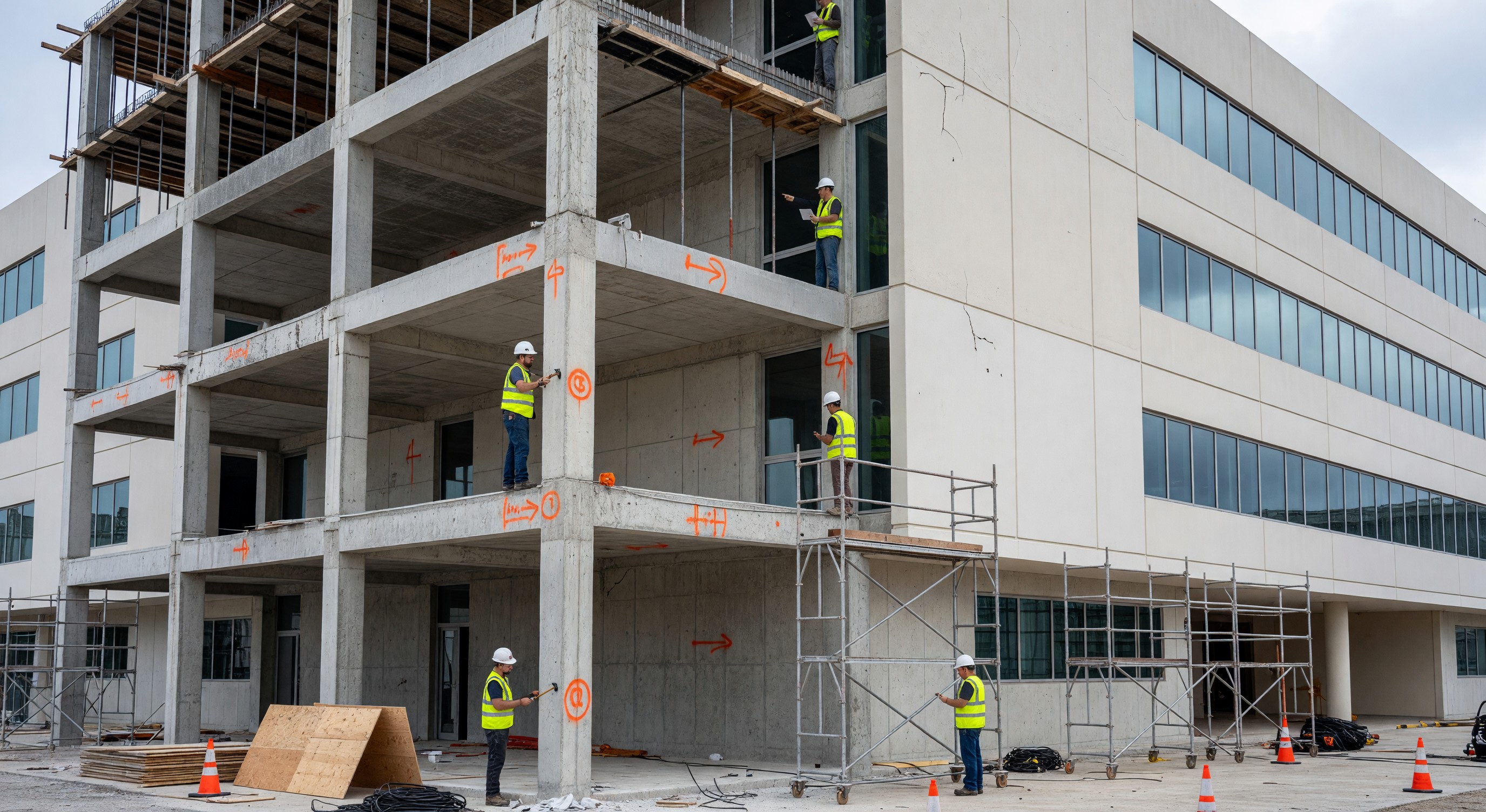
Periodic visual inspection: Structural staff or contracted engineers should conduct visual inspections of accessible structural elements — columns, beams, slabs, foundation walls — on a regular cycle. Look for:
- Concrete spalling or cracking
- Corrosion staining indicating rebar corrosion
- Deflection or settlement beyond design limits
- Masonry cracking or mortar deterioration
- Steel member corrosion or deformation
Post-event inspection: After any seismic event, significant flooding, major fire, or vehicle impact to the structure, a structural assessment should be conducted before declaring the affected area safe for continued occupancy.
Facility Condition Assessment (FCA): A comprehensive FCA typically conducted every 5-10 years should include structural system evaluation by a licensed structural engineer. The FCA identifies deficiencies, assigns remaining useful life estimates, and supports capital planning for structural remediation.
Renovation engineering review: Any renovation that involves cutting, coring, or loading structural members must be reviewed by a structural engineer before work proceeds. This is not optional — unapproved structural modifications can create immediate safety hazards and void occupancy permits.
Seismic Considerations for Essential Facilities
In seismic zones (ASCE 7 Seismic Design Categories D, E, and F, covering much of the western United States and portions of other regions), hospital structural requirements are substantially more stringent than ordinary commercial construction:
OSHPD requirements (California): California’s Office of Statewide Health Planning and Development (OSHPD) imposes mandatory seismic safety requirements for hospital buildings, including retrofit programs for older buildings that do not meet current standards. Non-structural bracing of mechanical, electrical, and plumbing systems is also mandated.
Non-structural seismic bracing: In seismic zones, it is not enough for the structural frame to survive an earthquake — ceilings, ductwork, pipe systems, equipment, and furnishings must be braced to prevent displacement and injury during seismic events. FEMA 412 and ASCE 7 Chapter 13 define non-structural seismic bracing requirements.
Seismic isolation systems: Some newer hospital buildings incorporate base isolation systems that decouple the building from ground motion, significantly reducing forces transmitted to the structure during earthquakes. Isolation systems require periodic inspection and maintenance per manufacturer requirements.
Soft story and torsion assessment: Older hospital buildings may have structural irregularities — soft stories with insufficient lateral resistance, plan irregularities causing torsional response — that create concentrated vulnerability in earthquakes. If a hospital operates in a seismic zone and has not been evaluated under current codes, a seismic assessment is warranted.
Façade and Envelope Interface
The structural system interacts with the building envelope — exterior walls, window systems, and roofing. Structural movement (thermal expansion, settlement, seismic drift) must be accommodated at these interfaces through properly designed and maintained expansion joints. Deficiencies at the structural-envelope interface are a common source of water intrusion that accelerates structural degradation.
Expansion joint covers and sealants should be inspected annually and replaced when deteriorated. Deferred maintenance at expansion joints consistently leads to water intrusion that damages structural elements, interior finishes, and mechanical systems.
Documentation and Record Keeping
Structural documentation is a long-term asset:
- Original structural drawings and specifications (as-built where available)
- Records of all structural modifications with engineering approvals
- Inspection reports from periodic visual inspections and FCAs
- Post-event assessment reports
- OSHPD compliance documentation (California facilities)
Structural records are needed during facility sales, financing, major renovation planning, and occasionally during regulatory inspection when structural modifications have affected occupancy classifications.
Frequently Asked Questions
Is there a required inspection frequency for hospital structural systems under Joint Commission standards? The Joint Commission does not specify structural inspection intervals. Building codes require permits and inspections for structural modifications, and jurisdictions may require periodic façade inspections for certain building types. Facility directors should establish a risk-based inspection program consulting with a licensed structural engineer, even without a prescribed regulatory requirement.
What triggers a mandatory structural assessment? Events that typically trigger an immediate structural assessment include: earthquake above M4.0 within 30 miles, significant flooding of structural spaces, major fire affecting structural members, vehicle or equipment impact to a structural element, and discovery of significant concrete cracking or structural distress during routine inspection.
Can facility staff perform structural inspections? Facility staff can conduct preliminary visual inspections and document observations. However, interpretation of structural distress — determining whether cracking indicates a safety issue or benign concrete shrinkage — requires a licensed structural engineer. Facilities should have a structural engineering relationship established before inspection findings require urgent evaluation.
How does equipment loading affect hospital structural systems? Heavy medical imaging equipment (3T MRI can weigh 30,000+ lbs including shielding) may require structural reinforcement for floor loads. New equipment installations should include a structural review comparing the equipment load to the floor’s rated capacity. Facility directors should require a structural loading check as part of every major equipment installation project.