Hospital roofs are complex, high-stakes assets. They shelter clinical operations continuously, support significant mechanical equipment loads, and their failure — whether through active leaks or latent moisture accumulation — creates immediate clinical disruption and long-term building envelope damage. Managing roofing systems with appropriate rigor is a core facility asset management responsibility.
Healthcare facility directors who treat roofing as a deferred maintenance item until leaks appear are consistently paying 3–5 times more for roof replacement than those who manage roofs proactively, because deferred maintenance allows water intrusion to damage the structural deck, insulation, and interior finishes that are far more expensive to remediate than the roof membrane itself.
Hospital Roof Complexity
Hospital roofs differ from commercial building roofs in several important ways:
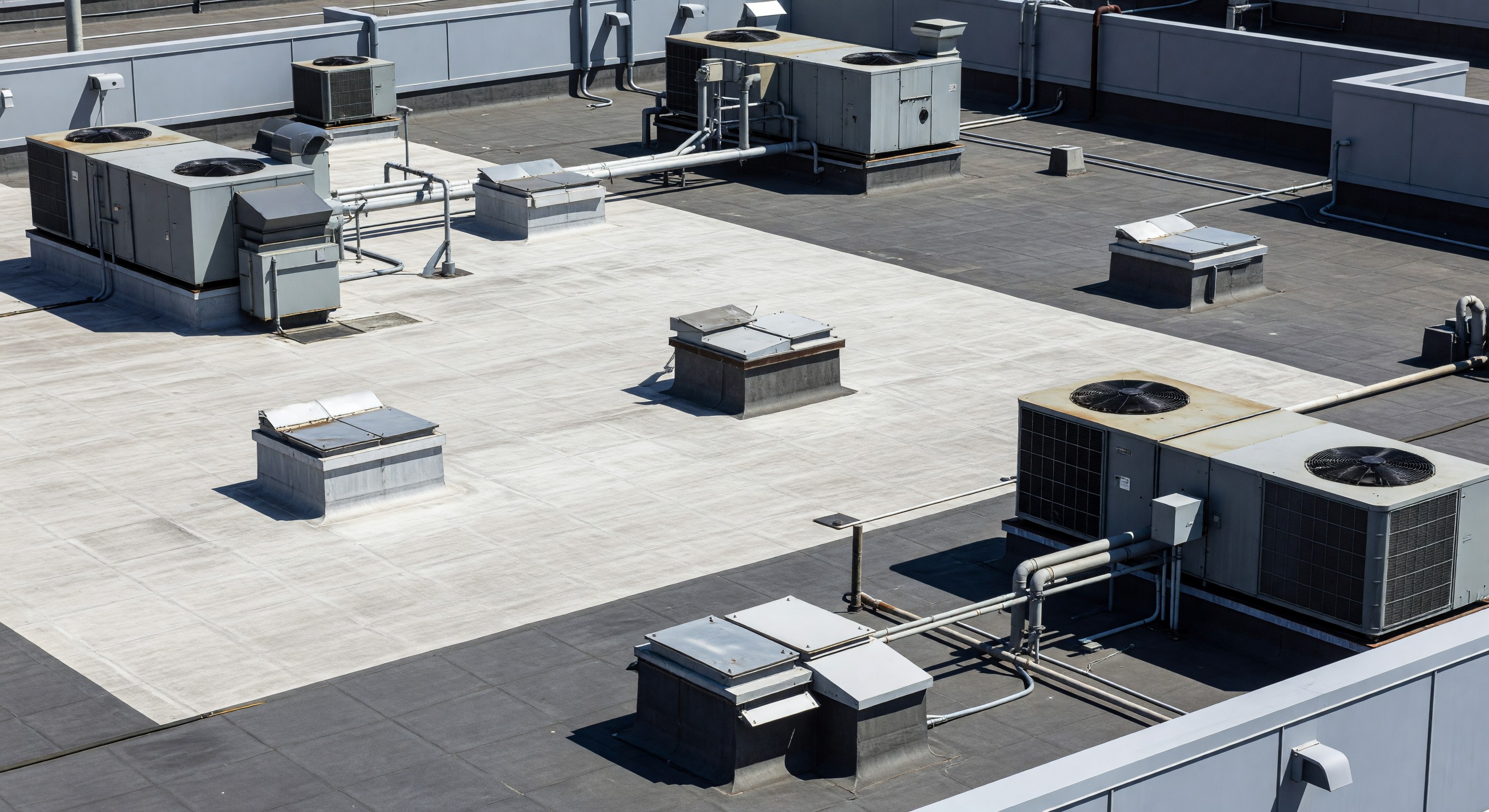
Mechanical equipment density — Hospital roofs support HVAC equipment at densities that exceed nearly any commercial application. Air handling units, cooling towers, exhaust fans, generator exhaust stacks, medical gas vents, and telecommunications equipment create a complex landscape of penetrations, curbs, and equipment pads. Each penetration is a potential water entry point that requires specific flashing detail and regular inspection.
Continuous operations — Unlike office buildings where access for roof work is relatively unconstrained, hospital roofs must be accessed without disrupting clinical operations. Vibration from demolition, chemical odors from roofing materials, and construction debris risk require careful management.
Critical adjacent systems — Leaks from hospital roofs don’t reach empty offices — they potentially reach clinical areas, electrical rooms, supply storage, and sterile processing. The consequence of a roof leak that damages a pharmacy, an OR suite, or a critical electrical room can be measured in hundreds of thousands of dollars.
Energy performance — Hospital HVAC systems are large consumers of energy. Roof insulation performance directly affects cooling and heating loads. Aging roofs with wet or degraded insulation impose significant energy penalties.
Roofing System Types in Healthcare
Single-ply membrane (TPO, EPDM, PVC) — The most common modern hospital roofing specification. Single-ply membranes are factory-fabricated sheets welded or adhered into a continuous waterproofing layer. TPO (Thermoplastic Polyolefin) is the most common current specification, offering good heat-weld seam quality and UV resistance. EPDM (Ethylene Propylene Diene Monomer) is a mature, proven technology with excellent long-term performance. PVC offers superior chemical resistance, important near kitchen exhaust areas.
Built-up roofing (BUR) — Traditional multi-ply asphaltic systems. Still common on older hospital buildings. BUR systems can last 20–30 years with maintenance. Replacement typically involves complete tear-off due to weight accumulation in multiple-layer systems.
Modified bitumen — A hybrid between BUR and single-ply, offering some advantages of both. Common on hospital buildings constructed in the 1990s and 2000s.
Metal roofing — Used primarily on lower-slope sections of newer hospital buildings. Metal roofing requires specific knowledge and contractors for leak investigation and repair.
Inspection Program
A proactive hospital roofing inspection program includes:
Semi-annual inspections — Spring and fall inspections following seasonal extremes. Inspect all membrane surfaces, flashings, penetration details, expansion joints, drain systems, and equipment curbs. Document findings with photographs. Track findings year-over-year to assess membrane deterioration rate.
Post-storm inspections — After significant weather events (hail, high winds, heavy snow/ice), inspect for damage. Hail damage to single-ply membranes may not be immediately visible but creates leak potential at impact points.
Third-party infrared thermography — Annual or biennial infrared (IR) scanning of roof membrane from above or below identifies subsurface wet insulation that is invisible to visual inspection. Wet insulation has measurably different thermal mass than dry insulation, visible in thermal imaging. IR surveys are the most cost-effective tool for detecting latent moisture accumulation before it becomes a major problem.
Core cuts — When IR surveys or other indications suggest wet insulation, exploratory core cuts through the membrane and insulation confirm moisture presence, insulation condition, and deck condition.
Capital Replacement Planning
Hospital roofing assets should be included in the facility’s capital plan with anticipated replacement cycles:
- Single-ply TPO/EPDM with proper maintenance: 20–30 years
- BUR with maintenance: 15–25 years
- Modified bitumen: 15–20 years
- Metal roofing: 30–50 years with minimal maintenance
Capital replacement cost for hospital roofing ranges from $15–$35 per square foot for tear-off and replacement, depending on roofing type, membrane specification, insulation thickness, and regional labor market. A 50,000 square foot hospital roof replacement project is a $750,000–$1.75 million capital commitment.
Phasing large roof replacements over multiple budget years — replacing buildings or roof sections incrementally — allows capital to be distributed while prioritizing the oldest or most deteriorated sections.
Managing Roofing Contractors in Healthcare
Contractor qualifications — Require FM Approved or UL-listed contractors for warranty-eligible work. Factory-trained applicators for the specific membrane system being installed. OSHA safety program compliance. References from healthcare facility work specifically.
Work hours and clinical coordination — Define restricted work hours near occupied clinical areas. Equipment-intensive work (hot kettles, pneumatic nailers) may require night or weekend scheduling near sensitive clinical areas.
Infection control — Active roofing work above occupied areas can introduce contamination through air handling unit intakes and mechanical system penetrations. Coordinate with infection control before work begins on roof areas adjacent to immunocompromised patient units.
Warranty terms — Manufacturer warranties for single-ply membrane systems range from 10–30 years depending on insulation type and membrane specification. Warranties require installation by factory-certified contractors and periodic inspection by the manufacturer’s representative. Review warranty terms before specifying a roofing system.
Frequently Asked Questions
What is the most cost-effective roofing maintenance investment? Drain maintenance — keeping roof drains clear of debris — is the highest-ROI maintenance investment in hospital roofing. Ponding water from blocked drains accelerates membrane deterioration, increases structural load, and dramatically increases leak probability. A $200/year drain maintenance program prevents far more damage than its cost.
How do we handle a roof leak that is dripping into a clinical area? Immediate clinical response: contain water with buckets and absorbent materials, protect patient-accessible equipment from water contact, assess whether the affected area must be temporarily taken out of service. Simultaneously, dispatch maintenance to the roof for assessment and emergency repair (tarping or temporary patching). Document the leak origin and extent. Contact your roofing contractor for emergency repair. Assess ICRA requirements if the leak creates a mold risk above a clinical area.
Should we reroof over existing membrane or tear down to the deck? When the existing insulation is dry and the structural deck is sound, a recover (new membrane over existing) is significantly less expensive than full tear-off and replacement. When infrared surveys or core cuts reveal wet insulation, or when the existing system has multiple layers that add excessive weight, full tear-off is necessary. Have a licensed roofing consultant assess the existing system before specifying the replacement approach.
How do we protect roof assets during construction on adjacent projects? Require the general contractor’s written roofing protection plan before construction begins on any project that involves roof access, overhead crane operations, or adjacent work that could affect the roof. Protection measures include: temporary barriers around roof sections not in active work, boot cleaning stations at roof access points, housekeeping rules for debris management, and daily inspection of protected areas.