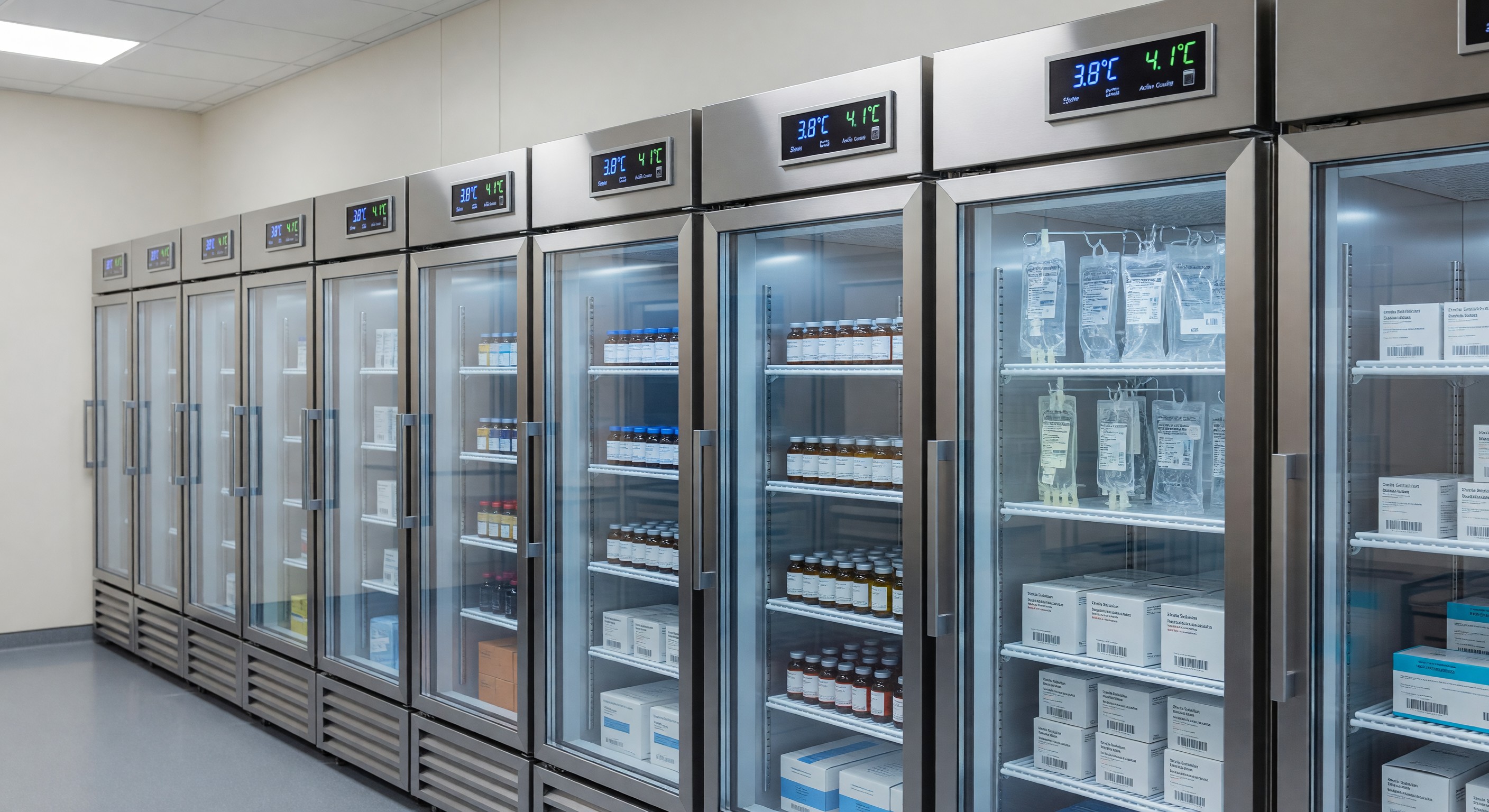
Medical refrigeration in healthcare facilities is a patient safety system disguised as a building utility. Pharmaceutical products stored outside temperature specifications lose potency or become dangerous. Blood products exposed to temperature excursions are discarded, creating product shortages and financial losses. Biological specimens with temperature excursions are non-viable, causing patients to undergo repeat procedures.
The financial stakes are significant—pharmaceutical and blood product inventories in a typical 300-bed hospital represent millions of dollars in stored value at risk from refrigeration failures. The patient care stakes are higher still. A failed blood bank refrigerator during an active surgical case, a vaccine supply compromised by temperature excursion during a community immunization program, or insulin that has lost potency in a patient care unit refrigerator all have direct clinical consequences.
Facility directors responsible for medical refrigeration systems must ensure that equipment is properly specified, monitored, and maintained—and that backup provisions are in place for the inevitable equipment failures.
Categories of Healthcare Refrigeration
Healthcare refrigeration spans a wide range of temperature requirements across multiple application types:
Pharmaceutical Refrigerators (2–8°C / 36–46°F) General pharmaceutical refrigerators store a wide range of medications—vaccines, biologics, insulin, some liquid medications—requiring temperature maintenance in the 2–8°C range. These units are purpose-designed for pharmaceutical use (not modified household refrigerators) with performance characteristics that maintain consistent internal temperatures through door openings and ambient temperature variation.
Vaccine Storage Vaccines have specific storage requirements that vary by vaccine type—most require 2–8°C refrigeration, while some require freezing (-50 to -15°C). The CDC’s Vaccine Storage and Handling Toolkit provides detailed requirements. NFPA 99 does not directly regulate vaccine refrigerators, but CDC and state health department requirements create equivalent mandatory standards for facilities that participate in immunization programs.
Blood Bank Refrigerators (1–6°C) Blood bank refrigerators store red blood cells and require tighter temperature control and more sophisticated alarm systems than general pharmaceutical refrigerators. These are specialized medical-grade units with dedicated temperature monitoring, multiple alarms, and documentation capability that meets AABB (Association for the Advancement of Blood & Biotherapies) and FDA requirements.
Plasma Freezers (-18°C or below) Fresh frozen plasma and cryoprecipitate require storage at -18°C or below, with some facilities maintaining -30°C for extended storage. Plasma freezers must maintain temperature stability during the loading and unloading of blood products and must have reliable alarm and monitoring systems.
Ultra-Low Freezers (-80°C) Research and some clinical applications require ultra-low temperature storage at -80°C or below. These units—which maintain research samples, some cell therapies, and specialty biologics—are among the most critical refrigeration assets on healthcare campuses given the irreplaceable nature of stored samples.
Specimen Refrigerators (2–8°C) Laboratory specimen refrigerators store biological specimens for analysis or pending culture results. Temperature excursions may cause specimen degradation that requires patient recollection.
Monitoring Requirements
The consequences of refrigeration temperature excursions in healthcare settings make continuous automated temperature monitoring essential. Healthcare refrigeration monitoring programs typically include:
Continuous Electronic Monitoring All pharmaceutical, blood, and specimen refrigerators should have continuous electronic temperature monitoring with data logging. Monitoring should capture temperature at defined intervals (typically every 5–30 minutes) and store data in a format accessible for regulatory review.
CDC requirements for vaccine storage specify continuous temperature monitoring with data logging. AABB requirements for blood bank refrigerators require continuous monitoring with alarm capability. The Joint Commission’s EC standards require that healthcare facilities maintain pharmaceutical storage at required temperatures.
Alarm Systems Temperature excursion alarms must notify appropriate staff when temperatures move outside acceptable ranges—before product is compromised. Alarm systems should:
- Provide audible and visual alerts at the refrigerator location
- Notify off-site or after-hours personnel through pager, text, or centralized monitoring
- Log alarm events with timestamps for documentation
- Have tested alarm notification pathways verified regularly
Calibration Temperature monitoring sensors must be calibrated regularly and documented. NIST-traceable calibration standards should be used. Calibration records should be retained and available for regulatory review.
Backup Power Provisions
Medical refrigerators must remain within temperature specifications during power outages. NFPA 99 and healthcare facility planning standards address emergency power provisions for critical refrigeration:
Emergency Power Connection Critical medical refrigerators—blood bank, pharmacy refrigerators containing high-value medications, vaccine storage—should be connected to emergency power circuits that restore power from backup generators within the NFPA 99-required 10-second window. Identifying which refrigerators are emergency power connected and verifying this connection status during commissioning and periodic testing is essential.
Thermal Reserve A full refrigerator maintains temperature longer than a partially loaded unit during a power outage. Maintaining adequate product levels in critical refrigerators improves thermal reserve during brief power interruptions. Many facilities also maintain packaged ice or phase-change materials as supplemental thermal protection for brief outages.
Spare Equipment For applications where a refrigerator failure cannot be accommodated by emergency power or thermal reserve alone—ultra-low freezers particularly—maintaining a spare unit in ready standby allows rapid transfer of critical materials without temperature excursion.
Preventive Maintenance for Medical Refrigeration
Medical refrigerator preventive maintenance should address all components that affect temperature performance and reliability:
Condenser Cleaning Condenser coils accumulate dust and lint that reduce heat rejection efficiency, increasing compressor work and eventually affecting temperature maintenance. Quarterly condenser cleaning maintains performance and extends equipment life.
Door Gasket Inspection and Replacement Door gaskets that have hardened, cracked, or lost adhesion allow warm air infiltration that compromises temperature maintenance and increases compressor cycling. Annual gasket inspection with replacement as needed is appropriate for high-cycle refrigerators.
Refrigerant Leak Detection Healthcare refrigerators using hydrofluorocarbon refrigerants are subject to EPA Section 608 refrigerant management requirements. Annual refrigerant leak checks for larger units (50+ pounds of refrigerant) are required by EPA. Leak detection should also be incorporated into routine PM to identify small leaks before they affect performance.
Compressor and Electrical System Inspection Annual inspection of compressor operation (amp draw, oil level where accessible, vibration), electrical connections, and thermostat calibration identifies components approaching failure before they cause unscheduled downtime.
Response to Temperature Excursions
A defined response protocol for temperature excursions should be documented and communicated to pharmacy, laboratory, blood bank, and nursing staff who manage medical refrigerators:
- Immediate notification to pharmacy or blood bank leadership and facilities maintenance
- Product evaluation — pharmacy or clinical staff assess whether stored products have been compromised based on temperature log, duration of excursion, and product-specific guidelines
- Product quarantine — affected products quarantined pending evaluation; do not continue to use without clinical assessment
- Documentation — complete temperature log documentation of the excursion event and duration
- Equipment assessment — facilities evaluates equipment failure cause and arranges repair or replacement
- Regulatory reporting — certain excursions (vaccine, blood product) may require reporting to public health authorities, FDA, or AABB
Frequently Asked Questions
Can household or commercial refrigerators be used for pharmaceutical storage in healthcare facilities? No. CDC, USP, and Joint Commission guidance consistently prohibit the use of household or commercial food refrigerators for pharmaceutical storage. Purpose-built pharmaceutical refrigerators maintain tighter temperature uniformity, have doors designed to minimize temperature fluctuation from opening, and are validated to maintain temperature during power variations—performance characteristics that household and commercial units don’t provide.
What’s the appropriate response when a blood bank refrigerator alarm activates after hours when blood bank staff are not on-site? A response protocol should identify who receives alarm notifications after hours, who is authorized to assess product status (typically the on-call blood bank technician or pathologist), and what clinical steps are taken if product is quarantined pending assessment. This protocol should be tested and documented before an after-hours incident occurs.
How often should medical refrigerator temperature monitoring systems be tested? Monitoring alarm systems should be tested at least annually, with testing that verifies both the alarm trigger and the notification pathway. For critical applications (blood bank, ultra-low freezers), more frequent testing—quarterly or semi-annually—is appropriate. Testing records should be retained as documentation of alarm system functionality.
What documentation should be retained for medical refrigerator compliance? Retain: continuous temperature monitoring logs (at least 3 years; check specific state and regulatory requirements), alarm test records, calibration certificates for monitoring sensors, equipment preventive maintenance records, and temperature excursion investigation and corrective action documentation.