Hospital plumbing systems deliver one of the most fundamental needs in patient care: clean water for hand hygiene, patient care procedures, sterilization, dietary operations, and domestic use. They also manage the waste streams from clinical operations — body fluids, laboratory waste, and the diverse effluents of a 24/7 healthcare enterprise.
For facility directors, plumbing infrastructure requires continuous attention across aging distribution systems, infection control implications, regulatory compliance, and the operational reliability that clinical operations demand.
Domestic Hot and Cold Water Distribution
Hospital domestic water systems must reliably deliver both cold and hot water to hundreds of fixtures throughout a campus. Key management parameters:
Hot water temperature — ASHRAE 188 and healthcare industry best practice require maintaining domestic hot water at 140°F (60°C) at the water heater and throughout the circulating system to prevent Legionella amplification. Delivering water to patient fixtures at 120°F or below (to prevent scalding) requires thermostatic mixing valves at point of use.
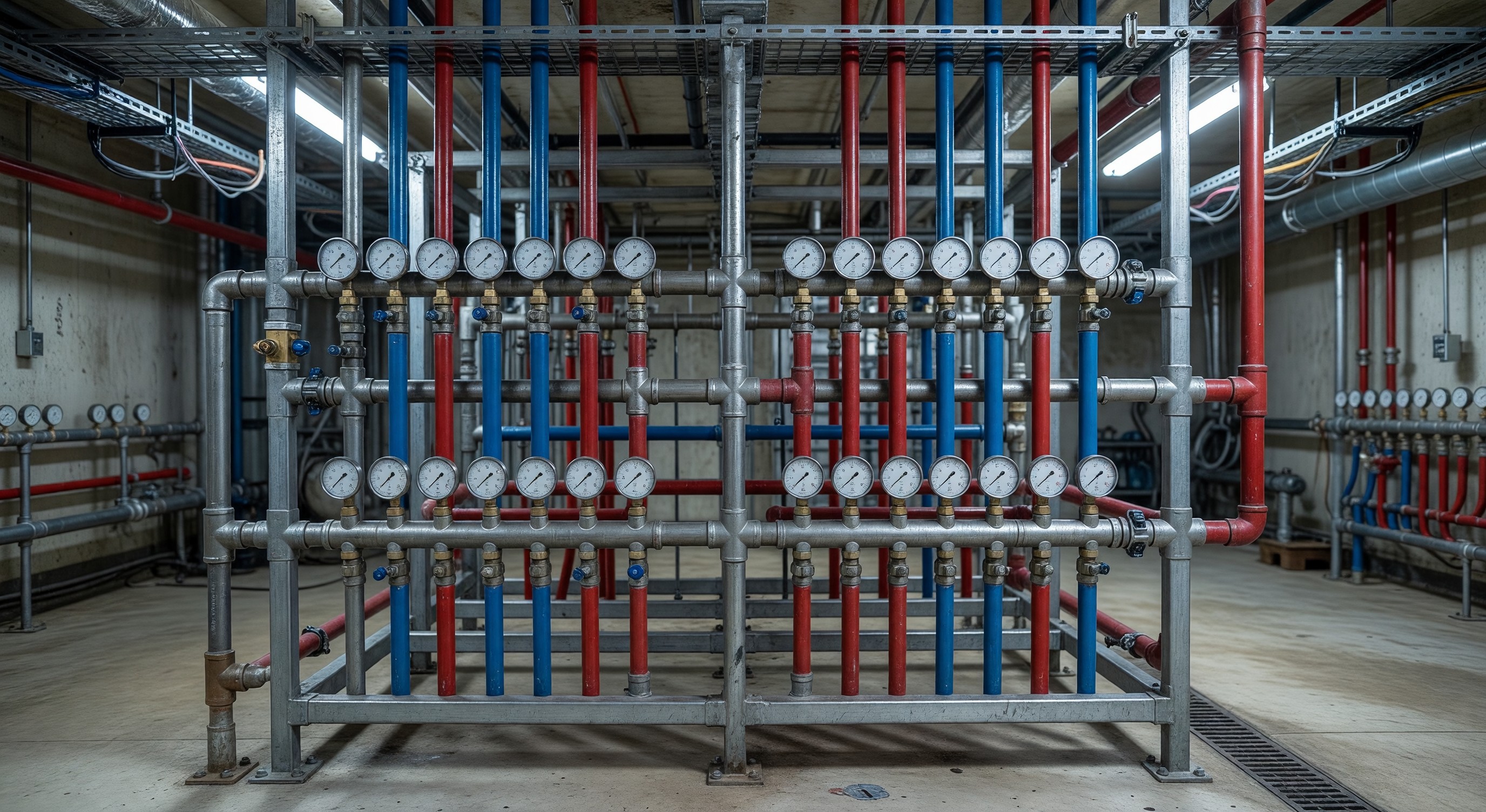
Recirculation system — Hospital hot water systems use recirculating loops that continuously circulate hot water through the distribution system, maintaining temperature at all fixtures without dead legs. Verify that all recirculation pumps are operational and that the loop design achieves the required temperature at the farthest fixture.
Pressure management — Domestic water pressure must be adequate for all simultaneous fixture uses. Hospital peak demand can be substantial. Pressure reducing valves in the distribution system maintain acceptable pressures in high-pressure zones.
Cross-connection prevention — Backflow prevention devices protect the potable water supply from contamination by non-potable sources. NFPA 99 and plumbing codes require appropriate backflow prevention at connections to equipment, equipment with chemical treatment (cooling towers, autoclaves), and non-potable water sources.
Backflow Prevention Program
Backflow prevention is both a regulatory requirement and a patient safety issue. Cross-connections between the potable water system and non-potable sources (cooling tower water, irrigation systems, laboratory equipment, dental vacuum systems) can result in chemical or biological contamination of the drinking water supply.
Annual backflow preventer testing — All reduced pressure zone (RPZ) assemblies and double check valve assemblies in the potable water system must be tested annually by a licensed backflow prevention assembly tester. Test records are required by most plumbing codes and water utilities.
Backflow preventer inventory — Maintain a complete inventory of all backflow prevention devices in the facility, with location, type, size, and test history. Surprises during inspections — backflow preventers that no one knew existed, or connections without required backflow prevention — are avoided with a current, complete inventory.
Water utility compliance — Most water utilities require registration of all backflow prevention assemblies serving commercial accounts and documentation of annual testing. Confirm your utility’s reporting requirements are being met.
Clinical Plumbing Requirements
NFPA 99 Chapter 5 establishes requirements for plumbing in patient care areas:
Handwashing sinks — NFPA 99 and AIA Guidelines for Design and Construction of Hospitals specify handwashing sink requirements for patient care areas, including required locations (at minimum in each patient care room, at nursing stations, in procedure rooms).
Scrub sinks — Surgical scrub sinks outside ORs must meet specific water supply, drainage, and fixture requirements per NFPA 99.
Emergency shower and eyewash stations — OSHA and ANSI Z358.1 require emergency showers and eyewash stations in areas where staff may be exposed to hazardous chemicals. These must be tested and flushed weekly to maintain water quality and confirm operability.
Contaminated waste drains — Laboratory and procedural areas generate liquid waste that requires disposal through the sanitary sewer. Some laboratory waste streams require pre-treatment (pH adjustment, pathogen inactivation) before sewer discharge. Review laboratory waste characterization with your environmental compliance team.
Aging Infrastructure: Common Failures in Hospital Plumbing
Galvanized steel pipe corrosion — Hospital buildings from the 1960s–1980s commonly have galvanized steel domestic water piping that is approaching or past end of useful life. Corrosion creates tuberculation (internal buildup), reduces flow, releases iron particles, and can create water quality issues. Replacement with copper or CPVC piping improves both performance and water quality.
Aging cast iron waste systems — Cast iron drain and waste piping in older buildings can develop cracks, root intrusion, and deterioration. Camera inspection of waste lines identifies conditions before they result in waste backups or structural failures.
Drain trap failures — Inactive floor drains in mechanical and utility rooms can lose their water seal over time if not regularly primed, allowing sewer gases (hydrogen sulfide, methane) to enter building spaces. Establish a regular trap priming program for all floor drains, particularly in areas that are not regularly occupied.
Failed pipe insulation — Hot water pipe insulation that deteriorates allows heat loss that contributes to Legionella risk in recirculating hot water systems. Cold water pipe insulation failures lead to condensation and potential mold growth. Inspect pipe insulation during routine maintenance rounds.
Plumbing PM Program Elements
Monthly — Inspection and flushing of infrequently used fixtures, verification of water temperature at distal fixtures, visual inspection of accessible piping in mechanical rooms.
Quarterly — Emergency shower and eyewash station testing (typically weekly ANSI requirement, but ANSI Z358.1 weekly minimum), water pressure checks at system extremities.
Annual — Backflow preventer testing and certification, domestic hot water recirculation pump inspection, water heater maintenance per manufacturer schedule, drain line CCTV inspection at problem areas.
Frequently Asked Questions
How do we manage water system pressure loss events that affect clinical operations? Establish a water pressure emergency protocol: notify clinical leadership, pharmacy, and dietary immediately; assess which clinical functions are affected and implement clinical alternatives (bottled water for hand hygiene, procedure postponement if appropriate); contact the water utility if the cause is external; contact plumbing service for internal system investigation. Include water pressure failure in your Emergency Operations Plan utility annex.
What are the signs that a hospital domestic water system has Legionella risk? Physical indicators include: hot water temperature below 120°F at faucets (insufficient temperature to inhibit growth), discolored or turbid water suggesting biofilm disturbance, areas of the building with infrequent water use, post-renovation reconnections, and recent water system modifications. The water management program’s monitoring data is the primary Legionella risk indicator — environmental Legionella testing results provide direct evidence of risk.
Can we use plastic (PEX or CPVC) pipe for domestic water distribution in a hospital? PEX and CPVC are approved by most plumbing codes for domestic water distribution and are used successfully in healthcare facility construction and renovation. The materials must be NSF/ANSI 61 certified for potable water contact. CPVC requires careful management of pipe joining solvent, which produces fumes that must be controlled in occupied areas. PEX has excellent chemical resistance and flexibility advantages but requires specific fitting systems. Either is acceptable for clinical areas with appropriate installation practice.
How do we handle water service disruption from utility main work? Develop a water conservation and continuity plan that includes: notification to clinical leaders and dietary before planned outages, stockpiling of bottled water for hand hygiene alternatives, assessment of procedures requiring water that should be rescheduled, coordination with central sterile processing (which requires high-quality water for sterilizer operation), and verification that temporary connection to fire protection system is maintained if fire suppression system connections could be affected.