Healthcare organizations across the United States have made formal net zero energy commitments. The Health Care Without Harm “Health Care Climate Challenge” and the HHS Healthcare Sector Sustainability Pledge have gathered hundreds of hospital system signatories committed to reducing carbon emissions to net zero—many by 2030, most by 2050. For facility directors, these commitments translate into concrete operational and capital planning challenges.
Hospital campuses present the hardest net zero challenge in the built environment. They operate 24 hours a day, 365 days a year, cannot interrupt critical patient care systems for energy management, and have energy consumption profiles—steam for sterilization, extensive HVAC for airborne infection control, medical gases, uninterruptible power for life-critical equipment—that cannot simply be turned off or deferred to off-peak hours.
Yet healthcare organizations are making meaningful progress. Understanding the strategic framework, technology options, and sequencing of net zero efforts in healthcare helps facility directors translate organizational commitments into executable plans.
The Healthcare Energy Challenge
To understand the net zero pathway for healthcare, facility directors need clarity on where the energy actually goes.
Where Hospital Energy Is Consumed
- HVAC (space conditioning, ventilation): 40–55% of total energy consumption
- Lighting: 10–15%
- Medical and plug loads (equipment, IT, medical devices): 20–30%
- Domestic hot water and steam: 10–15%
- Food service: 3–5%
Achieving net zero requires addressing each of these consumption categories—some through direct reduction, some through electrification of fossil fuel uses, and the remainder through renewable energy generation and procurement.
The Four Strategic Pillars of Healthcare Net Zero
1. Energy Efficiency: Reducing What You Use The most cost-effective first step is reducing energy consumption through operational improvements and facility upgrades. In healthcare, efficiency opportunities include:
- HVAC setback in unoccupied areas (operating room setback when not scheduled, administrative areas after hours)
- LED lighting conversion campus-wide
- Building envelope improvements (window replacement, roof insulation, air sealing)
- High-efficiency chillers, cooling towers, and boilers
- Variable-speed drives on pumps and fans to reduce energy at partial load
- Heat recovery from exhaust air streams
The average hospital that hasn’t implemented systematic energy management can achieve 15–25% energy reduction through these measures. The resulting smaller energy “load” to power with renewable energy makes the renewable energy component of net zero significantly more affordable.
2. Electrification: Eliminating Fossil Fuels Most hospital campuses burn natural gas or fuel oil for steam generation, space heating, domestic hot water, and backup power. Net zero carbon requires eliminating or offsetting these fossil fuel uses.
Healthcare-specific electrification challenges:
- Steam systems — Many hospitals use steam for sterilization (required by AAMI ST79) and space heating through campus distribution systems. Transitioning to electric alternatives (electrode boilers for steam generation, heat pump systems for space heating) requires significant capital investment and system redesign.
- Backup generators — Hospital emergency power systems (NFPA 99, NFPA 110) currently require diesel backup generators for critical life safety loads. Battery storage and non-fossil-fuel alternatives are being explored, but diesel backup remains the standard for healthcare critical systems.
- Cooking equipment — Commercial kitchens can transition to electric cooking equipment with relatively modest operational adjustment.
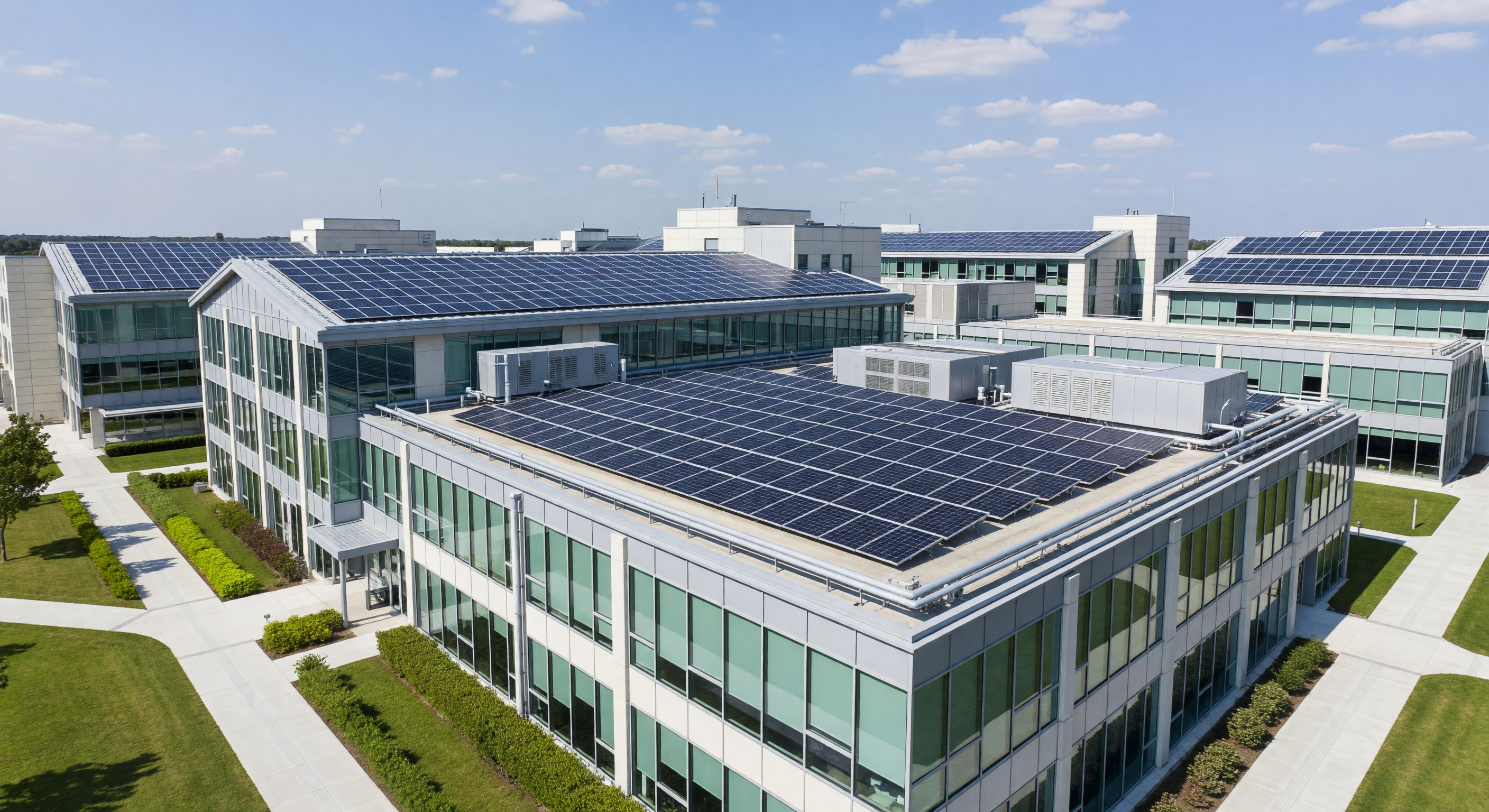
3. On-Site Renewable Generation Solar photovoltaic is the primary on-site renewable generation technology accessible to most hospital campuses:
- Rooftop solar on existing buildings
- Solar canopies over surface parking lots
- Ground-mounted solar on available campus land
The generation capacity achievable from available roof and parking canopy area at a typical hospital campus covers 5–25% of campus electrical load depending on campus configuration and local solar resource. This is meaningful but not sufficient for net zero on its own.
4. Renewable Energy Procurement The gap between what can be generated on-site and what the campus consumes is typically addressed through off-site renewable energy procurement:
- Power Purchase Agreements (PPAs) for utility-scale solar or wind
- Renewable Energy Certificates (RECs) matched to consumption
- Community solar subscriptions
- Direct ownership of off-site renewable projects (more common for large health systems)
PPAs have become the primary tool for large health systems to achieve significant renewable energy percentages affordably. A well-structured PPA provides price stability, eliminates upfront capital requirements for generation assets, and delivers verifiable renewable energy credits that support organizational carbon reporting.
Sequencing the Net Zero Journey
Most healthcare net zero strategies follow a phased approach:
Phase 1 (Years 1–5): Efficiency Foundation Establish energy baseline, implement efficiency measures with best economics (LED conversion, HVAC controls, equipment replacement), and commit to renewable energy procurement to match current consumption.
Phase 2 (Years 5–10): Electrification and On-Site Generation Electrify fossil fuel uses as equipment reaches end-of-life, install on-site solar generation, expand renewable procurement, and implement building-level carbon accounting.
Phase 3 (Years 10–25): Deep Decarbonization Address remaining hard-to-electrify uses (steam for sterilization, backup power), implement remaining efficiency measures, and achieve verified net zero status through combination of reduction and procurement.
Obstacles Specific to Healthcare
24/7 Critical Operations Energy retrofits that require temporary system shutdown are exceptionally complex in active healthcare facilities. Sequencing construction and equipment replacement around clinical operations requires extensive planning, temporary systems, and phasing that increases project cost and duration.
Infection Control Requirements HVAC modifications in clinical areas require careful infection control management. The air changes, filtration requirements, and pressure relationships mandated by ASHRAE 170 cannot be compromised during renovation. Construction phasing that maintains clinical environmental requirements adds complexity and cost to HVAC retrofit projects.
Backup Power Standards NFPA 99 Category 1 spaces (areas where loss of power could cause patient harm or death) require emergency power backup from sources that can restore power within 10 seconds. Current diesel backup generator systems meet this requirement. Alternative emergency power technologies—battery storage, fuel cells—must demonstrate the same reliability before healthcare regulators will accept them as equivalents.
Frequently Asked Questions
What’s the realistic net zero timeline for a mid-size community hospital? Most mid-size community hospitals that commit to net zero now can achieve operational net zero (scope 1 and scope 2 emissions) by 2035–2040 with aggressive investment. Full value chain net zero (including supply chain) is a 2050 timeframe aspiration for most healthcare organizations. The timeline depends significantly on capital availability and how aggressively electrification of fossil fuel uses is pursued.
How do healthcare net zero commitments interact with NFPA 99 backup power requirements? This is the most significant regulatory tension in healthcare net zero planning. NFPA 99 and state health facility licensing currently require diesel backup generators for Category 1 life safety loads. Some AHJs are beginning to accept alternative emergency power approaches when backed by appropriate reliability documentation, but diesel backup remains the standard. Healthcare organizations should engage with their AHJ during net zero planning to understand emerging flexibility in backup power requirements.
Are there federal incentives available for hospital net zero investments? The Inflation Reduction Act (2022) extended significant incentives applicable to healthcare organization energy investments. Tax-exempt organizations (which most not-for-profit hospitals are) can claim direct pay for many IRA clean energy credits, including the Investment Tax Credit for solar generation, the Commercial Energy Efficiency Tax Credit for building system improvements, and Alternative Fuel Vehicle Infrastructure credits for EV charging. Healthcare CFOs and legal counsel should evaluate IRA direct pay implications for planned investments.
How should healthcare facility directors communicate net zero progress to the board? Annual energy and carbon scorecards that track progress against baseline are the standard board communication tool. Key metrics include: total energy consumption (absolute and per-adjusted occupied bed), carbon emissions (scope 1, scope 2), renewable energy percentage, and progress against net zero milestone targets. Benchmark against peer organizations where data is available through programs like the EPA’s ENERGY STAR for Healthcare.