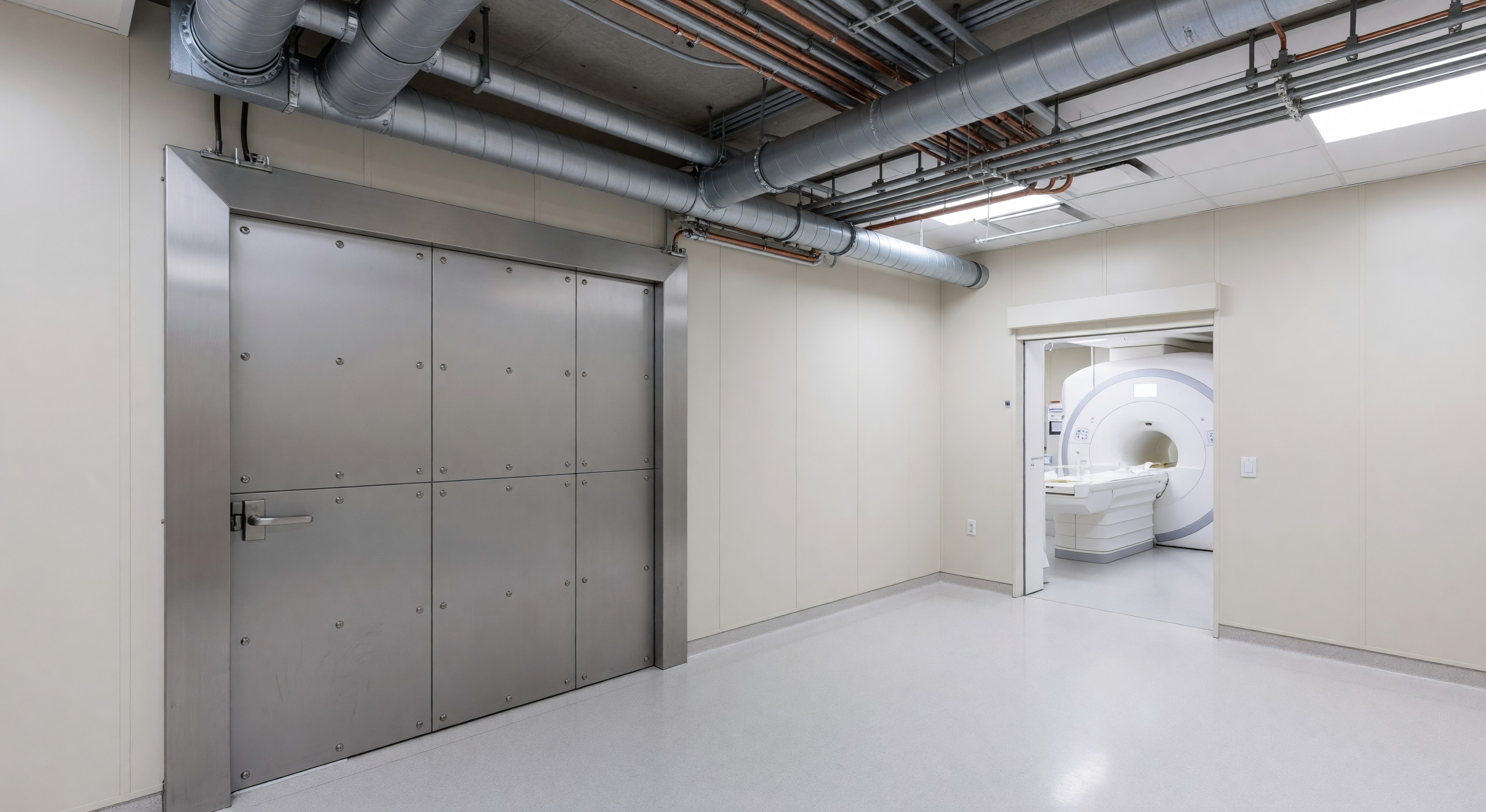
Medical imaging and treatment equipment imposes infrastructure requirements on hospital facilities that exceed anything else in the built environment. MRI machines require radiofrequency shielding, CT scanners require radiation shielding, linear accelerators need concrete vaults rated to 10,000+ pounds per square foot of live load, and cardiac catheterization labs demand precise HVAC conditions to support aseptic interventional procedures.
Facility directors must understand these requirements not only during initial construction but throughout the life of the equipment — managing infrastructure maintenance, coordinating equipment replacements, and ensuring that utility systems supporting imaging remain reliable.
MRI Suite Infrastructure
RF Shielding
MRI scanners generate powerful radiofrequency (RF) fields that must be contained within the suite to prevent interference with other electronic systems and to protect the image quality from external RF sources. RF shielding consists of copper or aluminum sheet installed within the walls, floor, and ceiling of the MRI room during construction.
RF shield integrity is critical and remarkably fragile:
- Any penetration through the shield — electrical conduit, mechanical piping, data cables — requires specially designed filtered or waveguide penetrations that maintain shield continuity
- Shield doors are specialized engineered components that seal against the shield perimeter; door seals require periodic inspection and replacement as they wear
- Any modification to the room — new conduit, new cable pathway, plumbing repair — must be designed and executed to maintain RF shield integrity
RF shield performance should be tested (attenuation measurement across the frequency range of the scanner) after construction and after any modification that might affect the shield. MRI equipment vendors specify minimum attenuation requirements.
Magnetic Safety Zone Management
MRI scanners generate powerful static magnetic fields that persist continuously — they cannot be “turned off” during maintenance. The five-zone safety model (American College of Radiology) defines controlled access zones based on magnetic field strength:
- Zone IV (MRI magnet room): access strictly restricted to screened individuals
- Zone III: access controlled by MR personnel
- Zones I and II: general public areas with appropriate screening infrastructure
Facility directors must ensure physical access controls enforce zone boundaries: magnetically safe door hardware (no ferromagnetic components), appropriate non-ferrous construction materials within Zone III and IV, and clearly marked zone boundaries.
MRI HVAC Requirements
MRI scanners require precisely controlled ambient conditions:
- Temperature: typically 65-75°F (18-24°C) with tight control (±1-2°F)
- Humidity: 30-70% relative humidity
- Significant heat rejection from the scanner’s gradient coils requires high-capacity cooling, often with supplemental precision cooling units in addition to the building HVAC system
Helium boil-off from the superconducting magnet must be safely vented to the exterior through a dedicated quench pipe. If the magnet quenches (rapid uncontrolled loss of superconductivity), large volumes of helium discharge through this pipe — the pipe must be clear and unobstructed, and the quench event requires immediate evacuation of the suite.
Power Requirements
MRI scanners require dedicated, filtered electrical service:
- High-current dedicated circuits from the main electrical panel
- Power conditioning (UPS or isolation transformer) to protect scanner electronics from power quality issues
- Ground fault protection and grounding system meeting scanner vendor specifications
CT Scanner Room Requirements
CT scanners emit ionizing radiation (X-rays) during operation. Room shielding is designed by a medical physicist to ensure radiation levels outside the room meet regulatory limits per NCRP Report 147 guidelines and applicable state radiation control regulations.
CT shielding is typically lead-lined drywall or concrete with defined lead equivalency for each wall, ceiling, and floor based on:
- Scanner workload (number of procedures per day)
- Use factor for each wall (percentage of time primary beam faces that wall)
- Occupancy factor for adjacent spaces
CT scanner replacement with a higher-power system may require shielding recalculation and upgrade before the new equipment can be installed. This should be identified early in equipment procurement planning.
CT rooms require:
- High-capacity HVAC to manage substantial heat generation from the gantry
- Dedicated high-voltage power supply
- Control room with lead glass observation window for operator protection
Cardiac Catheterization Laboratory
Cardiac cath labs perform interventional procedures requiring:
Radiation shielding: Similar to CT rooms, cath labs use fluoroscopy equipment generating significant radiation. Shielding designed by a medical physicist is required.
Clean environment: Interventional procedures require clean HVAC conditions approaching surgical suite standards — positive pressure, HEPA filtration, and defined air change rates per ASHRAE 170.
Ceiling-mounted equipment systems: Cath labs often have ceiling-suspended X-ray equipment, lighting systems, and monitor booms that require structural reinforcement of the ceiling and careful coordination between structural and MEP engineers.
Large power requirements: Imaging equipment, patient monitoring, electrophysiology systems, and hemodynamic monitoring together require substantial electrical capacity with emergency backup.
Linear Accelerator (LINAC) Vault
Radiation therapy linear accelerators are among the most infrastructure-intensive clinical systems in a hospital. The LINAC vault requires:
Massive shielding: Concrete walls typically 5-7 feet thick on the primary beam wall, 3-5 feet on secondary walls. The vault may weigh thousands of tons — structural engineering for the foundation and floor slab is a major design element.
Maze entrance: Rather than a direct-entry door that would require an enormous amount of shielding, LINAC vaults use maze entry configurations that reduce the radiation path to the entrance.
Isolation from vibration: LINACs are sensitive to building vibration. The vault should be located away from sources of mechanical vibration (chillers, MRI quench events) and the floor slab isolated from structural vibration paths.
HVAC: Heat rejection from the LINAC is substantial; dedicated cooling with redundancy is required to prevent treatment interruption.
Maintenance Coordination for Medical Equipment Rooms
These specialized spaces require close collaboration between facilities and clinical engineering for maintenance:
- HVAC maintenance in MRI suites requires magnetically safe tools and personnel without cardiac pacemakers or metal implants
- RF shield penetration repairs require specialized contractors with appropriate shield repair certifications
- Radiation shielding modifications require medical physicist review and potentially re-inspection by state radiation control regulators
Frequently Asked Questions
Who designs the shielding for CT and radiation therapy rooms? Radiation shielding design must be performed by a qualified medical physicist. The physicist calculates the required shielding based on equipment specifications, workload assumptions, and regulatory limits. The shielding design is reviewed by state radiation control agencies and the local building authority before construction. Never accept a shielding specification from the equipment vendor alone without independent medical physicist review.
Can an MRI scanner be replaced without room modifications? Only if the replacement scanner has the same or lower field strength and the same or lower RF frequency, and the replacement vendor verifies compatibility with the existing infrastructure (shielding, HVAC, power, quench pipe). In practice, newer scanners are often higher field strength (1.5T to 3T) and require infrastructure review. Early engagement of the equipment vendor and a medical physicist during procurement avoids surprises.
What triggers a regulatory inspection when medical equipment rooms are modified? Modifications to radiation-producing equipment rooms (CT, cath lab, LINAC) typically require notification to the state radiation control program and may require a shielding review and re-inspection before resuming clinical operations. MRI room modifications may require RF shield testing but generally do not trigger state radiation inspections. Always verify with your state radiation control authority before beginning any modification to a regulated imaging space.
How is LINAC vault maintenance different from other clinical spaces? LINAC vaults are radiation-controlled areas. Entry during operation is strictly controlled. Maintenance during off-hours requires radiation safety officer authorization and documentation. Any structural modification to the vault shielding must be reviewed by a medical physicist and potentially re-permitted. Emergency access during clinical hours requires coordination with the radiation therapy team to ensure the vault is in a safe condition.