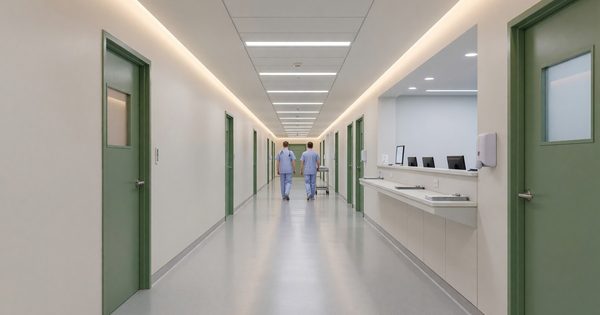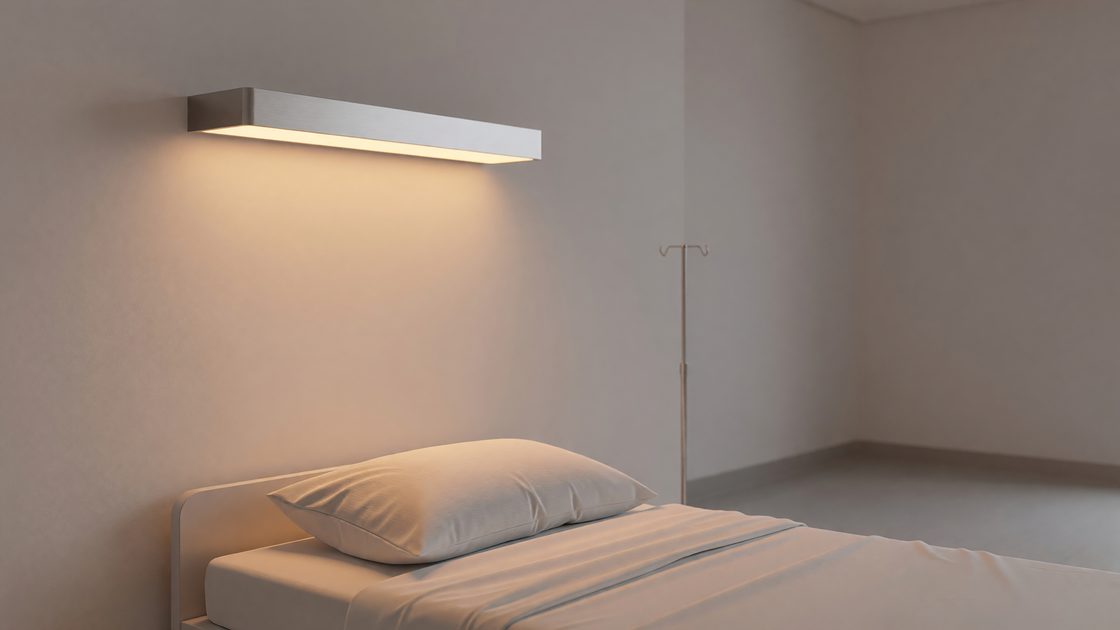
Lighting upgrades sit at an unusual intersection for healthcare facility directors in 2026: the capital case for LED conversion is now well-established on energy savings alone, but the more interesting decisions involve circadian-tuned patient-room lighting with documented clinical benefits, ongoing federal incentive programs that materially change project economics for nonprofit health systems, and surgical suite lighting requirements that any conversion project must meet regardless of the energy or clinical case for upgrading.
The Baseline Standard: ANSI/IES RP-29
ANSI/IES RP-29 (Recommended Practice: Lighting Hospital and Healthcare Facilities) is the recommended-practice baseline that ASHE facility-design guidance references for illuminance levels, color rendering, and glare control across clinical and non-clinical hospital spaces. Any lighting upgrade project — whether driven primarily by energy savings, patient experience, or code compliance — needs to be evaluated against RP-29’s space-specific requirements, since a conversion that reduces energy use but fails to meet illuminance or color-rendering expectations for a given space type creates a new problem rather than solving the original one. Surgical suites, exam rooms, and general patient-care areas each have distinct RP-29 requirements, and a uniform lighting spec applied facility-wide without accounting for these differences is a common planning mistake.
LED Conversion Economics and Available Incentives
The core economic case for LED conversion — meaningfully lower energy consumption and longer fixture life than legacy fluorescent or HID lighting — is no longer a novel argument, but the incentive landscape available to fund it has continued to evolve, and facility directors should confirm current program details rather than relying on prior-year assumptions:
- Section 48 Investment Tax Credit (ITC), monetizable for nonprofit health systems via the Section 6417 Elective (Direct) Pay election, allows tax-exempt organizations to receive a direct payment in lieu of a tax credit they otherwise couldn’t use, materially changing the economics of qualifying clean-energy and efficiency projects for nonprofit hospitals that previously couldn’t access ITC-style incentives at all.
- Section 179D supports lighting and building-efficiency retrofits through a deduction that can be allocated to the designer on projects for tax-exempt entities, since the owning organization itself often can’t use a deduction directly — this allocation mechanism is worth discussing with your design firm early in project scoping, since it affects how the project is structured contractually.
- Domestic-content thresholds tied to certain incentive programs are escalating over time, and confirming current-year thresholds with your tax and legal advisors before finalizing equipment sourcing decisions is worth the diligence, since a project that assumed one year’s threshold could face a different bar by the time equipment is actually procured and installed.
Given how frequently IRS guidance on these provisions continues to be refined, facility directors should treat any specific percentage or threshold figure as something to verify with current tax counsel at the time of project development rather than something to lock into planning documents based on an earlier reference point.
Circadian-Tuned Lighting: The Clinical Case
Beyond energy efficiency, tunable LED systems that adjust color temperature and intensity across the day — brighter, cooler light during daytime hours and warmer, dimmer light in the evening — have accumulated a growing body of peer-reviewed research in inpatient settings pointing toward measurable improvements in patient sleep quality and, in some studies, broader recovery-related outcomes. The underlying mechanism is grounded in circadian biology: light exposure timing and color temperature are known regulators of the sleep-wake cycle, and the fixed, often harsh, uniform lighting common in older hospital construction works against natural circadian rhythm rather than supporting it, particularly for patients on extended inpatient stays.
Facility directors evaluating circadian lighting for patient rooms should treat it as a documented clinical-outcomes opportunity worth discussing with nursing and clinical leadership, not solely a facilities decision — the case for prioritizing which units get circadian-tuned lighting first (medical-surgical units with longer average lengths of stay, behavioral health units, ICU step-down) benefits from clinical input on where the sleep-disruption problem is most acute.
Surgical Suite Lighting Compliance
Regardless of the energy or clinical case elsewhere in the facility, surgical suite lighting has its own non-negotiable requirements that any conversion project must satisfy:
- Color rendering index (CRI) and illuminance levels specific to surgical task lighting are governed by RP-29 and related standards, and a general-purpose LED retrofit product intended for corridors or patient rooms is not automatically appropriate for surgical field or scrub-sink lighting.
- Surgical light fixtures (the actual overhead surgical lights, distinct from general room lighting) have their own certification and maintenance requirements separate from general facility lighting upgrades, and a broader LED conversion project scope should clearly delineate which fixtures are in scope versus the specialized surgical lighting equipment that follows a different procurement and compliance path entirely.
- Any conversion work in an active or adjacent surgical suite requires infection-control coordination, since lighting retrofit work can generate dust and requires the same ICRA (Infection Control Risk Assessment) planning as any other construction activity in or near a sterile environment.
Controls, Commissioning, and Long-Term Maintenance
A frequent oversight in LED conversion projects is treating them as a fixture-swap exercise while underscoping the controls and commissioning work that determines whether the promised savings and clinical benefits actually materialize. Occupancy sensing, daylight harvesting near exterior glazing, and the tunable-color scheduling that makes circadian lighting function are all controls-layer capabilities, not properties of the fixture alone. A project that installs capable fixtures but never properly commissions the control sequences can leave a facility paying for tunable hardware that runs at a single static setting, capturing neither the energy nor the clinical value it was specified for.
Commissioning also matters for verifying that the delivered illuminance and color rendering actually meet the space-specific expectations the design assumed, rather than trusting the product cut sheets — real-world performance depends on mounting height, room finishes, and fixture spacing that a catalog specification can’t account for. On the maintenance side, LED conversion changes the failure profile rather than eliminating it: fixtures fail less often but driver electronics and control components become the recurring service items, and integrated fixtures can require whole-unit replacement where a legacy fixture would have taken a simple lamp change. Confirming parts availability and the service model for the specific product line, and documenting the control programming so it can be maintained after the installing contractor leaves, protects the investment across the fixtures’ service life.
Sequencing a Facility-Wide Lighting Upgrade
Given the range of considerations, a practical sequencing approach for a comprehensive lighting capital project:
- Segment the facility by space type and RP-29 requirement category before specifying any product, rather than assuming a single LED product line will work uniformly across corridors, patient rooms, exam spaces, and surgical suites.
- Confirm current incentive program eligibility and requirements with tax counsel before finalizing equipment sourcing, given how frequently domestic-content and elective-pay program details continue to be refined.
- Engage nursing and clinical leadership on circadian-lighting prioritization if that’s part of the project scope, using clinical input to sequence which units receive tunable lighting first.
- Scope surgical suite work as its own compliance track, coordinated with infection-control and surgical services leadership, distinct from the general facility LED conversion timeline.
- Target summer retrofit windows for unit-level work where feasible, aligning with lower-census periods before fall census typically rises, to minimize clinical-workflow disruption during installation.
Frequently Asked Questions
Does a general LED conversion project automatically satisfy surgical suite lighting requirements? No — surgical suite task lighting has distinct color-rendering and illuminance requirements under RP-29, and the surgical light fixtures themselves have separate certification requirements from general room lighting. Scope surgical areas as a distinct compliance track within any broader conversion project.
What is the Section 6417 Elective Pay election and why does it matter for nonprofit hospitals? It allows tax-exempt organizations to receive a direct payment in lieu of a tax credit they otherwise couldn’t use, which materially changes the economics of qualifying energy-efficiency projects for nonprofit health systems that previously had no practical way to access Investment Tax Credit-style incentives.
Is there solid clinical evidence for circadian-tuned patient-room lighting, or is it mostly aspirational? There is a growing body of peer-reviewed research in inpatient settings showing measurable sleep-quality and, in some studies, broader recovery-related improvements associated with circadian-tuned lighting, grounded in established circadian biology research on light exposure and the sleep-wake cycle.
Should domestic-content thresholds affect equipment sourcing decisions for lighting incentive programs? Yes — thresholds tied to certain incentive programs have been escalating over time, so confirm current-year requirements with tax and legal advisors before finalizing sourcing, rather than relying on a threshold figure from an earlier planning cycle.
When is the best time to schedule unit-level lighting retrofit work in an occupied hospital? Summer, or other lower-census periods specific to your facility’s patient-volume patterns, generally minimizes clinical-workflow disruption compared to scheduling the same work during peak-census months.
Further Reading from Authoritative Sources
- ASHE — American Society for Health Care Engineering — facility lighting design guidance referencing ANSI/IES RP-29 and related standards.
- DOE — Federal Energy Management Program — federal guidance on building efficiency incentives, including provisions relevant to nonprofit and tax-exempt organizations.