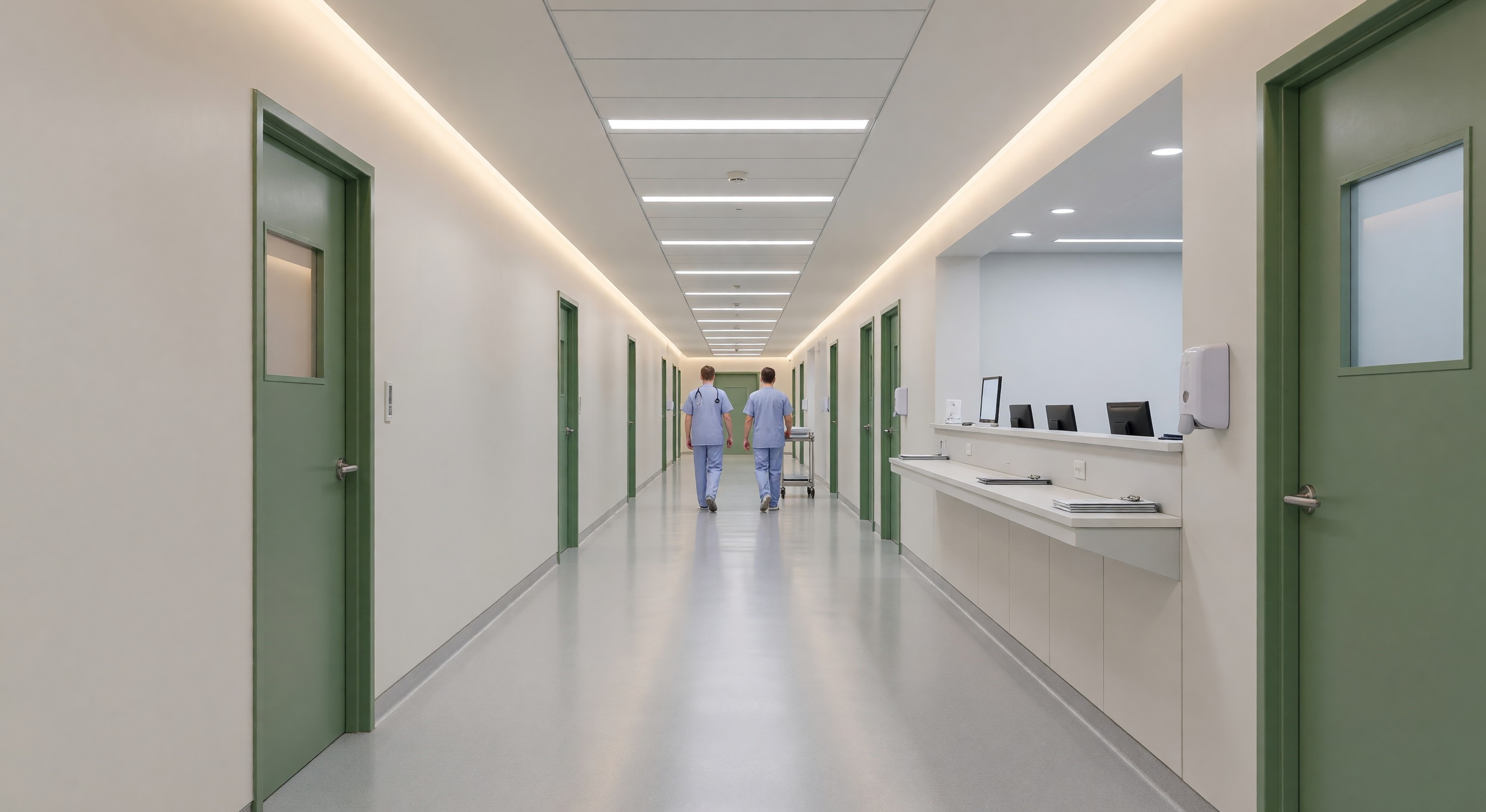
Hospital lighting is one of the most clinically consequential building system decisions in healthcare facility design and management. Inadequate lighting in clinical areas contributes to medication errors, surgical complications, and staff fatigue. Excessive or poorly designed lighting in patient rooms disrupts healing sleep and contributes to hospital-acquired delirium—a serious complication particularly common in elderly patients. Parking area and exterior lighting deficiencies create safety risks for staff and visitors and, under OSHA’s workplace violence prevention rule, represent documented physical environment hazards.
Facility directors managing healthcare lighting systems must balance clinical performance requirements, regulatory standards, energy efficiency goals, and maintenance budget constraints across environments ranging from operating suites to parking decks.
Regulatory and Standards Framework
Healthcare facility lighting standards draw from multiple sources:
ANSI/IES Healthcare Facility Lighting Standard The Illuminating Engineering Society’s RP-29 (Lighting for Hospitals and Health Care Facilities) provides the primary technical reference for healthcare lighting design. It specifies illuminance levels (in footcandles or lux) for different healthcare space types, color rendering requirements, and special considerations for clinical task lighting.
The Facility Guidelines Institute (FGI) Guidelines The FGI Guidelines for Design and Construction of Hospitals include lighting requirements incorporated into state health facility licensing regulations in most states. These guidelines specify illuminance minimums for operating rooms, patient rooms, exam rooms, nursing stations, and other clinical spaces.
Joint Commission Environment of Care Standards EC.02.06.01 requires that healthcare organizations maintain appropriate lighting levels throughout the facility. Lighting deficiencies identified during internal inspections must be corrected, and documentation of lighting maintenance should be available for survey review.
OSHA Workplace Violence Prevention OSHA’s healthcare workplace violence prevention rule requires assessment of lighting adequacy in areas where employees work. Lighting deficiencies in staff work areas, parking, and walking paths represent physical environment hazards requiring remediation.
Clinical Space Lighting Requirements
Operating Rooms Operating rooms have the most demanding lighting requirements in any building type. General ambient OR lighting typically runs 100–200 footcandles. Surgical task lighting from overhead surgical luminaires provides 2,000–10,000 footcandles at the surgical field. Modern LED surgical lights offer precise color rendering (CRI 95+) that allows accurate tissue color identification and shadow-free illumination of the surgical field.
Support areas adjacent to the OR—scrub sinks, instrument tables—require intermediate illumination of 50–100 footcandles. Transition lighting design must account for the significant adaptation challenge surgeons face when moving between the bright OR field and lower-illuminated adjacent areas.
Patient Rooms Patient room lighting must serve multiple functions with careful design: general room illumination for staff clinical tasks, reading light at patient controls, night lighting that allows staff observation without disturbing sleep, and emergency lighting that remains operational during power outages.
Research on hospital-acquired delirium has established that inappropriate lighting—insufficient daytime light and excessive nighttime light—is a significant contributing factor. Healthcare lighting guidelines now recommend maximizing daylight access and providing circadian-supportive lighting that transitions from high-intensity, cool-color-temperature daytime illumination to low-intensity, warm-color-temperature nighttime illumination in patient areas.
Emergency Department ED lighting must support rapid clinical assessment across a high-volume, variable-acuity environment. Examination spaces require 100+ footcandles for clinical tasks. Waiting areas should provide comfortable illumination without the harsh brightness that can exacerbate distress in anxious patients and families.
Pharmacy Pharmacy requires high-quality task lighting for medication verification: 70–100 footcandles minimum with high color rendering (CRI 90+) to support accurate label reading and medication identification.
LED Conversion in Healthcare Facilities
The transition from fluorescent and high-intensity discharge (HID) lighting to LED technology has reached maturity in healthcare facilities. LED conversion programs deliver:
Energy Reduction LED luminaires typically use 30–50% less energy than the fluorescent fixtures they replace, with significantly longer lifespans (50,000–100,000 hours versus 15,000–25,000 hours for fluorescent). The energy reduction calculation for a healthcare campus lighting conversion frequently generates simple payback periods of 3–6 years.
Maintenance Cost Reduction Reduced lamp replacement frequency—and the associated labor cost of bulb changes in clinical environments, where infection control precautions and operational disruption must be managed—is a significant component of LED conversion ROI in healthcare.
Color Quality Improvement Modern healthcare-grade LED products offer significantly better color rendering than the fluorescent products they replace. Color Rendering Index (CRI) values of 90+ and specific color point selection for clinical applications support improved clinical task performance.
Controls Integration LED lighting integrates effectively with dimming controls, occupancy sensors, and building automation systems. Healthcare facilities that implement LED conversion with integrated controls—allowing rooms to be automatically adjusted based on occupancy and time of day—achieve greater energy savings than lamp replacement alone.
Exterior and Parking Lighting
Exterior campus lighting and parking facility lighting serve safety, security, and operational functions. IES RP-20 provides illuminance recommendations for healthcare facility exterior areas including:
- Parking lots: 1–5 footcandles average horizontal illumination (higher at entrances)
- Pedestrian walkways: 2–5 footcandles average
- Emergency department arrival and drop-off: 5–10 footcandles
- Parking structure interiors: 5–10 footcandles minimum
OSHA workplace violence prevention assessments frequently identify parking area lighting deficiencies as physical environment hazards for staff who park during evening and overnight shifts. Healthcare organizations responding to OSHA workplace violence rule requirements should audit parking area lighting against IES standards and prioritize remediation of deficiencies identified in hazard assessments.
Lighting Maintenance Programs
Effective healthcare lighting maintenance programs address three primary maintenance activities:
Group Relamping/Replacement Group replacement of lighting products on a defined schedule—rather than individually replacing products as they fail—reduces labor cost and prevents the illuminance deficiencies that occur as individual products age and light output diminishes (lumen depreciation). LED products have extended group replacement intervals compared to fluorescent, but planning for LED driver replacement at 15–20 years is appropriate in long-term maintenance programming.
Cleaning Luminaire cleaning significantly affects maintained illuminance levels. Dust accumulation on fixtures, reflectors, and lenses can reduce effective light output by 10–20%. Cleaning schedules should reflect the dust generation rates in different healthcare environments—clinical areas with high HVAC flow rates accumulate less dust than utility and storage areas.
Documentation Lighting inspection and maintenance records support Joint Commission EC compliance documentation. Annual lighting surveys that document illuminance measurements in key clinical areas, note deficiencies, and track remediation provide the audit trail that surveyors look for.
Frequently Asked Questions
What’s the current best practice for patient room lighting to minimize hospital-acquired delirium risk? Current evidence supports a circadian-supportive lighting approach: bright, cool-temperature light (5000–6500K) during daytime hours to support alertness and circadian alignment; dim, warm-temperature light (2700–3000K) in the evening and overnight. Controls that allow patients to adjust brightness for personal preference during the day, combined with automated nighttime setback, represent the state of the art in patient room lighting design for delirium risk reduction.
Should healthcare facilities prioritize LED conversion or lighting control systems for energy reduction? Both deliver significant value, but LED conversion typically delivers more energy reduction per dollar of investment in most existing healthcare facilities. The optimal approach is LED conversion with integral controls (occupancy sensing, dimming capability) rather than legacy luminaire conversion versus controls as separate priorities.
What color temperature is recommended for operating room general lighting? Operating room general lighting typically uses 4000–5000K color temperature to support high-color-rendering conditions without the harsh coolness of extreme blue-white light. Surgical task luminaires may use slightly different color temperatures optimized for tissue identification. Consult with the clinical team and lighting designer when specifying OR lighting to account for the specific clinical procedures performed in the space.
How should healthcare facilities approach lighting in behavioral health and psychiatric areas? Behavioral health and psychiatric unit lighting requires additional design considerations: concealed or protected fixtures to prevent use as ligature points or weapons, high color rendering for accurate patient assessment, and the ability to control lighting levels for therapeutic and de-escalation purposes. Specific guidelines for psychiatric facility lighting are available from the American Institute of Architects Academy on Architecture for Health.