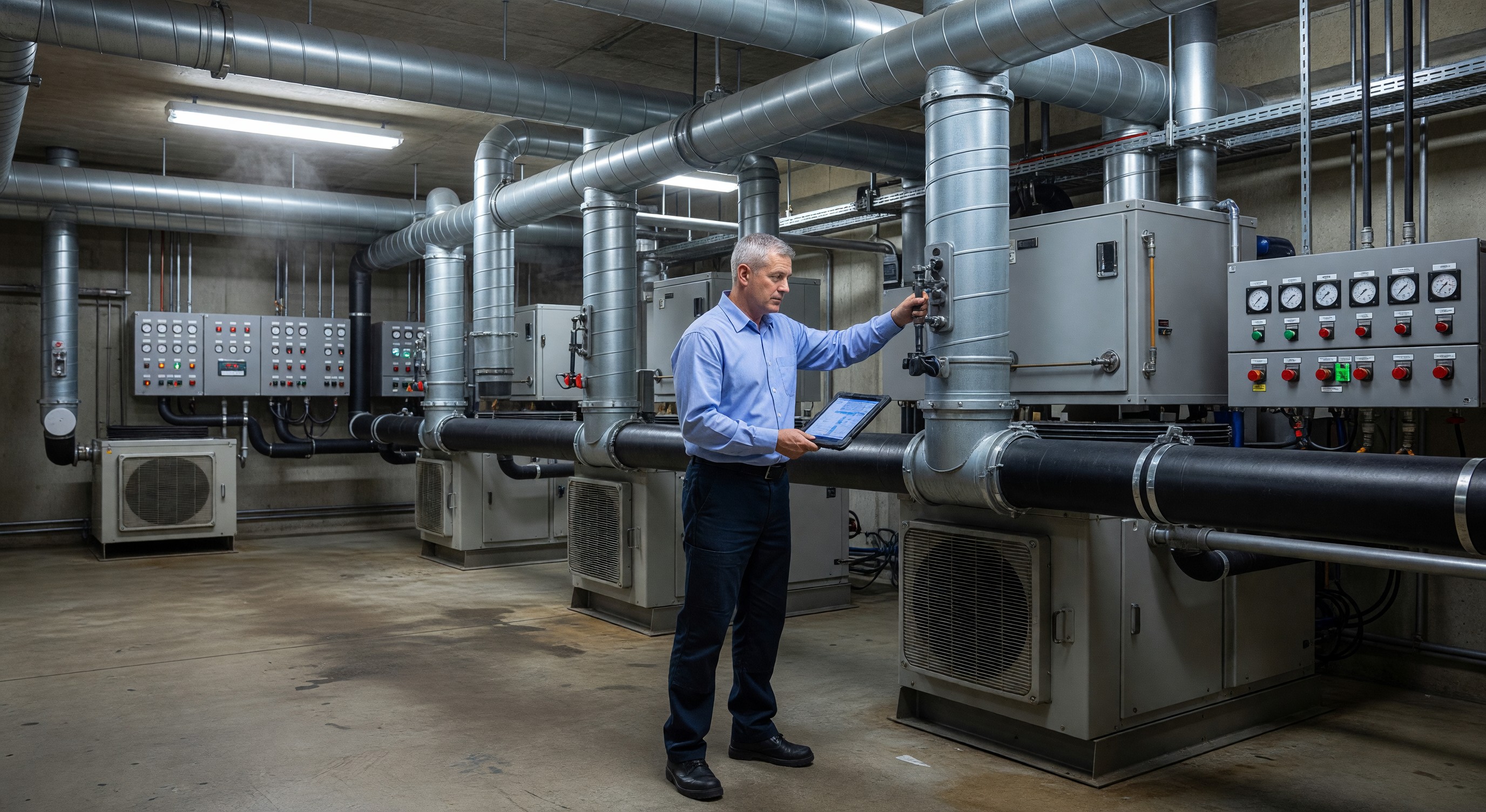
HVAC commissioning in healthcare facilities is a quality assurance process that verifies building systems perform as specified and as the clinical environment requires. In an industry where HVAC performance directly affects patient safety—where operating room temperature control prevents surgical site infections and where isolation room pressure differentials contain airborne pathogens—commissioning is not a convenience but a patient safety discipline.
Healthcare facilities invest heavily in HVAC systems. Commissioning ensures that investment delivers the intended performance. And retro-commissioning—applying commissioning principles to existing systems—recovers performance that has degraded over years of operation and often delivers energy savings that more than pay for the work.
What Healthcare HVAC Commissioning Covers
Commissioning verifies that HVAC systems meet the design intent established in project documentation—the engineer of record’s specifications, ASHRAE 170 requirements, and any facility-specific standards. A comprehensive healthcare HVAC commissioning process includes:
Design Review The commissioning agent (Cx) reviews design documents to verify that specified systems meet applicable standards (ASHRAE 170, FGI Guidelines), that control sequences are completely and unambiguously described, and that testing requirements are specified. Design review identifies ambiguities and gaps before construction that would create field problems.
Contractor Startup Verification The Cx verifies that equipment is installed per specifications, that factory startup procedures are completed and documented, and that the system is ready for functional performance testing.
Functional Performance Testing The core of commissioning is functional testing of each system and control sequence under actual operating conditions. For healthcare HVAC, this includes:
- Verification of air change rates in all clinical spaces (operating rooms, isolation rooms, protective environments, sterile processing)
- Temperature and humidity setpoint verification under occupied conditions
- Pressure differential verification and documentation in all pressure-critical spaces
- Smoke control system testing
- Emergency mode operation testing
- Alarm and fault response verification
Issues Log Management The Cx documents all deficiencies identified during testing and manages resolution through a formal issues log. Contractors are responsible for correcting deficiencies; the Cx verifies correction and re-tests.
Systems Manual and Training Commissioning deliverables include a systems manual documenting as-built sequences of operations, setpoints, and maintenance requirements, and owner training that transfers operating knowledge to facilities staff.
ASHRAE 170 Verification Requirements
ASHRAE 170-2017 (Ventilation of Health Care Facilities) establishes the ventilation requirements for specific healthcare space types that commissioning must verify:
Air Changes per Hour Operating rooms: 20+ total air changes per hour (4+ outside air). Critical care: 6+ total changes per hour. Airborne infection isolation: 12+ total changes per hour. These minimums must be verified under occupied design conditions, not just at maximum system capacity.
Pressure Relationships Positive pressure rooms (operating rooms, protective environment rooms): Maintain positive pressure relative to adjacent spaces. Negative pressure rooms (airborne infection isolation, soiled utility): Maintain negative pressure relative to adjacent spaces. Pressure relationships must be verified at all doors, including with doors in both open and closed positions.
Temperature and Humidity Operating rooms: 68–75°F, 20–60% relative humidity. Sterile processing: 60–73°F, 30–60% RH. Specific requirements vary by space type—the commissioning process must verify that control sequences achieve required conditions across the full range of outdoor conditions and occupancy states.
Retro-Commissioning: Recovering Lost Performance
Most hospital HVAC systems underperform their design intent after years of operation. Control sequences drift. Sensor calibration degrades. Building modifications change airflow patterns without corresponding control adjustments. Equipment wears and capacity declines. The cumulative effect is HVAC systems that aren’t delivering the environmental performance they were designed and installed to provide.
Retro-commissioning (RCx) applies commissioning principles to existing systems to identify and correct these performance gaps. A healthcare RCx project typically includes:
Data Collection and Analysis Review of BAS trend data, energy bills, maintenance records, and any available original commissioning documentation to identify anomalies and performance gaps before site investigation begins.
Site Investigation Systematic field investigation of HVAC equipment, controls, and spaces to verify current performance against design intent. This includes physical inspection of equipment condition, control component function verification, and representative air balance measurements.
Findings and Opportunity Identification Documentation of identified deficiencies (equipment not performing as intended) and operational deficiencies (systems performing as controlled but not optimally configured). Healthcare RCx findings typically fall into categories:
- Sensors out of calibration (leading to incorrect environmental control)
- Control sequences that don’t match design intent or have been improperly modified
- Air balancing that has drifted from design
- Equipment maintenance deficiencies affecting performance
- Energy optimization opportunities (supply air temperature resets, variable volume improvements, scheduling optimization)
Implementation and Verification Corrections are implemented by facilities staff or contractors and verified through functional performance testing that documents achieved performance.
Energy Savings Healthcare retro-commissioning consistently identifies energy savings of 5–15% of HVAC energy consumption. For a large hospital spending $2–5 million annually on HVAC energy, this represents $100,000–$750,000 in annual savings. Simple payback periods for healthcare RCx projects typically run 1–3 years.
Documentation as a Compliance Asset
One of the most valuable outputs of healthcare HVAC commissioning is the documented performance record it creates. Joint Commission EC.02.06.01 requires that healthcare organizations maintain clinical environments within required parameters. Commissioning and retro-commissioning reports provide:
- Baseline documentation of achieved environmental conditions at commissioning
- Evidence of functional testing completion
- Benchmark data for future performance comparison
- Technical documentation supporting ICRA decisions
Organizations that have commissioned their HVAC systems have significantly better documentation to present during Joint Commission surveys than those relying on operational logs alone.
Frequently Asked Questions
Who should perform healthcare HVAC commissioning—the contractor or an independent agent? Independent commissioning agents (not employed by or affiliated with the design or construction team) provide the most objective verification. The Joint Commission and many healthcare organizations require independent commissioning for new construction and major renovations in clinical areas. For existing building retro-commissioning, the same principle applies—internal facilities staff can gather data, but independent verification adds credibility to findings.
What’s the commissioning requirement for a healthcare HVAC renovation project? Any renovation that modifies HVAC systems serving clinical spaces—changing duct configurations, replacing equipment, modifying controls—should include commissioning of the affected systems. The scope of commissioning should be proportional to the scope of modification: minor modifications may require only verification of specific changed systems, while significant system replacements require comprehensive functional performance testing.
How often should healthcare facilities conduct retro-commissioning? Building systems generally drift from optimal performance over 3–7 years of operation. A 5-year retro-commissioning cycle is a recognized best practice that catches performance degradation before it significantly affects clinical environmental quality or energy costs. Facilities that lack comprehensive BAS monitoring may benefit from more frequent RCx; those with sophisticated fault detection systems may identify and correct issues between formal RCx cycles.
What qualifications should healthcare facility directors look for in a commissioning agent? Look for commissioning agents with ASHRAE-Certified Commissioning Process Management Professional (CPMP) or Building Commissioning Association (BCA) certification, documented experience with healthcare commissioning projects, familiarity with ASHRAE 170 and the FGI Guidelines, and references from comparable healthcare commissioning projects. Healthcare commissioning requires specialized knowledge of clinical environmental requirements that general building commissioning experience doesn’t fully address.