Flooring selection in healthcare facilities involves tradeoffs that rarely arise in other building types. Surface cleanability, infection control, acoustic performance, patient fall risk, staff fatigue, equipment mobility, and lifecycle cost must all be weighed simultaneously. The wrong flooring choice creates years of remediation costs and potential infection control risks.
Facility directors responsible for renovation planning and capital budgeting need a working understanding of flooring system categories, their performance characteristics in healthcare environments, and the maintenance programs that determine how long investments last.
Infection Control as the Primary Design Driver
Unlike commercial or residential settings, infection prevention requirements shape flooring selection more than aesthetics. The CDC’s Healthcare Infection Control Practices Advisory Committee (HICPAC) guidelines and The Joint Commission’s EC standards require that surfaces in patient care areas be cleanable with hospital-grade disinfectants without degrading.
Key infection control requirements for healthcare flooring:
- Seamless or minimal-seam surfaces: Seams and grout joints harbor biofilm and microorganisms that resist cleaning. Sheet vinyl, poured epoxy, and terrazzo minimize seams in high-risk clinical areas.
- Chemical resistance: Hospital disinfectants — quaternary ammonium compounds, bleach solutions, hydrogen peroxide accelerated formulations — can damage flooring materials not rated for healthcare cleaning protocols. Flooring must be certified for compatibility with the facility’s actual disinfectant products.
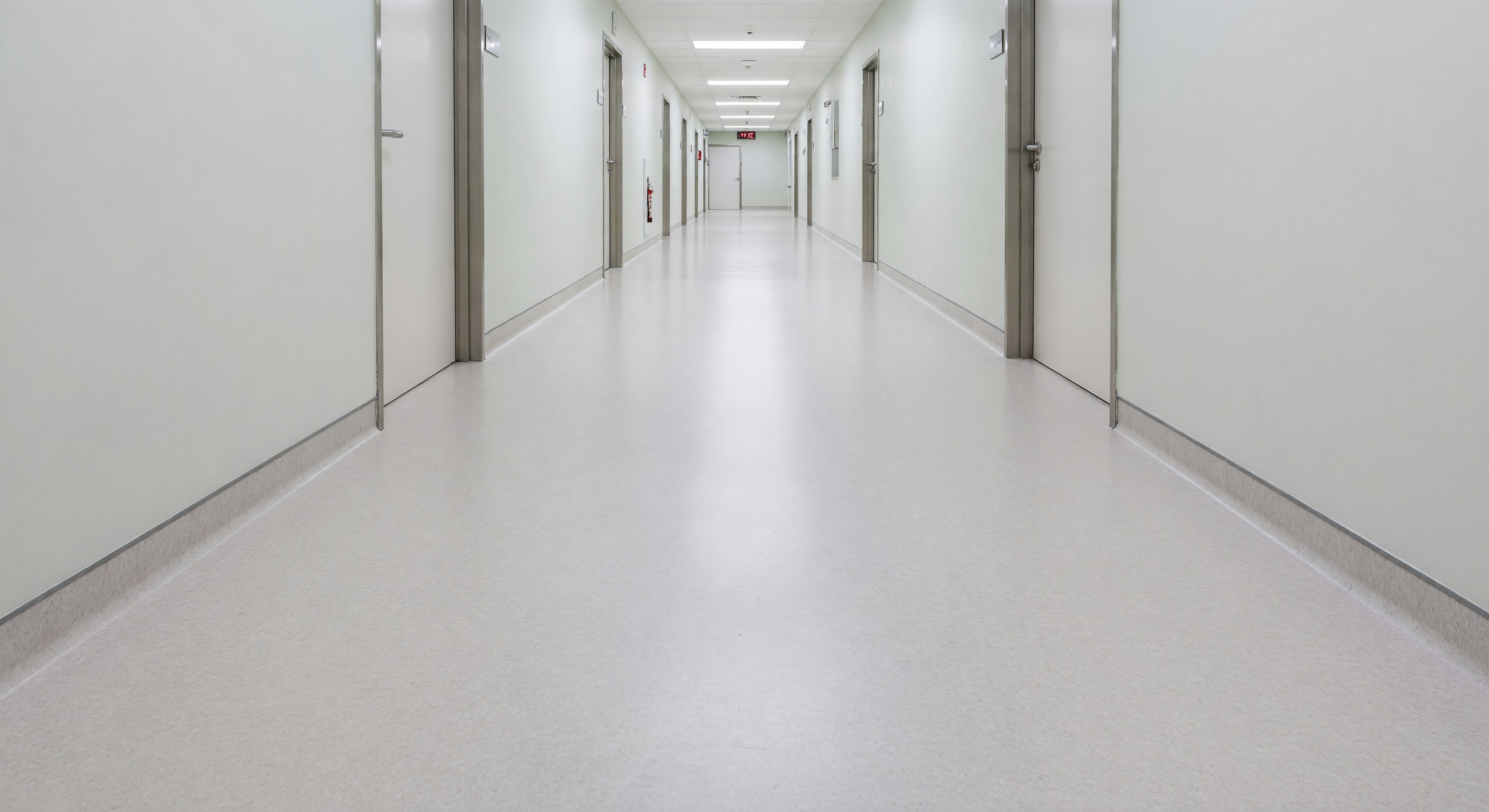
- Coved base transitions: Floor-to-wall transitions with integral cove base (no gap between flooring and wall) eliminate collection points for contamination and allow surface disinfection to continue up the wall.
- Impervious surfaces: Permeable or highly porous flooring is not appropriate in patient care areas, isolation rooms, or sterile processing.
Flooring Categories in Healthcare
Sheet Vinyl and Resilient Tile
Sheet vinyl (homogeneous and heterogeneous): The most common healthcare flooring choice. Homogeneous vinyl is consistent material throughout the thickness — better durability for high-traffic areas. Heterogeneous vinyl has a wear layer over a backing — wider design options but more susceptible to wear through.
Sheet vinyl in 6-foot or 12-foot widths minimizes seams. Welded seams (heat-welded with matching vinyl cord) create a seamless, waterproof surface appropriate for all clinical environments.
Luxury vinyl tile (LVT) and luxury vinyl plank (LVP): Click-lock systems offer easier installation but create gaps at seams that can harbor contamination in high-acuity patient care areas. LVT/LVP is more appropriate for administrative, waiting, and visitor areas than acute care patient rooms.
Rubber Flooring
Rubber flooring offers superior acoustic performance compared to vinyl — relevant for patient rooms where footfall noise affects sleep and recovery. Solid rubber tiles or sheet rubber with welded seams provide:
- High chemical resistance
- Excellent durability in high-traffic areas
- Anti-fatigue properties that reduce staff musculoskeletal injury risk
- Good slip resistance in wet conditions
Cost is higher than vinyl, making rubber flooring most appropriate for targeted areas: nursing stations, corridors with heavy cart traffic, and procedure areas where staff stand for extended periods.
Epoxy and Cementitious Coatings
Poured epoxy flooring provides a monolithic, seamless surface with excellent chemical resistance. Common applications:
- Sterile processing departments (requires resistance to high-alkalinity cleaning agents)
- Laboratory areas (chemical spill resistance)
- Loading docks and service areas
- Kitchen and food service areas
Epoxy surfaces are hard and unforgiving — not appropriate for patient care areas where fall impact softening is a safety consideration. They require periodic recoating as surfaces wear.
Carpet
Carpet is generally avoided in clinical patient care areas due to infection control concerns. Carpet holds moisture and supports biofilm that resists surface disinfection. However, carpet may be appropriate in:
- Administrative offices
- Waiting areas with no patient care activities
- Conference rooms
- Some behavioral health environments where acoustic softening and a non-institutional appearance are therapeutic goals
If carpet is used, selection should specify antimicrobial treatments, low pile height for easier cleaning, and compliance with HICPAC guidelines for carpet placement limitations.
Terrazzo
Terrazzo — cementitious or epoxy matrix with aggregate — provides exceptional durability and a highly cleanable surface. Historically common in hospital lobbies and corridors, modern epoxy terrazzo is truly seamless and appropriate for clinical areas. Initial cost is high but lifecycle cost is favorable given 40+ year lifespans with appropriate maintenance.
Acoustic Performance Considerations
Noise in hospitals affects patient recovery, staff performance, and patient satisfaction scores (HCAHPS). Flooring contributes to acoustic performance through:
- Impact sound insulation: Rubber and cushioned vinyl reduce footfall noise transmission to floors below
- Airborne sound absorption: Carpet provides the highest airborne sound absorption but conflicts with infection control
- Hard surface reflection: Polished concrete and terrazzo maximize sound reflection — high reverberant noise levels in corridors
The FGI Guidelines for Design and Construction of Hospitals include acoustic performance criteria for specific healthcare occupancy types. Flooring specification should reference these criteria.
Slip Resistance and Fall Prevention
Patient falls are a Joint Commission National Patient Safety Goal. Flooring slip resistance contributes to fall prevention, particularly in wet areas:
- ANSI A137.1 defines Dynamic Coefficient of Friction (DCOF) requirements for floor surfaces
- Wet-area flooring (shower rooms, therapy pools, utility rooms) requires higher DCOF ratings than dry-area flooring
- Transition strips between flooring types create tripping hazards that must be minimized with flush transitions
- Reflective surfaces can create glare that affects patient visual perception and increases fall risk
Lifecycle Management
Flooring lifecycle cost depends on initial product cost, installation cost, maintenance requirements, and replacement interval:
- Sheet vinyl: 10-15 year lifecycle with appropriate maintenance
- Rubber: 20+ year lifecycle
- Epoxy coatings: 7-10 years before recoat; 20+ years total if recoated on schedule
- Terrazzo: 40+ year lifecycle
- Carpet: 7-10 year lifecycle (lower in high-traffic areas)
Maintenance programs — daily damp mopping, periodic stripping and refinishing (for finish-coated vinyl), and periodic recoating (for epoxy) — are critical to achieving rated lifecycles.
Frequently Asked Questions
Can sheet vinyl flooring be used in operating rooms? Yes, sheet vinyl with welded seams is appropriate for operating rooms. The flooring must meet antistatic requirements (formerly important for flammable anesthetic gas control — now less critical since modern anesthetics are not flammable, but antistatic flooring is still specified in many OR designs). Flooring must also be compatible with the OR’s disinfection protocol, including any sporicidal agents used between cases.
How should flooring be selected for behavioral health units? Behavioral health unit flooring must balance infection control, ligature resistance, and therapeutic environment goals. Avoid flooring materials with edges or components that can be removed and used as weapons. Avoid highly reflective surfaces that can cause disorientation. Rubber flooring with integral cove base is commonly specified; carpet in limited areas may be appropriate per the clinical team’s therapeutic environment assessment.
What is the role of the Environment of Care committee in flooring decisions? Flooring decisions in clinical areas should be reviewed by the Environment of Care committee, which includes infection prevention, nursing leadership, and facilities. Infection prevention will review cleanability and compatibility with the facility’s disinfectant products. Nursing leadership provides input on patient safety and staff ergonomics. Facilities provides lifecycle cost and maintenance perspective.
How often should hospital flooring be replaced? Replacement intervals depend on flooring type, traffic level, and maintenance quality. Budget planning should include flooring replacement as a capital line item, with conditions assessments conducted every 3-5 years to identify areas approaching end of lifecycle. Unexpected replacement due to deferred maintenance or water damage is far more expensive than planned lifecycle replacement.