Fire suppression systems in healthcare facilities operate under a more demanding regulatory framework than any other building type. The combination of non-ambulatory patients, 24-hour occupancy, high-value medical equipment, complex HVAC integration, and the presence of flammable medical gases creates a fire risk environment that requires comprehensive suppression system coverage and rigorous maintenance programs.
For healthcare facility directors, fire suppression system compliance touches multiple regulatory domains simultaneously: NFPA standards, The Joint Commission Environment of Care standards, CMS Conditions of Participation, and state health facility licensing requirements. A deficiency in fire suppression maintenance can trigger findings across all of these regulatory bodies simultaneously.
Regulatory Framework
NFPA 13: Standard for the Installation of Sprinkler Systems NFPA 13 governs the design and installation of automatic sprinkler systems, including coverage requirements, pipe sizing, sprinkler head selection, and system configuration. Healthcare occupancy-specific provisions in NFPA 13 require complete sprinkler coverage throughout hospital buildings with limited exceptions.
NFPA 25: Standard for the Inspection, Testing and Maintenance of Water-Based Fire Protection Systems NFPA 25 is the primary reference for ongoing ITM (inspection, testing, and maintenance) of installed sprinkler systems. It specifies inspection frequencies, test procedures, documentation requirements, and impairment management protocols. Healthcare facilities must comply with NFPA 25 requirements and maintain documentation of compliance.
NFPA 101: Life Safety Code NFPA 101 references sprinkler system requirements and establishes that sprinkler systems in healthcare occupancies must be continuously maintained in operating condition. Sprinkler system impairments trigger specific life safety management requirements under NFPA 101 and Joint Commission EC standards.
The Joint Commission EC.02.03.05 This standard requires healthcare organizations to maintain fire suppression systems in operating condition and conduct required inspections, tests, and maintenance per NFPA 25. Surveyors review ITM documentation as a standard part of Environment of Care surveys.
CMS Conditions of Participation CMS requires that healthcare facilities certified for Medicare and Medicaid comply with applicable NFPA standards through the Life Safety Code requirements incorporated in 42 CFR Part 482. CMS life safety surveys specifically inspect fire suppression system compliance.
NFPA 25 Inspection, Testing, and Maintenance Requirements
NFPA 25 establishes a comprehensive ITM program with requirements at different intervals:
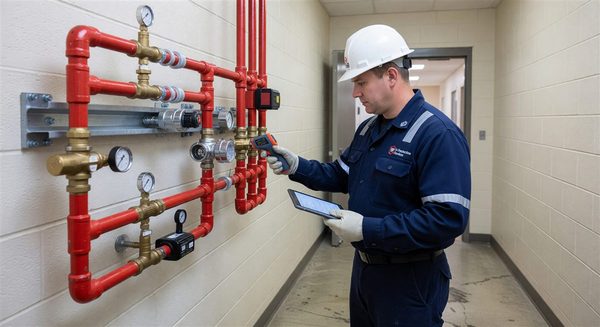
Weekly/Monthly Inspections
- Control valve position verification (all valves in open position)
- Waterflow alarm device and control valve condition
- Gauges (water pressure readings)
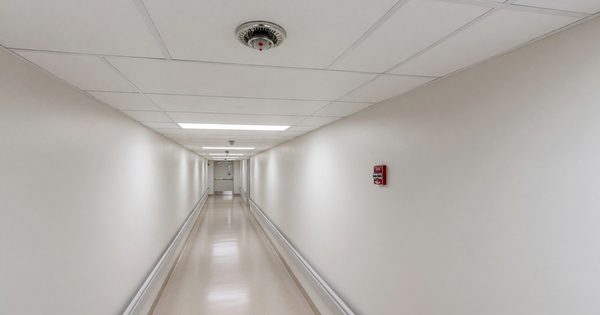
- Sprinkler heads visible from the floor (obstructions, physical damage)
Quarterly Inspections
- Waterflow alarm test
- Supervisory signal device test (tamper switches on control valves)
- Valve inspection (all control valves, gate valves, check valves)
Annual Inspections
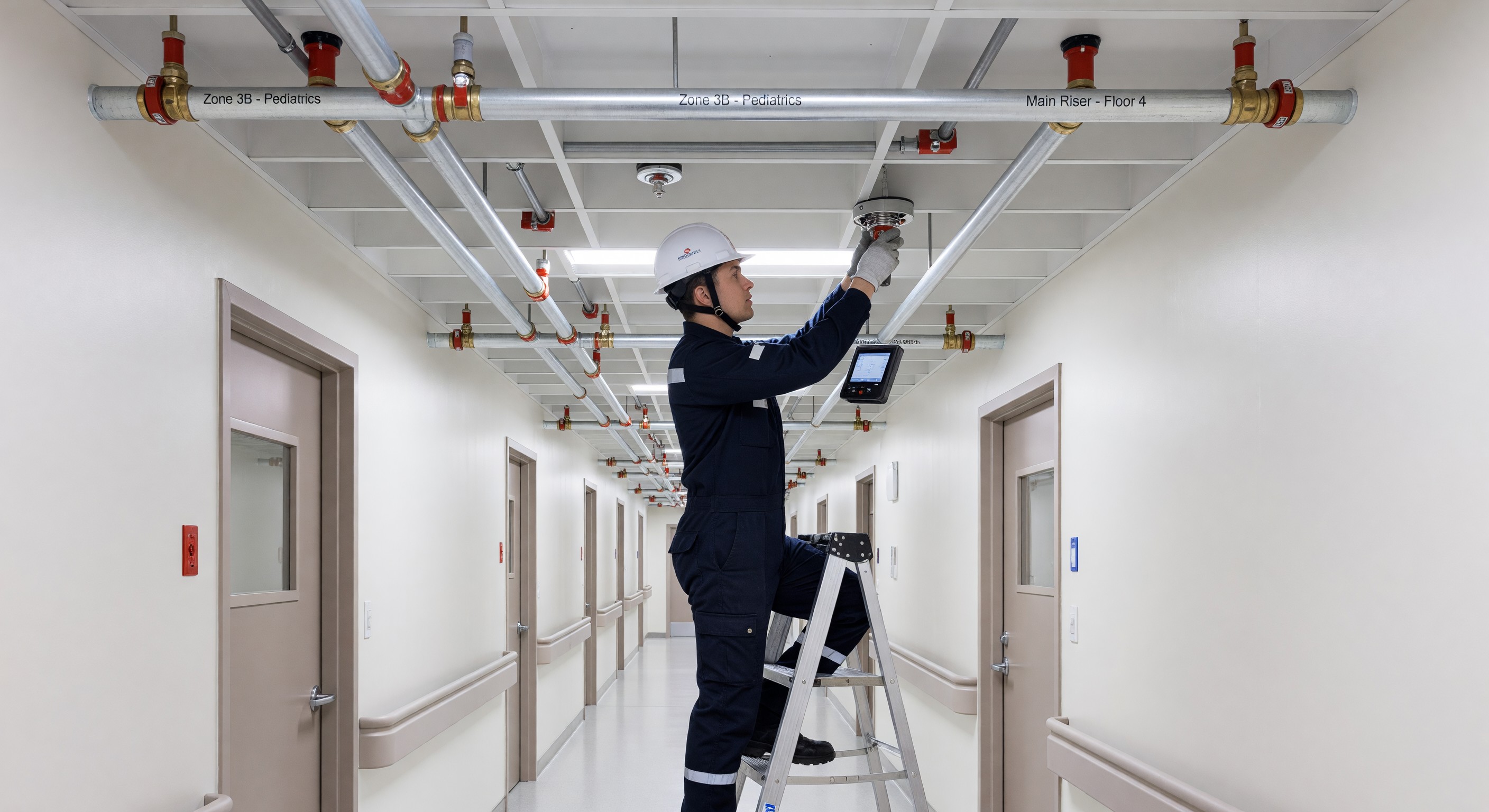
- All sprinkler heads (close-up inspection for corrosion, paint, physical damage, improper orientation)
- Pipe hangers and seismic bracing
- Full waterflow alarm test with flow switch verification
- Main drain test and pressure measurement
- Dry system inspections (air pressure, heat, priming water)
Five-Year Requirements
- Internal pipe inspection for obstruction (5-year internal inspection)
- Sprinkler heads subject to harsh environments (corrosive, high-temperature) replacement
50-Year Requirement
- Sample sprinkler head replacement and testing program (representative samples of sprinkler heads installed for 50 years must be replaced and tested, or all heads replaced)
Impairment Management
Sprinkler system impairments—planned or unplanned interruptions to system coverage—require specific management under NFPA 25 and Joint Commission EC standards.
Impairment Program Requirements A designated impairment coordinator must be assigned. Notification procedures must be followed for planned impairments: notify the fire department, affected departments, security, and the facility’s insurance carrier. Compensatory measures must be implemented during the impairment period.
Compensatory Measures During sprinkler system impairments, healthcare facilities typically implement:
- Increased security patrols in the affected area
- Temporary restrictions on hot work in the impaired area
- Patient relocation from areas with extended impairments
- Notification of occupants in the affected area
- Standby fire hose coverage in some circumstances
Joint Commission EC.02.03.05 requires documentation of impairment management procedures and records of all impairments including duration and compensatory measures implemented.
Special Suppression Systems in Healthcare
Beyond standard wet-pipe sprinkler systems, healthcare facilities incorporate specialized suppression systems for specific environments:
Pre-Action Systems Pre-action systems require a separate detection event to open the pre-action valve before water can flow to sprinkler heads. This two-step activation prevents accidental water damage in environments with high-value equipment—MRI suites, data centers, operating rooms in some configurations, and archives. Pre-action systems are more complex and require additional maintenance compared to standard wet-pipe systems.
Clean Agent Systems Data centers, server rooms, and some medical equipment areas use clean agent suppression systems (FM-200, Novec 1230, CO2) that suppress fires without water damage. Clean agent systems require annual inspection and maintenance per NFPA 2001 and vendor specifications, including agent weight verification and discharge nozzle inspection.
Kitchen Hood Suppression Healthcare facility kitchen hood suppression systems protect cooking equipment against grease fires. These systems are governed by NFPA 17A and require semi-annual inspection, testing, and maintenance in addition to cleaning records for the exhaust hood system.
Common Compliance Deficiencies
Healthcare facility fire suppression programs commonly produce the following deficiency findings during Joint Commission and CMS surveys:
- Sprinkler heads with paint overspray, dust accumulation, or physical damage
- Missing escutcheon plates creating gaps in ceiling membrane
- Storage or equipment within 18 inches of sprinkler heads (clearance requirement)
- Control valve supervisory switch test documentation gaps
- Incomplete impairment records
- Expired ITM contracts with gaps in documentation continuity
- Dry pipe system inspection deficiencies
An internal fire suppression inspection program—reviewing for these common deficiencies on a quarterly basis rather than discovering them during external surveys—is the most effective proactive compliance strategy.
Frequently Asked Questions
What are the consequences of Joint Commission findings related to fire suppression systems? Sprinkler system deficiencies are typically classified as Requirement for Improvement (RFI) findings during Joint Commission surveys. Depending on severity, they may be immediately corrected during the survey or require a documented corrective action plan with follow-up verification. Persistent or critical findings can result in focused surveys or accreditation status changes. CMS findings can trigger more immediate enforcement action depending on severity classification.
Can healthcare facilities use alternative suppression arrangements under waivers or equivalencies? CMS allows healthcare facilities to apply for equivalency determinations when full compliance with NFPA 101 sprinkler requirements is not immediately achievable. Equivalency applications must demonstrate that the proposed alternative provides equivalent life safety protection. The application and approval process is complex and time-consuming; facilities pursuing equivalency should engage qualified fire protection engineers and legal counsel.
What documentation should healthcare facilities maintain for fire suppression system compliance? Maintain copies of all ITM inspection and test reports, impairment records (with dates, durations, and compensatory measures), contractor licensing documentation, service contracts, and as-built system drawings. These records should be organized for rapid retrieval during surveys and retained for a minimum of three years (or longer per state requirements).
How should healthcare facilities manage sprinkler system maintenance in active patient care areas? Work in active patient care areas requires coordination with clinical leadership, infection control, and nursing to minimize disruption and manage clinical risk during planned impairments. Sprinkler work that requires system shutdown in patient care areas should be scheduled during lowest-census periods, with the shortest practical impairment duration, and with documented compensatory measures in place throughout.