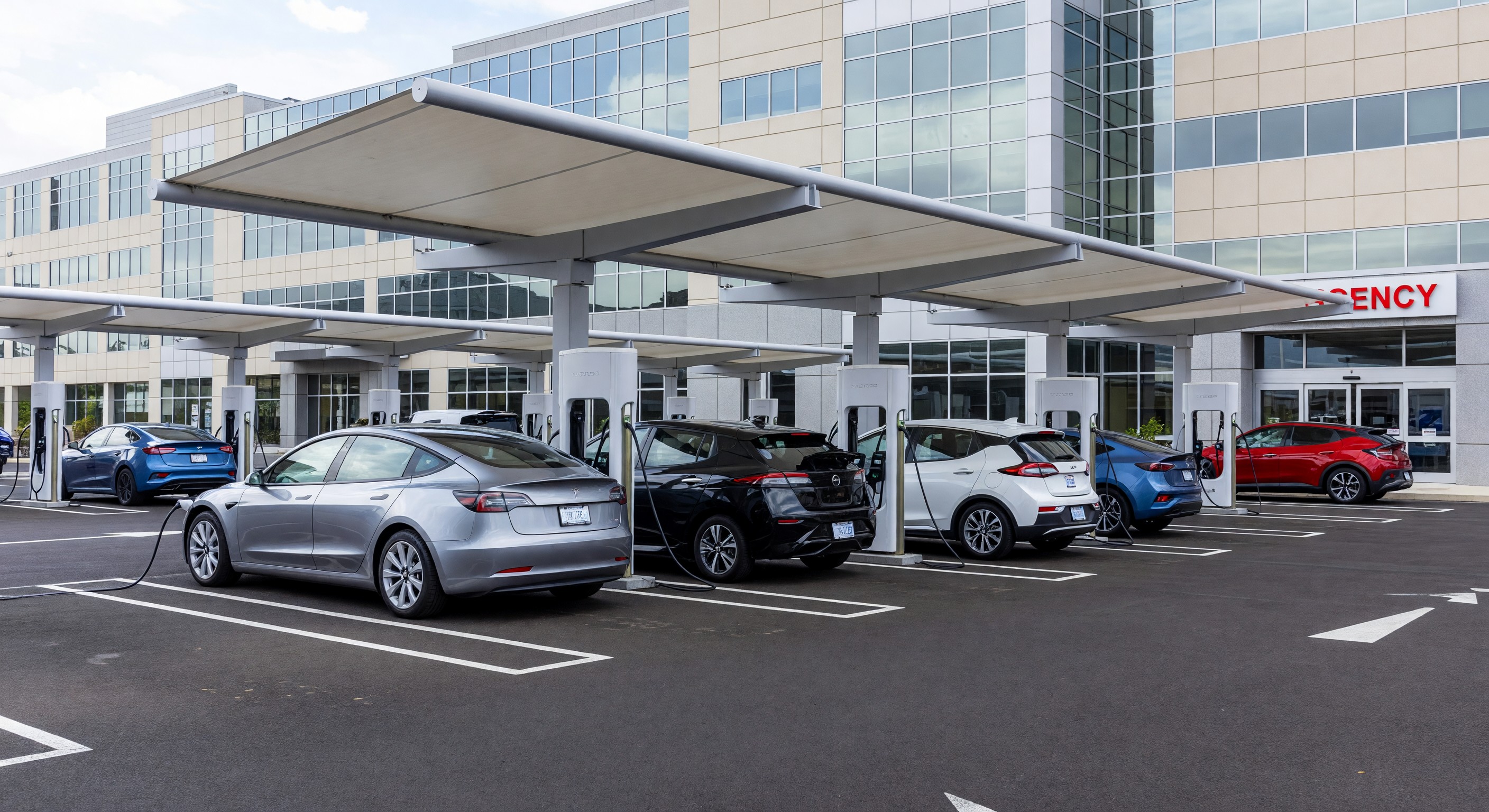
Electric vehicle adoption among healthcare workers, patients, and visitors has reached a threshold where EV charging infrastructure is no longer an optional amenity—it’s an expected facility. In major metropolitan markets and technology corridors, EV ownership among the demographics that staff and use hospitals has reached 20–30%, generating daily charging conflicts at facilities with inadequate infrastructure.
At the same time, regulatory pressure is increasing: multiple states have implemented or are implementing EV-ready requirements for new commercial parking construction, and federal grant programs have made funding available that early movers are capturing. Healthcare organizations that continue to defer EV infrastructure planning will find themselves navigating more expensive retrofit projects without access to the grant support currently available.
This guide addresses the planning considerations, technology options, funding landscape, and phased implementation approaches that healthcare facility directors need to develop credible EV infrastructure plans.
Understanding EV Charging Level Types
Not all EV charging is equivalent, and the right mix for a hospital campus depends on parking dwell time by user type:
Level 1 (120V AC, ~1.2 kW) Level 1 is standard household current delivered through a standard outlet. It adds approximately 3–5 miles of range per hour of charging. Level 1 is practical only for locations where vehicles park for 8+ hours (overnight employee parking in some contexts) and is not generally recommended for healthcare campus deployment given the time required.
Level 2 (240V AC, 3.3–19.2 kW) Level 2 charging adds 15–60 miles of range per hour of charging depending on the charger power rating and vehicle onboard charger capacity. Most EVs can accept 7–11 kW of Level 2 charging, adding 25–40 miles per hour. Level 2 is appropriate for employee parking where vehicles park for 4–8 hours, allowing most employees to charge meaningfully during a work shift.
Level 2 infrastructure costs $2,000–$8,000 per port installed, depending on electrical service distance and installation complexity.
DC Fast Charging / Level 3 (50–350 kW) DC fast chargers deliver energy directly as DC current, adding 100–300+ miles of range per hour of charging. DCFC can add meaningful range in 20–30 minutes. This level is appropriate for visitor and patient parking where dwell times are shorter and users need rapid charging to arrive home with adequate range.
DCFC infrastructure costs $30,000–$150,000 per port installed, including electrical service upgrades that DCFC typically requires.
Load Management: The Critical Planning Challenge
The electrical demand implications of EV charging are the most significant planning challenge for hospital campuses. A large hospital campus with 200 Level 2 charging ports running simultaneously could add 1,400 kW (1.4 MW) of instantaneous electrical demand—equivalent to a meaningful percentage of the campus’s entire peak electrical load.
Most hospital campuses cannot simply add this load to their existing electrical service without capacity upgrades. And electrical demand charges—utility charges based on the highest 15-minute average demand each month—mean that even brief peaks from simultaneous charging can significantly increase utility costs.
Smart Charging and Load Management Systems Managed charging platforms resolve the demand challenge by coordinating charging across all stations to stay within a defined power budget. Rather than each charger operating independently at full power, the system dynamically allocates available power across active sessions—charging at full rate when grid conditions allow, throttling power when the budget approaches.
Well-implemented managed charging allows a campus to serve significantly more vehicles than the electrical infrastructure would support without load management, while maintaining acceptable charge speeds for most users.
Demand Response Participation Many utilities offer demand response programs that compensate commercial customers for reducing electrical load during grid stress events. EV charging loads are ideal for demand response participation—they can be throttled or paused during brief demand response events with minimal impact on vehicle owners, while generating meaningful utility incentive payments.
Utility Rate Structure Optimization Time-of-use rate structures that offer lower electricity prices during off-peak hours can significantly reduce EV charging costs. Managed charging systems that shift charging to overnight off-peak hours for vehicles that are parked overnight (employee night shift, covered/garage parking) reduce the cost per mile of charging while shifting load to periods that benefit the grid.
Electrical Infrastructure Requirements
Planning EV charging infrastructure begins with an electrical infrastructure assessment:
Service Capacity What is the existing electrical service capacity for each parking area? Matching charging requirements to available capacity (or planning service upgrades) is the starting point for any deployment plan.
Conduit and Wiring Infrastructure The cost of electrical conduit and wiring installation often exceeds the cost of charging equipment itself, particularly for surface lots with long runs from electrical panels. Installing conduit infrastructure in advance—even before charging equipment is ready—dramatically reduces future retrofit costs.
Panel Capacity and Location Identifying existing panel locations and capacity in or near parking areas determines how much charging can be deployed without significant electrical infrastructure investment. Remote panels may require utility service upgrades that involve utility coordination and long lead times.
Funding Landscape
Multiple funding sources are available to offset healthcare organization EV charging investment:
Inflation Reduction Act Tax Credits (Direct Pay) Tax-exempt healthcare organizations can claim direct payment (cash equivalents) for several IRA clean energy credits:
- Alternative Fuel Vehicle Refueling Property Credit (30C): 30% of qualified EVSE costs, up to $100,000 per location
- Bonus credits available for installations in low-income communities and on tribal land
NEVI Formula Program The National Electric Vehicle Infrastructure (NEVI) formula program provides funding through state DOTs for EV charging on designated Alternative Fuel Corridors. Hospital campuses on or near these corridors may qualify for significant NEVI funding.
State Programs Most states with significant EV markets have state-administered utility or grant programs supporting commercial EV charging installation. Program details and funding availability vary significantly by state and change frequently as programs are funded and depleted.
Utility Programs Many electric utilities offer rebate programs, make-ready infrastructure programs (where the utility installs the electrical service upgrade at no cost to the customer), and rate incentives for commercial EV charging. Contacting the utility’s commercial accounts team early in the planning process is essential.
Phased Implementation Approach
Few healthcare campuses can fund complete EV infrastructure deployment at once. A phased approach allows progressive build-out aligned with capital availability and evolving demand:
Phase 1: Infrastructure Foundation Install conduit, wiring, and panel capacity in all parking areas—even before installing charging equipment. This “EV-ready” infrastructure costs a fraction of full charging deployment but eliminates the expensive excavation and construction required for future expansion.
Phase 2: Initial Deployment Install Level 2 charging in the highest-demand locations: employee parking areas where staff express highest demand, visitor lots serving outpatient facilities with longer dwell times, and any areas with grant funding support.
Phase 3: Expansion Expand to all remaining parking areas as demand grows and budget allows. Add DCFC capability at high-visibility campus entrance locations and visitor parking areas.
Phase 4: Advanced Capabilities Implement vehicle-to-grid (V2G) capability if utility programs and vehicle compatibility support it, and integrate with campus energy storage for demand management optimization.
Frequently Asked Questions
How many EV charging ports should a hospital plan to install? Planning targets should be based on current and projected EV ownership in the employee and visitor populations, not just current charging requests. A facility where 15% of employees currently drive EVs may see 30–40% EV ownership within five years. Most EV infrastructure planning guidance suggests designing for 5–10 years of projected demand at initial deployment rather than current demand.
Should hospitals prioritize employee or visitor parking for EV charging? Both populations need to be served, but they have different requirements. Employee parking benefits most from Level 2 charging with managed load distribution across many ports. Visitor parking—particularly outpatient—benefits from faster charging (higher-power Level 2 or DCFC) that allows meaningful charging in 1–3 hours. Priority allocation depends on which population has stronger expressed demand and where infrastructure investment is most cost-effective.
What’s the operational cost of running hospital EV charging? Operational costs include electricity cost (offset by charging fees if the facility charges users), network management platform subscription fees, and routine maintenance. Most hospitals offer free or low-cost EV charging to employees as a benefit, with visitor charging priced at cost recovery or modest profit. Operating profitability depends on local electricity rates, the fee structure, and charging utilization rates.
How do EV charging requirements interact with NFPA codes for healthcare facilities? NFPA 70 (National Electrical Code) governs EV charging system installation. NFPA 88A covers parking structure requirements including EV charging provisions—ventilation requirements, fire suppression provisions, and EV parking limitations for certain parking structure types. Healthcare facility EV charging plans should be reviewed by the authority having jurisdiction (AHJ) to ensure compliance with applicable NFPA and local requirements.